US President George W Bush has rejected claims his administration uses torture and defended the CIA's methods.
He was responding to a New York Times report that the US Justice Department secretly authorised harsh interrogation techniques
for terror suspects in 2005.
The alleged 2005 memo came months after a 2004 opinion in which the Justice Department declared torture abhorrent.
Mr Bush said: "This government does not torture people. We stick to US law and our international obligations."
According to the New York Times, the interrogation techniques endorsed by a 2005 Justice Department memo were some of the
harshest ever used by the CIA.
They included head-slapping, exposure to freezing temperatures and simulated drowning, known as water-boarding.
'Protecting the people'
The 2005 legal opinion was reportedly issued shortly after former Attorney General Alberto Gonzales took over the Justice
Department.
A second memo issued later that year advised that none of the techniques in use by the CIA would breach anti-torture legislation
before Congress that barred "cruel, inhuman and degrading" treatment of prisoners, the New York Times said.
Its report also cited officials saying that the CIA had returned in summer 2007 to its practice of holding terror suspects
in secret prisons overseas.
In a hastily arranged press appearance on Friday, Mr Bush defended his administration's methods and said interrogations
were carried out by "highly-trained professionals".
"When we find somebody who may have information regarding an attack on America, and you bet we're going to detain them,
you bet we're going to question them," he said.
"The American people expect us to find out information, this actionable intelligence, so we can help protect them. That's
our job."
The techniques used had been "fully disclosed to appropriate members of the United States Congress", he added.
Lawmakers' concern
Democrats in both the Senate and the House of Representatives on Thursday demanded to see the two alleged secret memos
from 2005.
Several Republicans have said they were satisfied with those briefings but a handful have joined with Democrats in expressing
their concern, says the BBC's Jamie Coomarasamy in Washington.
The politicians suggest that the administration many not have been forthcoming enough, or may even have condoned techniques
that overstepped the boundaries of legality, our correspondent says.
The issue of detainee interrogation is now likely to figure even more prominently in the confirmation hearings of Mr Bush's
nominee for attorney general, Michael Mukasey, due to begin later this month, he adds.
Saudis freed from Guantanamo Bay
Sixteen Saudis have arrived in Riyadh after being released by US authorities from the Guantanamo Bay detention camp.
More than 90 Saudi detainees have now been sent home from the camp in Cuba.
Saudi Interior Minister Prince Nayef bin Abdul Aziz said he hoped this would lead to the release of the remaining Saudis
- believed to number 37.
About 340 detainees are being held in Guantanamo on suspicion of links to terrorism. Many have been there several years,
but most have not been charged.
Two of the three inmates who committed suicide in the detention camp in June 2006 were from Saudi Arabia.
Washington is reducing the number of prisoners at the centre with a view to eventually closing it down.
US court weighs Guantanamo case
A new US appeals court has begun hearing the case of a Canadian accused of killing a US soldier in Afghanistan.
The US government has gone to the Court of Military Commission Review to appeal against a decision by military judges in
June to throw out Mr Khadr's case.
The case collapsed because US military authorities had failed to designate him an "unlawful" enemy combatant.
They had sought to make Mr Khadr one of the first Guantanamo Bay inmates to be tried before a military commission.
Critics have questioned the legality of the new appeals court, which was quickly set up and staffed after the US government
appealed against the judges' ruling.
But in opening discussions, the military judges did not appear to accept Mr Khadr's attorneys' argument that the court
had been improperly formed.
The appeals court is expected to rule within a month on whether Mr Khadr should have to face a military commission.
No jurisdiction?
The US authorities hope the appeals court's decision will end the legal limbo which has paralysed the new tribunal system
since June.
The issue stems from the fact that under a new system of military justice approved by Congress last year, detainees facing
trial must be designated "unlawful enemy combatants".
When they were assessed years earlier they were described only as "enemy combatants".
The word "unlawful" did not appear, giving the new tribunals no jurisdiction, according to the military judges who heard
Mr Khadr's case.
The Pentagon argues there is no material difference between the two terms and that it is a matter of semantics.
If the appeals court rules against the government, it is possible that review tribunals will have to reassess some 520
prisoners designated simply as "enemy combatants".
Charges 'unproven'
Mr Khadr, now 20, was only 15 when he was captured in Afghanistan, and was accused of killing a US soldier during a battle
at a suspected al-Qaeda base in 2002.
His lawyers argue that he cannot be labelled as a terrorist until the charges against him are proven in court.
The case against another Guantanamo Bay detainee, Yemeni Salim Ahmed Hamdan, was also dropped because of the failure of
US military officials to call him "unlawful".
Salim Ahmed Hamdan has been accused of being al-Qaeda leader Osama Bin Laden's driver and bodyguard. Mr Hamdan says he
was just a driver and not an al-Qaeda member.
He had appeared in court charged with murder, attempted murder, conspiracy and providing support for terrorism.
Pentagon Study Sees Threat in Guantánamo Detainees
— Accelerating the public relations battle over terrorism suspects held at Guantánamo Bay, a new study of detainees in 2004 and 2005 requested by the Pentagon argues that many were a proven threat to United States
forces. They included fighters of Al Qaeda, veterans of terrorism training camps and men who had experience with explosives, sniper rifles and rocket-propelled grenades,
it said.
The report, by a terrorism study center at West Point, is essentially a rebuttal by the military of growing assertions by advocates for detainees that the American naval station
at Guantánamo Bay, Cuba, is filled with hapless innocents and low-level cooks and other support personnel who pose no real
threat.
It paints a chilling portrait of the detainees, asserting that publicly available information indicates that 73 percent
of them were a “demonstrated threat” to American or coalition forces. In all, it says, 95 percent were at the
least a “potential threat,” including detainees who had played a supporting role in terrorist groups or had expressed
a commitment to pursuing violent jihadist goals. The study is based on information from detainees’ hearings in 2004
and 2005.
The authors made clear that one of their goals was to affect public attitudes. They said the report should “enhance
our collective understanding of the threats facing the United States, its allies and its interests and how we respond to them.”
Pentagon officials have been saying since the spring that they planned a major public relations response in what has become
a heated war of perceptions over the situation at Guantánamo. The report indicates it may be the centerpiece of that effort.
With about 360 detainees still held at Guantánamo, the struggle to shape perceptions has become a central focus for the
Bush administration and for advocates of the detainees. In the courts and Congress as well as in internal administration debates,
some officials have argued that the detainees are far more dangerous than they are portrayed in the news media and in arguments
by their advocates.
The report is an analysis of previously released military summaries of the unclassified evidence used in 516 of the military’s
hearings that determine whether detainees are properly held as enemy combatants. It was written at the request of the Pentagon
by the Combating Terrorism Center at the United States Military Academy at West Point, a teaching and research center that
describes itself as “actively involved in supporting the global war on terror.”
The report says it is an analysis of the same data as a February 2006 report that has become a major irritation to military
officials because it has become the foundation for assertions that harmless men are imprisoned at Guantánamo under extreme
conditions. The 2006 report was by Seton Hall University School of Law and two lawyers who represent detainees, Mark P. Denbeaux, a law professor there, and his son and law partner,
Joshua W. Denbeaux.
The Seton Hall report concluded that only 8 percent of the detainees had been characterized by the military as Qaeda fighters
and that 55 percent had not been determined to have committed any hostile acts against the United States.
Both reports are based on partial descriptions of the military’s evidence against detainees. The summaries are the
descriptions of unclassified evidence given detainees at the start of the military hearings that rule on whether they are
properly held as enemy combatants.
Most of the hearings, combatant status review tribunals, were conducted in a six-month period beginning in the fall of
2004.
The Seton Hall report has drawn wide attention, including in Congress, because it was one of the first comprehensive studies
of Pentagon information on the detainees. “The reality is that a very large fraction of the detainees seem to be at
most a ragtag collection of ‘support’ personnel for low-level foot soldiers,” Professor Denbeaux told the
Senate in April.
In an interview on Wednesday, Professor Denbeaux said the new report massaged the information to draw conclusions that
would be helpful to the Pentagon. “It appears to be a self-serving attempt to put a different slant on the information
they presented as the truth in 2004,” he said.
The new report, released in time for administration testimony on Guantánamo in Congress on Thursday, includes a critique
of the Seton Hall report, asserting that it drew speculative conclusions and ignored the context of some military information
on detainees.
Lt. Col. Joseph H. Felter, the director of the Combating Terrorism Center and a West Point faculty member, said the new
report was an independent evaluation conducted without Pentagon supervision.
Colonel Felter acknowledged, however, that military officials had indicated they wanted to contest the Seton Hall report.
“They had been getting a lot of inquiries related to this previous study,” he said. “They had a lot of
concerns with the conclusions, but they did not have another study.”
Bush Approves New CIA Methods Interrogations Of Detainees To Resume
President Bush set broad legal boundaries for the CIA's harsh interrogation of terrorism suspects yesterday, allowing the intelligence agency to resume a program that was suspended
last year after criticism that it violated U.S. and international law.
In an executive order lacking any details about actual interrogation techniques, Bush said the CIA program will now comply
with a Geneva Conventions prohibition against "outrages upon personal dignity, in particular humiliating and degrading treatment."
His order, required by legislation signed in October, was delayed for months amid tense debate inside the administration.
"We can now focus on our vital work, confident that our mission and authorities are clearly defined," CIA Director Michael V. Hayden said in a statement to agency employees. Although human rights groups have alleged that CIA interrogators used torturous
and illegal methods, Hayden said the program had gleaned "irreplaceable" information from terrorism detainees.
Two administration officials said that suspects now in U.S. custody could be moved immediately into the "enhanced interrogation"
program and subjected to techniques that go beyond those allowed by the U.S. military.
Rights activists criticized Bush's order for failing to spell out which techniques are now approved or prohibited. It said
instead that CIA interrogators cannot undertake prohibited acts such as torture and murder, and it barred religious denigration
and humiliating or degrading treatment "so serious that any reasonable person, considering the circumstances, would deem"
it "beyond the bounds of human decency." Detainees, it said, must be provided with "the basic necessities of life," including
adequate food and water, clothing, essential medical care, and "protection from extremes of heat and cold."
"All the order really does is to have the president say, 'Everything in that other document that I'm not showing you is
legal -- trust me,' " said Tom Malinowski of Human Rights Watch.
The CIA interrogation guidelines are contained in a classified document. A senior intelligence official, asked whether
this list includes such widely criticized methods as the simulated drowning known as "waterboarding," declined to discuss
specifics but said "it would be very wrong to assume that the program of the past would move into the future unchanged."
CIA detainees have also alleged they were left naked in cells for prolonged periods, subjected to sensory and sleep deprivation
and extreme heat and cold, and sexually taunted. A senior administration officials briefing reporters yesterday said that
any future use of "extremes of heat and cold" would be subject to a "reasonable interpretation . . . we're not talking about
forcibly induced hypothermia."
Congressional reaction to the order was muted, as key lawmakers said they were only informed of its contents yesterday.
Republican Sens. John McCain (Ariz.), Lindsey O. Graham (S.C.) and John W. Warner (Va.), who helped draft legislation last year requiring the executive order, issued a joint statement that they needed more
information before making a judgment. They said the administration has not responded to the questions they asked during a
recent briefing on the new order and the detainee program.
Sen. John D. Rockefeller IV (D-W.Va.), chairman of the Senate intelligence committee, said it was unclear what the order "really means and how it
will translate into actual conduct by the CIA." In a statement, Rockefeller repeated a committee demand made last spring that
the White House turn over a copy of the Justice Department's legal analysis of the new guidelines.
Similar demands for internal documents related to the Bush administration's warrantless surveillance program have been
rebuffed by the White House.
The steps leading to yesterday's order began with Bush's determination in January 2002 that members of al-Qaeda and the Taliban, as well as other allegedly terrorist captives, were "enemy combatants" rather than prisoners of war covered by the 1949
Geneva Conventions.
Criticism of the U.S. military's treatment of detainees -- first in Afghanistan and at the military prison at Guantanamo Bay, Cuba, and later at the Abu Ghraib prison in Iraq -- eventually provoked the Pentagon to rewrite its interrogation guidebook and explicitly ban many of the techniques endorsed and used by the CIA. But a new
law enforced those limits only for detainees in military custody.
Criticism of the CIA began with revelations in late 2005 that the agency had imprisoned and interrogated "high-value" suspects
in secret prisons in third countries. But after the Supreme Court ruled last summer, in Hamdan v. Rumsfeld, that all
U.S. prisoners -- of any nationality, being held in any country -- were covered by Geneva protections against degrading treatment, Bush publicly confirmed the existence of the CIA prisons and announced that 14 remaining
CIA prisoners had been transferred to military custody at Guantanamo.
Bush maintained the CIA interrogation program had always been legal, but the White House said the Geneva provision, Common
Article 3, was vague and undefined. After the CIA suspended its "enhanced interrogations" to ensure its officers could not
be charged with crimes, Congress ordered the administration to ensure, via executive order, that any further such interrogations
complied with both domestic and international law.
Bush's statement said the techniques could be used against any "alien detainee" determined by the CIA director to be a
member or supporter of al-Qaeda, the Taliban or associated organizations likely to have information about attacks against
the United States or its allies.
Over the past several months, the secret list of CIA techniques has been the subject of interagency debate at the highest
levels, with the State Department anxious to avoid offending allied governments, and the Department of Defense concerned that any CIA excesses could cause U.S. soldiers captured in the future to be subject to abuses.
The intelligence official said the agency itself had studied the effectiveness of past techniques and retained or jettisoned
them on a "sliding scale." The criteria, he said, were what was "appropriate, effective, lawful and sustainable." While Hayden
did not get "everything [he] might have wanted" in the guidelines, the official said, they contained everything the CIA needed
and "more than was asked for."
To help allay concerns, new safeguards were added, the official said. Every use of an "enhanced" technique must be personally
approved by Hayden in every instance, he said. "There will be no lone wolves, interrogations will always be conducted by a
team, and anybody on the team can knock it off at any time."
A senior administration official said that the new rules do not require that the International Committee of the Red Cross have access to CIA prisoners. Many other nations interpret international treaties as requiring such access for all detainees
everywhere.
Pushing the Envelope on Presidential Power
Shortly after the first accused terrorists reached the U.S. naval prison at Guantanamo Bay, Cuba, on Jan. 11, 2002, a delegation
from CIA headquarters arrived in the Situation Room. The agency presented a delicate problem to White House counsel Alberto R. Gonzales, a man with next to no experience on the subject. Vice President Cheney's lawyer, who had a great deal of experience, sat
nearby.
The meeting marked "the first time that the issue of interrogations comes up" among top-ranking White House officials,
recalled John C. Yoo, who represented the Justice Department. "The CIA guys said, 'We're going to have some real difficulties getting actionable
intelligence from detainees'" if interrogators confined themselves to treatment allowed by the Geneva Conventions.
From that moment, well before previous accounts have suggested, Cheney turned his attention to the practical business of
crushing a captive's will to resist. The vice president's office played a central role in shattering limits on coercion of
prisoners in U.S. custody, commissioning and defending legal opinions that the Bush administration has since portrayed as
the initiatives, months later, of lower-ranking officials.
The vice president's office pushed a policy of robust interrogation that made its way to the U.S. naval
prison at Guantanamo Bay, Cuba, above, and Abu Ghraib prison in Iraq. More Cheney photos...
Cheney and his allies, according to more than two dozen current and former officials, pioneered a novel distinction between
forbidden "torture" and permitted use of "cruel, inhuman or degrading" methods of questioning. They did not originate every
idea to rewrite or reinterpret the law, but fresh accounts from participants show that they translated muscular theories,
from Yoo and others, into the operational language of government.
A backlash beginning in 2004, after reports of abuse leaked out of Iraq's Abu Ghraib prison and Guantanamo Bay, brought
what appeared to be sharp reversals in courts and Congress -- for Cheney's claims of executive supremacy and for his unyielding
defense of what he called "robust interrogation."
But a more careful look at the results suggests that Cheney won far more than he lost. Many of the harsh measures he championed,
and some of the broadest principles undergirding them, have survived intact but out of public view.
RELATED STORY Presidential Power Dick Cheney's views on executive supremacy -- like many of his core beliefs about foreign policy and defense
-- have held remarkably steady over the years. More »
The vice president's unseen victories attest to traits that are often ascribed to him but are hard to demonstrate from
the public record: thoroughgoing secrecy, persistence of focus, tactical flexibility in service of fixed aims and close knowledge
of the power map of government. On critical decisions for more than six years, Cheney has often controlled the pivot points
-- tipping the outcome when he could, engineering stalemate when he could not and reopening debates that rivals thought were
resolved.
"Once he's taken a position, I think that's it," said James A. Baker III, who has shared a hunting tent with Cheney more than once and worked with him under three presidents. "He has been pretty
damn good at accumulating power, extraordinarily effective and adept at exercising power."
'At Any Time and in Any Place'
David S. Addington, Cheney's general counsel, set the new legal agenda in a blunt memorandum shortly after the CIA delegation returned to Langley.
Geneva's "strict limits on questioning of enemy prisoners," he wrote on Jan. 25, 2002, hobbled efforts "to quickly obtain
information from captured terrorists."
No longer was the vice president focused on procedural rights, such as access to lawyers and courts. The subject now was
more elemental: How much suffering could U.S. personnel inflict on an enemy to make him talk? Cheney's lawyer feared that
future prosecutors, with motives "difficult to predict," might bring criminal charges against interrogators or Bush administration
officials.
Geneva rules forbade not only torture but also, in equally categorical terms, the use of "violence," "cruel treatment"
or "humiliating and degrading treatment" against a detainee "at any time and in any place whatsoever." The War Crimes Act
of 1996 made any grave breach of those restrictions a U.S. felony [Read the act]. The best defense against such a charge, Addington wrote, would combine a broad presidential directive for humane
treatment, in general, with an assertion of unrestricted authority to make exceptions.
The vice president's counsel proposed that President Bush issue a carefully ambiguous directive. Detainees would be treated
"humanely and, to the extent appropriate and consistent with military necessity, in a manner consistent with the principles
of" the Geneva Conventions. When Bush issued his public decision two weeks later, on Feb. 7, 2002, he adopted Addington's
formula -- with all its room for maneuver -- verbatim.
In a radio interview last fall, Cheney said, "We don't torture." What he did not acknowledge, according to Alberto J. Mora, who served then as the Bush-appointed Navy general counsel, was that the new legal framework was designed specifically to
avoid a ban on cruelty. In international law, Mora said, cruelty is defined as "the imposition of severe physical or mental
pain or suffering." He added: "Torture is an extreme version of cruelty."
How extreme? Yoo was summoned again to the White House in the early spring of 2002. This time the question was urgent.
The CIA had captured Abu Zubaida, then believed to be a top al-Qaeda operative, on March 28, 2002. Case officers wanted to
know "what the legal limits of interrogation are," Yoo said.
This previously unreported meeting sheds light on the origins of one of the Bush administration's most controversial claims.
The Justice Department delivered a classified opinion on Aug. 1, 2002, stating that the U.S. law against torture "prohibits
only the worst forms of cruel, inhuman or degrading treatment" and therefore permits many others. [Read the opinion] Distributed under the signature of Assistant Attorney General Jay S. Bybee, the opinion also narrowed the definition of "torture" to mean only suffering "equivalent in intensity" to the pain of "organ
failure ..... or even death."
When news accounts unearthed that opinion nearly two years later, the White House repudiated its contents. Some officials
described it as hypothetical, without disclosing that the opinion was written in response to specific questions from the CIA.
Administration officials attributed authorship to Yoo, a law professor at the University of California at Berkeley who had
come to serve in the Office of Legal Counsel.
But the "torture memo," as it became widely known, was not Yoo's work alone. In an interview, Yoo said that Addington,
as well as Gonzales and deputy White House counsel Timothy E. Flanigan, contributed to the analysis.
The vice president's lawyer advocated what was considered the memo's most radical claim: that the president may authorize
any interrogation method, even if it crosses the line into torture. U.S. and treaty laws forbidding any person to "commit
torture," that passage stated, "do not apply" to the commander in chief, because Congress "may no more regulate the President's
ability to detain and interrogate enemy combatants than it may regulate his ability to direct troop movements on the battlefield."
That same day, Aug. 1, 2002, Yoo signed off on a second secret opinion, the contents of which have never been made public.
According to a source with direct knowledge, that opinion approved as lawful a long list of interrogation techniques proposed
by the CIA -- including waterboarding, a form of near-drowning that the U.S. government has prosecuted as a war crime since
at least 1901. The opinion drew the line against one request: threatening to bury a prisoner alive.
Yoo said for the first time in an interview that he verbally warned lawyers for the president, Cheney and Defense Secretary
Donald H. Rumsfeld that it would be a risky policy to permit military interrogators to use the harshest techniques, because the armed services,
vastly larger than the CIA, could overuse the tools or exceed the limits. "I always thought that only the CIA should do this,
but people at the White House and at DOD felt differently," Yoo said. The migration of those techniques from the CIA to the
military, and from Guantanamo Bay to Abu Ghraib, aroused worldwide condemnation when abuse by U.S. troops was exposed.
Through is spokeswoman, Tasia Scolinos, Gonzales declined a request for an interview about his time in the White House
counsel's office and his interactions with Cheney. The vice president's spokeswoman, Lea Anne McBride, declined to comment
on Yoo's recollection.
Cheney and national security adviser Condoleezza Rice confer in February 2002, around the time that detainee interrogation limits were being discussed. Rice wouldn't learn about
the 'torture memo' until June 2004. More Cheney photos...
On June 8, 2004, national security adviser Condoleezza Rice and Secretary of State Colin L. Powell learned of the two-year-old torture memo for the first time from an article in The Washington Post [Read the article]. According to a former White House official with firsthand knowledge, they confronted Gonzales together in his
office.
Rice "very angrily said there would be no more secret opinions on international and national security law," the official
said, adding that she threatened to take the matter to the president if Gonzales kept them out of the loop again. Powell remarked
admiringly, as they emerged, that Rice dressed down the president's lawyer "in full Nurse Ratched mode," a reference to the
head nurse of the mental hospital in the 1975 film "One Flew Over the Cuckoo's Nest."
Neither of them took their objections to Cheney, the official said, a much more dangerous course.
'His Client, the Vice President'
In the summer and fall of 2002, some of the Bush administration's leading lawyers began to warn that Cheney and his Pentagon
allies had set the government on a path for defeat in court. As the judicial branch took up challenges to the president's
assertion of wartime power, Justice Department lawyers increasingly found themselves defending what they believed to be losing
positions -- directed by the vice president and his staff. One of the uneasy lawyers was Solicitor General Theodore B. Olson , a conservative stalwart whose wife, Barbara, had died on Sept. 11, 2001 when the hijacked American Airlines Flight 77 crashed
into the Pentagon. Olson shared Cheney's robust view of executive authority, but his job was to win cases. Two that particularly
worried him involved U.S. citizens -- Jose Padilla and Yaser Esam Hamdi -- who had been declared enemy combatants and denied
access to lawyers.
Federal courts, Olson argued, would not go along with that. But the CIA and military interrogators opposed any outside
contact, fearing relief from the isolation and dependence that they relied upon to break the will of suspected terrorists.
Flanigan said that Addington's personal views leaned more toward Olson than against him, but that Addington beat back the
proposal to grant detainees access to lawyers, "because that was the position of his client, the vice president."
Decision time came in a heated meeting in Gonzales's corner office on the West Wing's second floor, according to four officials
with direct knowledge, none of whom agreed to be quoted by name about confidential legal deliberations. Olson was backed by
associate White House counsel Bradford A. Berenson , a former law clerk to Supreme Court Justice Anthony M. Kennedy.
Berenson told colleagues that the court's swing voter would never accept absolute presidential discretion to declare a
U.S. citizen an enemy and lock him up without giving him an opportunity to be represented and heard. Another former Kennedy
clerk, White House lawyer Brett Kavanaugh, had made the same argument earlier.
Addington accused Berenson of surrendering executive power on a fool's prophecy about an inscrutable court. Berenson accused
Addington of "know-nothingness."
Gonzales listened quietly as the Justice Department and his own staff lined up against Addington. Then he decided in favor
of Cheney's lawyer.
John D. Ashcroft, who was attorney general at the time, declined to discuss details of the dispute but said the vice president's views "carried
a great deal of weight. He was the E.F. Hutton in the room. When he talked, everybody would listen." Cheney, he said, "compelled
people to think carefully about whatever he mentioned."
When a U.S. District Court ruled several months later that Padilla had a right to counsel, Cheney's office insisted on
sending Olson's deputy, Paul Clement, on what Justice Department lawyers called "a suicide mission": to tell Judge Michael B. Mukasey that he had erred so grossly
that he should retract his decision. Mukasey derided the government's "pinched legalism" and added acidly that his order was
"not a suggestion or request."
Cheney's strategy fared worse in the Supreme Court, where two cases arrived for oral argument alongside Padilla's on April
28, 2004.
For months, Olson and his Justice Department colleagues had pleaded for modest shifts that would shore up the government's
position. Hamdi, the American, had languished in a Navy brig for two and a half years with out a hearing or a lawyer. Shafiq
Rasul, a British citizen at Guantanamo Bay, had been held even longer. Olson could make Cheney's argument that courts had
no jurisdiction, but he wanted to "show them that you at least have some system of due process in place" to ensure against
wrongful detention, according to a senior Justice Department official who closely followed the debates.
Addington, the vice president's counsel fought and won again. He argued that any declaration of binding rules would restrict
the freedom of future presidents and open the door to further lawsuits. On June 28, 2004, the Supreme Court ruled 8 to 1 in
the Hamdi case that detainees must have a lawyer and an opportunity to challenge their status as enemy combatants before a
"neutral decision maker." The Rasul decision, the same day, held 6 to 3 that Guantanamo Bay is not beyond the reach of federal
law.
Eleven days later, Olson stepped down as solicitor general. His deputy succeeded him. What came next was a reminder that
it does not pay to cross swords with the vice president.
Ashcroft, with support from Gonzales, proposed a lawyer named Patrick Philbin for deputy solicitor general. Philbin was
among the authors of the post-Sept. 11 legal revolution, devising arguments to defend Cheney's military commissions and the
denial of habeas corpus rights at Guantanamo Bay. But he had tangled with the vice president's office now and then, objecting
to the private legal channel between Addington and Yoo and raising questions about domestic surveillance by the National Security
Agency.
Cheney's lawyer passed word that Philbin was an unsatisfactory choice. The attorney general and White House counsel abandoned
their candidate.
"OVP plays hardball," said a high-ranking former official who followed the episode, referring to the office of the vice
president. "No one would defend Philbin."
'Administration Policy'
Rumsfeld, Cheney's longtime friend and mentor, gathered his senior subordinates at the Pentagon in the summer of 2005.
He warned them to steer clear of Senate Republicans John McCain, John W. Warner and Lindsay O. Graham, who were drafting a
bill to govern the handling of terrorism suspects.
"Rumsfeld made clear, emphatically, that the vice president had the lead on this issue," said a former Pentagon official
with direct knowledge.
Defense Secretary Donald H. Rumsfeld, a longtime Cheney mentor, tours Abu Ghraib in May 2004. In 2005, he made it clear that Cheney 'has the lead on this issue,'
said a Pentagon official, referring to the treatment of detainees More Cheney photos...
Though his fingerprints were not apparent, Cheney had already staked out a categorical position for the president. It came
in a last-minute insert to a "statement of administration policy" by the Office of Management and Budget, where Nancy Dorn, Cheney's former chief of legislative affairs, was deputy director. Without normal staff clearance, according to two Bush
administration officials, the vice president's lawyer added a paragraph -- just before publication on July 21, 2005 -- to
the OMB's authoritative guidance on the 2006 defense spending bill [Read the document].
"The Administration strongly opposes" any amendment to "regulate the detention, treatment or trial of terrorists captured
in the war on terror," the statement said. Before most Bush administration officials even became aware that the subject was
under White House review, Addington wrote that "the President's senior advisers would recommend that he veto" any such bill.
Among those taken unawares was Deputy Defense Secretary Gordon R. England. More than a year had passed since Bush expressed "deep disgust" over the abuse photographed at Abu Ghraib, and England told
aides it was past time to issue clear rules for U.S. troops.
In late August 2005, England called a meeting of nearly three dozen Pentagon officials, including the vice chief and top
uniformed lawyer for each military branch. Matthew Waxman, the deputy assistant secretary for detainee affairs, set the agenda.
Waxman said that the president's broadly stated order of Feb. 7, 2002 -- which called for humane treatment, "subject to
military necessity" -- had left U.S. forces unsure about how to behave. The Defense Department, he said, should clarify its
bedrock legal requirements with a directive incorporating the language of Geneva's Common Article 3 [Read Common Article 3]. That was exactly the language -- prohibiting cruel, violent, humiliating and degrading treatment -- that Cheney
had spent three years expunging from U.S. policy.
"Every vice chief came out strongly in favor, as did every JAG," or judge advocate general, recalled Mora, who was Navy
general counsel at the time.
William J. Haynes II, a close friend of Addington's who served as Rumsfeld's general counsel, was one of two holdouts in the room. The other was
Stephen A. Cambone, Rumsfeld's undersecretary for intelligence.
Waxman, believing his opponents isolated, circulated a draft of DOD Directive 2310. Within a few days, Addington and I.
Lewis "Scooter" Libby, Cheney's chief of staff, invited Waxman for a visit.
According to Mora, Waxman returned from the meeting with the message that his draft was "unacceptable to the vice president's
office." Another defense official, who made notes of Waxman's report, said Cheney's lawyer ridiculed the vagueness of the
Geneva ban on "outrages upon personal dignity," saying it would leave U.S. troops timid in the face of unpredictable legal
risk. When Waxman replied that the official White House policy was far more opaque, according to the report, Addington accused
him of trying to replace the president's decision with his own.
"The impact of that meeting is that Directive 2310 died," Mora said.
'Total Indifference to Public Opinion'
Over the next 12 months, Congress and the Supreme Court imposed many of the restrictions that Cheney had squelched.
"The irony with the Cheney crowd pushing the envelope on presidential power is that the president has now ended up with
lesser powers than he would have had if they had made less extravagant, monarchical claims," said Bruce Fein, an associate
deputy attorney general under President Ronald Reagan.
Flanigan, a founding member of that crowd, said he still believes that Addington and Yoo were right in their "application
of generally accepted constitutional principles." But he acknowledged that many battles ended badly. "The Supreme Court,"
Flanigan said, "decided to change the rules."
Even so, Cheney's losses were not always as they appeared.
On Oct. 5, 2005, the Senate voted 90 to 9 in favor of McCain's Detainee Treatment Act, which included the Geneva language
[Read the bill]. It was, by any measure, a rebuke to Cheney. Bush signed the bill into law. "Well, I don't win all the arguments,"
Cheney told the Wall Street Journal.
Yet he and Addington found a roundabout path to the exceptions they sought for the CIA, as allies in Congress made little-noticed
adjustments to the bill.
The final measure confined only the Defense Department to the list of interrogation techniques specified in a new Army
field manual. No techniques were specified for CIA officers, who were forbidden only in general terms to employ "cruel" or
"inhuman" methods. Crucially, the new law said those words would be interpreted in light of U.S. constitutional law. That
made a big difference to Cheney.
The Supreme Court has defined cruelty as an act that "shocks the conscience" under the circumstances. Addington suggested,
according to another government lawyer, that harsh methods would be far less shocking under circumstances involving a mass-casualty
terrorist threat. Cheney may have alluded to that advice in an interview with ABC's "Nightline" on Dec. 18, 2005, saying that
"what shocks the conscience" is to some extent "in the eye of the beholder."
Eager to put detainee scandals behind them, Bush's advisers spent days composing a statement in which the president would
declare support for the veto-proof bill on detainee treatment. Hours before Bush signed it into law on Dec. 30, 2005, Cheney's
lawyer intercepted the accompanying statement "and just literally takes his red pen all the way through it," according to
an official with firsthand knowledge.
Addington substituted a single sentence. Bush, he wrote, would interpret the law "in a manner consistent with the constitutional
authority of the President to supervise the unitary executive branch and as Commander in Chief."
Cheney's office had used that technique often. Like his boss, Addington disdained what he called "interagency treaties,"
one official said. He had no qualms about discarding language "agreed between Cabinet secretaries," the official said.
Top officials from the CIA, and the Justice, State and Defense departments unanimously opposed the substitution, according
to two officials. John B. Bellinger III, the ranking national security lawyer at the White House, warned that Congress would view Addington's statement as a "stick
in the eye" after weeks of consensus-building by national security adviser Stephen J. Hadley.
None of that mattered. With Cheney's weight behind it, White House counsel Harriet E. Miers sent Addington's version to
Bush for his signature.
"The only person in Washington who cares less about his public image than David Addington is Dick Cheney," said a former
White House ally. "What both of them miss is that ..... in times of war, a prerequisite for success is people having confidence
in their leadership. This is the great failure of the administration -- a complete and total indifference to public opinion."
'Almost Everything' Cheney Wanted
On June 29, 2006, the Supreme Court struck its sharpest blow to the house that Cheney built, ruling 5 to 3 that the president
had no lawful power to try alleged terrorists in military commissions [Read the opinion]. The tribunal order that Cheney brought to Bush's private dining room, and the game plan Cheney's lawyer wrote
to defend it, fetched condemnation on disparate legal grounds. The majority relied, as Addington's critics foresaw, on Justice
Kennedy's vote.
Not only did the court leave the president beholden to Congress for the authority to charge and punish terrorists, but
it rejected a claim of implicit legislative consent that Bush was using elsewhere to justify electronic surveillance without
a warrant. And not only did it find that Geneva's Common Article 3 protects "unlawful enemy combatants," but it also said
that those protections -- including humane treatment and the right to a trial by "a regularly constituted court" -- were enforceable
by federal judges in the United States.
The court's decision, in Hamdan v. Rumsfeld, was widely seen as a calamity for Cheney's war plan against al-Qaeda. As the
Bush administration formed its response, the vice president's position appeared to decline further still.
White House strategists agreed that they had to submit legislation to undo the damage of the Hamdan case. Cheney and Addington,
according to a former official with firsthand knowledge, favored a one-page bill. Their proposal would simply have stated
that the Geneva Conventions confer no right of access to U.S. courts, stripped U.S. courts of jurisdiction over foreign nationals
declared to be enemy combatants and affirmed the president's authority to create military commissions exactly as he had already
done. Bush chose to spend the fall of 2006 negotiating a much more complex bill that became the Military Commissions Act.
The White House proposal, said Joshua B. Bolten, the chief of staff, "did not come out exactly as the vice president would
have wanted."
In another reversal for Cheney, Bush acknowledged publicly on Sept. 6 that the CIA maintained secret prisons overseas for
senior al-Qaeda detainees, a subject on which he had held his silence since The Post disclosed them late in 2005. The president
announced that he had emptied the "black sites" and transferred their prisoners to Guantanamo Bay to be tried.
The same week, almost exactly a year after the vice president's office shelved Waxman's Pentagon plan, Waxman's successor
dusted it off. DOD Directive 2310.01E, the Department of Defense Detainee Program, included the verbatim text of Geneva's
Common Article 3 and described it, as Waxman had, as "a minimum standard for the care and treatment of all detainees." [Read the directive] The new Army field manual, published with the directive, said that interrogators were forbidden to employ a long
list of techniques that had been used against suspected terrorists since Sept. 11, 2001 -- including stripping, hooding, inflicting
pain and forcing the performance of sex acts.
For all the apparent setbacks, close observers said, Cheney has preserved his top-priority tools in the "war on terror."
After a private meeting with Cheney, one of them said, Bush decided not to promise that there would be no more black sites
-- and seven months later, the White House acknowledged that secret detention had resumed.
The Military Commissions Act, passed by strong majorities of the Senate and House on Sept. 28 and 29, 2006, gave "the office
of the vice president almost everything it wanted," said Yoo, who maintained his contact with Addington after returning to
a tenured position at Berkeley.
The new law withstood its first Supreme Court challenge on April 2. It exempts CIA case officers and other government employees
from prosecution for past war crimes or torture. Once again, an apparently technical provision held great importance to Cheney
and his allies.
Without repealing the War Crimes Act, which imposes criminal penalties for grave breaches of Geneva's humane-treatment
standards, Congress said the president, not the Supreme Court, has final authority to decide what the standards mean -- and
whether they even apply.
'I'd Like to Close Guantanamo'
Air Force Two touched down in Sydney this past Feb. 24. Cheney had come to discuss Iraq. Prime Minister John Howard brought the conversation around to an Australian citizen who had unexpectedly become a political threat.
Under pressure at home, Howard said he told Cheney that there must be a trial "with no further delay" for David Hicks,
31, who was beginning his sixth year at the U.S. naval prison at Guantanamo Bay. Five days later, Hicks was indicted as a
war criminal. On March 26, he pleaded guilty to providing "material support" for terrorism.
At every stage since his capture, as he changed taxis at the Afghan-Pakistan border, Hicks had crossed a legal landscape
that Cheney did more than anyone to reshape. He was Detainee 002 at Guantanamo Bay, arriving on opening day at an asserted
no man's land beyond the reach of sovereign law. Interrogators questioned him under guidelines that gave legal cover to the
infliction of pain and fear -- and, according to an affidavit filed by British lawyer Steven Grosz, Hicks was subjected to
beatings, sodomy with a foreign object, sensory deprivation, disorienting drugs and prolonged shackling in painful positions.
Ankle cuffs are seen locked to the floor of an interrogation room at Guantanamo Bay. The new legal framework
for interrogations was designed to leave room for cruelty. More Cheney photos...
The U.S. government denied those claims, and before accepting Hicks's guilty plea it required him to affirm that he had
"never been illegally treated." But the tribunal's rules, written under principles Cheney advanced, would have allowed the
Australian's conviction with evidence obtained entirely by "cruel, inhuman or degrading" techniques.
Shortly after Cheney returned from Australia, the Hicks case died with a whimper. The U.S. government abruptly shifted
its stance in plea negotiations, dropping the sentence it offered from 20 years in prison to nine months if Hicks would say
that he was guilty.
Only the dramatic shift to lenience, said Joshua Dratel, one of three defense lawyers, resolved the case in time to return
Hicks to Australia before Howard faces reelection late this year. The deal, negotiated without the knowledge of the chief
prosecutor, Air Force Col. Morris Davis, was supervised by Susan J. Crawford, the convening authority over military commissions. Crawford received her three previous government jobs from then-Defense
Secretary Cheney -- she was appointed as his special adviser, Pentagon inspector general and then judge on the U.S. Court
of Appeals for the Armed Forces.
Yet the tactical retreat on Hicks, according to Bush administration officials, diverted attention from the continuity of
U.S. policy on detainees.
A year after Bush announced at a news conference that "I'd like to close Guantanamo," the camp remains open and has been
expanded. Senior officials said Cheney, with few allies left, has turned back strong efforts -- by Rice, England, new Defense
Secretary Robert M. Gates and former Bush speechwriter Mike Gerson, among others -- to give the president what he said he wants.
Cheney and his aides "didn't circumvent the process," one participant said. "They were just very effective in using it."
'This is a Dangerous World'
More than a year after Congress passed McCain-sponsored restrictions on the questioning of suspected terrorists, the Bush
administration is still debating how far the CIA's interrogators may go in their effort to break down resistant detainees.
Two officials said the vice president has deadlocked the debate.
Bush said last September that he would "work with" Congress to review "an alternative set of procedures" for "tough" --
but, he said, lawful -- interrogation. He did not promise to submit legislation or to report particulars to any oversight
committee, and he has not done so.
Two questions remain, officials said. One involves techniques to be authorized now. The other is whether any technique
should be explicitly forbidden.
According to participants in the debate, the vice president stands by the view that Bush need not honor any of the new
judicial and legislative restrictions. His lawyer, they said, has recently restated Cheney's argument that when courts and
Congress "purport to" limit the commander in chief's warmaking authority, he has the constitutional prerogative to disregard
them.
If Cheney advocates a return to waterboarding, they said, they have not heard him say so. But his office has fought fiercely
against an executive order or CIA directive that would make the technique illegal.
"That's just the vice president," said Gerson, the former speechwriter, referring to Cheney's October remark that "a dunk
in the water" for terrorists -- a radio interviewer's term -- is "a no-brainer for me."
Gerson added: "It's principled. He's deeply conscious that this is a dangerous world, and he wants this president and future
presidents to be able to deal with that. He feels very strongly about these things, and it's his great virtue and his weakness."
Even though the White House has announced no timeline for a final decision in the midst of its renewed deliberations about whether to close the detention center at Guantanamo Bay, Cuba, some of the Republican presidential candidates are taking
the opportunity to remind their base where they stand.
Speaking with reporters in Helena, Mont., Mitt Romney reiterated his support for the facility.
“I believe that Guantanamo plays an important role in protecting our nation from violent, heinous terrorists,”
the former Massachusetts governor said. “Guantanamo is a symbol of our resolve.”
He added, “Evil still exists in the world. It did not go away when the Soviet Union collapsed.”
Mr. Romney raised eyebrows when he called for doubling Guantanamo during the last G.O.P. debate.
Representative Duncan Hunter, a G.O.P. candidate and member of the House Armed Services Committee, sought to arouse NIMBY
sentiments in his San Diego-area district on Friday, warning that Democratic legislation to close the prison would send terrorists to military bases nearby. “We should keep them isolated from the criminal population in this country,” he said.
Among the Republicans, only Senator John McCain and Representative Ron Paul have said they think Gitmo should be closed, and the Democratic candidates agree on closure.
Meanwhile, a top aide to Mr. Romney is on paid leave while accusations that he impersonated a state trooper and illegally ran a reporter’s license plate are investigated.
Jay Garrity has denied both charges. That latter charge, by the way, stemmed from this article by The Times’s Mark Leibovich.
Meanwhile, an advocacy group for victims of child abuse by Catholic clergy members is urging Rudolph W. Giuliani to fire a suspended priest who was then hired by Mr. Giuliani’s security consulting business. Alan Placa was accused of covering up sex crimes.
A spokesman for Giuliani Partners said the former New York mayor believes that his childhood friend has been “unjustly
accused.”
The Times’s Michael Cooper looks at Mr. Obama’s grassroots activists around New York City, and looks into whether the campaign represents a bona
fide movement or, as one liberal blogger put it, “a better-than-ordinary campaign for a candidate that’s personally
compelling, and not much more.” Alan Fram of The Associated Press writes that Mr. Obama could have problems if he is
unable to broaden his support past elites.
Mr. Obama is expected to raise at least $25 million this quarter, which ends this month, as is Senator Hillary Rodham Clinton,
The Washington Post reports. John Edwards, a Democrat, and Mr. McCain are likely to have disappointing numbers.
Aaron Gould Sheinin of The State of Columbia, S.C., looks at varying responses by five different campaigns from both parties to the deaths of nine firefighters in the early primary state.
As Mrs. Clinton returns to Little Rock, Ark., today, Politico.com reports on her past with the Rose Law Firm.
Gov. Bill Richardson, in Iowa Friday, said he would use support for Roe v. Wade, the landmark abortion decision, as a litmus test for Supreme Court nominees.
Afghan jail for some Gitmo detainees?
White House acknowledges meeting on facility's future was scrapped
WASHINGTON - The White House acknowledged Friday that a meeting to discuss the future of the Guantanamo
Bay detention facility had been planned but was canceled late Thursday, and confirmed that the United States is helping build
a prison in Afghanistan that would take some prisoners now at Guantanamo Bay.
The White House insisted the new facility was not meant as an alternative to the detainee facility
in Cuba.
The Bush administration wants to close Guantanamo Bay and move its terror suspects to prisons elsewhere,
but says no decision about the status of the facility is imminent. White House deputy press secretary Dana Perino said the
United States has released about 80 of some 375 detainees, and hopes to transfer several dozen Afghans back to Afghanistan
in the near future.
"America does not have any intention of being the world's jailer," Perino said, adding that the administration
wants other nations to take their prisoners back, and treat them humanely, but not let them back on the battlefield.
She said President Bush has directed Secretary of State Condoleezza Rice to work with her counterparts
around the world to try to repatriate the detainees to their home countries, make sure that they are held safely and treated
humanely and that they are not allowed to perpetrate acts of terrorism.
Flashpoint for the U.S. The Guantanamo Bay prison, set up in 2002 to house terror
suspects captured in military operations, mostly in Afghanistan, has been a flash point for criticism of the Bush administration
at home and abroad.
Human rights advocates and foreign leaders have repeatedly called for the shutdown of Guantanamo, and
the prison is regarded by many as proof of U.S. double standards on fundamental freedoms in the war on terrorism.
Some of the detainees come from countries that are U.S. allies, including Britain, Saudi Arabia and
Australia. Each of those governments raised complaints about the conditions or duration of detentions, or about the possibility
that detainees might face death sentences.
Sources: Momentum to close Gitmo Senior administration officials said Thursday
that a consensus is building for a plan to shut the detention center and transfer detainees to one of more Defense Department
facilities, including the maximum-security military prison at Fort Leavenworth, Kan. Perino would not comment on whether detainees
were headed to Kansas.
Bush's national security and legal advisers had been scheduled to discuss the move at a meeting Friday,
the officials said, but after The Associated Press reported it, the White House said the meeting would not take place that
day and no decision on Guantanamo Bay's status is imminent.
Three senior administration officials spoke about the discussions on condition of anonymity because
they were internal deliberations.
Perino said the meeting was canceled "very late" on Thursday because it was determined that a "meeting
wasn't necessary at this time."
"There was going to be a meeting in which Guantanamo detainee issues were discussed today, but that
has been taken off the schedule," Perino said Friday. "That doesn't mean that people don't continue to work on what the president
has asked them to do, which is work towards getting that facility closed."
Expected to consult soon, according to the officials, were Rice, Vice President Dick Cheney, Defense
Secretary Robert Gates, Attorney General Alberto Gonzales, Homeland Security chief Michael Chertoff, National Intelligence
Director Mike McConnell and Joint Chiefs of Staff Chairman Gen. Peter Pace.
The White House at first denied a meeting was planned. "No decisions on the future of Guantanamo Bay
are imminent, and there will not be a White House meeting tomorrow," said White House spokesman Scott Stanzel.
Stanzel added that "the president has long expressed a desire to close the Guantanamo Bay detention
facility and to do so in a responsible way. A number of steps need to take place before that can happen such as setting up
military commissions and the repatriation to their home countries of detainees who have been cleared for released.
"These and other steps havenot been completed," Stanzel said.
Cheney reluctant Previous plans to close Guantanamo have run into resistance from
Cheney, Gonzales and former Defense Secretary Donald Rumsfeld. But officials said the new suggestion is gaining momentum with
at least tacit support from the State and Homeland Security departments, the Pentagon, and the intelligence directorate.
Cheney's office and the Justice Department have been dead-set against the step, arguing that moving
"unlawful" enemy combatant suspects to the U.S. would give them undeserved legal rights.
They could still block the proposal, but pressure to close Guantanamo has been building since a Supreme
Court decision last year that found a previous system for prosecuting enemy combatants illegal. Recent rulings by military
judges threw out charges against two terrorism suspects under a new tribunal scheme.
Those decisions have dealt a blow to the administration's efforts to begin prosecuting dozens of Guantanamo
detainees regarded as the nation's most dangerous terror suspects.
Moves on the Hill In Congress, recently introduced legislation would require Guantanamo's
closure. One measure would designate Fort Leavenworth as the new detention facility.
Another bill would grant new rights to those held at Guantanamo Bay, including access to lawyers regardless
of whether the prisoners are put on trial. Still another would allow detainees to protest their detentions in federal court,
something they are now denied.
Gates, who took over the Pentagon after Rumsfeld was forced out last year, has said Congress and the
administration should work together to allow the U.S. to permanently imprison some of the more dangerous Guantanamo Bay detainees
elsewhere so the facility can be closed.
Military officials told Congress this month that the prison at Fort Leavenworth has 70 open beds and
that the brig at a naval base in Charleston, S.C., has space for an additional 100 prisoners.
Is Guantanamo Closure Imminent?
(CBS/AP) The Bush administration is nearing a decision to close the Guantanamo Bay, Cuba, detention facility and
move terror suspects from there to military prisons on U.S. soil, The Associated Press has learned.
But White House
spokesman Gordon Johndroe said in a statement today that no decisions on Gitmo are imminent.
"The President has long
expressed a desire to close the Guantanamo Bay detention facility and to do so in a responsible way," said Johndroe.
"A
number of steps need to take place before that can happen such as setting up military commissions and the repatriation to
their home countries of detainees who have been cleared for released."
President George Bush's top national security
and legal advisers are expected to discuss the move at the White House on Friday and it appears a consensus is developing
for the first time among Bush's inner circle, three senior administration officials told the AP on Thursday.
They
will consider a new proposal to shut the center and transfer detainees to one or more U.S. Defense Department facilities,
including the maximum security military prison at Fort Leavenworth in Kansas, where they could face trial, said the officials,
who spoke on condition of anonymity because they were discussing internal deliberations.
Officials familiar with the
agenda of Friday's meeting said Secretary of State Condoleezza Rice, Defense Secretary Robert Gates, Attorney General Alberto
Gonzales, Homeland Security chief Michael Chertoff, National Intelligence Director Mike McConnell, Joint Chiefs of Staff chairman
Gen. Peter Pace and Vice President Dick Cheney are likely to attend.
It was not immediately clear whether the meeting
will result in a final recommendation on Guantanamo to Bush.
Previous plans to close the Guantanamo prison have run
into fierce resistance from Cheney, Gonzales and former Defense Secretary Donald H. Rumsfeld. But officials said the new suggestion
is gaining momentum with at least tacit support from the State and Homeland Security departments, the Pentagon, and the U.S.
intelligence directorate.
Cheney's office and the Justice Department have been firmly opposed to the step, arguing
that moving “unlawful” enemy combatant suspects to the United States would give them undeserved legal rights.
They could still block the proposal, but pressure to close Guantanamo has been building since a Supreme Court decision
last year that found a previous system for prosecuting enemy combatants illegal and recent rulings by military judges that
threw out charges against two terror suspects under a new tribunal scheme.
Those decisions have dealt a blow to the
administration's efforts to begin prosecuting dozens of Guantanamo detainees regarded as the nation's most dangerous terrorist
suspects.
Congressional Democrats, now in the majority, and some Republicans also have taken up the cause. Several
recently introduced pieces of proposed legislation would require Guantanamo's closure and one that would designate Fort Leavenworth
as the new detention facility.
Another bill would grant new rights to those held at Guantanamo Bay, including access
to lawyers regardless of whether the prisoners were put on trial. Another would allow detainees to protest their detentions
in federal court, a right they now are denied.
“The push has reached a high point,” said one official.
“Something has to be done, and we want it done quickly.”
Gates, who took over the Pentagon after Rumsfeld
was forced out last year, has said Congress and the administration should work together to allow the United States to imprison
permanently some of the more dangerous Guantanamo Bay detainees elsewhere so the facility can be closed.
Military
officials told Congress this month that the prison at Fort Leavenworth has 70 open beds, and the brig at a naval base in Charleston,
South Carolina, has space for an additional 100 prisoners.
U.S. Transfers 6 From Guantanamo
(AP) The United States announced the transfer of six Guantanamo Bay prisoners back to their home countries, including
one who, according to his lawyers, now may face abuse in Tunisia for nonviolent political activities.
With the transfer of four men to Yemen and two to Tunisia, the U.S. military says it now holds about 375 men at its base
in southeast Cuba on suspicion of terrorism or links to al Qaeda or the Taliban.
The United States did not disclose the names of the prisoners Tuesday, but lawyers and human rights groups identified
one as Abdullah bin Omar, a 50-year-old Tunisian who has been held without charge since August 2002.
Attorney Zachary Katznelson of the British human rights group Reprieve said bin Omar faces "grave risk" of abuse and torture
in Tunisia for his involvement with Ennahdaha, which he described as a moderate, nonviolent Islamic political party.
"I hope and pray Tunisia is going to do the right thing, but I don't know that we can rely on that," Katznelson said in
a phone interview from London. "We are truly, truly concerned for Mr. bin Omar."
He said Reprieve tried without success to persuade the United States to halt or delay bin Omar's transfer after his family
said he had been convicted in absentia and sentenced to 23 years in prison for his involvement with a banned political group.
Katznelson said he had only been able to meet once with bin Omar, who may not have known he had been convicted.
"He said he had been told by Tunisian intelligence officers who visited (Guantanamo) that they had nothing on him. Clearly,
that is not the case," the lawyer said.
Bin Omar, who is married and has eight children, fled Tunisia to avoid political persecution, according to Reprieve, and
unsuccessfully sought political asylum in Pakistan, where he was living when he was captured by the United States.
A U.S. military spokesman, Navy Cmdr. Jeffrey Gordon, said no detainees are transferred out of Guantanamo without "credible
assurances" from their government that they will be treated humanely.
Since Guantanamo opened in 2002, the United States has released about 405 prisoners after determining they were not a
threat, did not have any intelligence value and their home country would be capable of preventing them from "rejoining the
fight" against the United States or its allies.
About 80 of the remaining prisoners have been cleared for transfer or release and are awaiting this determination.
Many of those transferred to the custody of their native countries have been released.
Obtaining the necessary assurances from Yemen has been difficult, which makes Tuesday's announcement that four detainees
were sent to that country relatively rare. There are about 100 Yemeni citizens in Guantanamo, more than from any other nation.
A group of U.S. defense attorneys traveled to Yemen last month to urge the government to lobby more aggressively for the
release of their clients, following the lead of Western nations that have used diplomatic pressure to bring their nationals
home.
Yemen's foreign minister, Abu Bakr al-Kerbi, later said at a news conference that it wants the detainees handed over to
be "tried according to the constitution and the Yemeni laws."
Colin Powell: Guantamano should be closed
WASHINGTON - Former Secretary of State Colin Powell said on Sunday the U.S. military prison at Guantanamo
Bay for foreign terrorism suspects should be immediately closed and its inmates moved to the United States.
Powell, who in a 2003 speech to the U.N. Security Council made the case for war against Iraq for possessing
weapons of mass destruction that were never found, said the controversial prison in Cuba had become a “major problem”
for the United States’ image abroad and done more harm than good.
“Guantanamo has become a major, major problem ... in the way the world perceives America and
if it were up to me I would close Guantanamo not tomorrow but this afternoon ... and I would not let any of those people go.
I would simply move them to the United States and put them into our federal legal system,” Powell told NBC’s 'Meet the Press'.
“Essentially, we have shaken the belief the world had in America’s justice system by keeping
a place like Guantanamo open and creating things like the military commission. We don’t need it and it is causing us
far more damage than any good we get for it,” he added.
The United States is holding about 380 foreign terrorism suspects at Guantanamo.
Rights groups and foreign governments have called for the prison to be closed, saying holding prisoners
there for years without trial violated legal standards. But Washington says the prison is legal and necessary to hold dangerous
individuals.
“I would get rid of Guantanamo and the military commission system and use established procedures
in federal law,” Powell said, saying some leaders around the world were using Guantanamo to hide their own misdeeds.
“It’s a more equitable way, and more understandable in constitutional terms,” he
added.
Pentagon appeals Guantanamo case
The Pentagon is to ask US military judges to reconsider a decision earlier this week to throw out charges against two
Guantanamo Bay detainees.
This week charges against Canadian Omar Khadr and Yemeni Salim Ahmed Hamdan, were dropped, casting fresh doubt on efforts
to try foreign terror suspects.
Both cases collapsed because military authorities had failed to designate the men as "unlawful" enemy combatants.
The Pentagon will be filing a motion for reconsideration, a spokesman said.
Salim Ahmed Hamdan has been accused of being al-Qaeda leader Osama Bin Laden's driver and bodyguard.
Canadian Omar Khadr was accused of killing a US soldier in Afghanistan with a grenade.
Legal limbo
Under a new system of military justice approved by Congress last year, detainees facing trial must be designated "unlawful
enemy combatants".
When they were assessed years earlier they were described only as "enemy combatants". The word "unlawful" did not appear,
giving the new tribunals no jurisdiction.
It seems the same may apply to all the other 380 detainees, leaving the tribunal system in legal limbo while Bush administration
lawyers race to clarify the situation.
The Pentagon argues there is no material difference between the two terms.
"The motion for reconsideration will go back to the two judges who ruled in each of these cases," Pentagon spokesman Bryan
Whitman said.
White House disagrees with Gitmo ruling
PRAGUE, Czech Republic - The White House on Tuesday said it disagreed with rulings by U.S. military
judges to drop all war crimes charges against two Guantanamo prisoners facing trial, and that the Defense Department was considering
whether to appeal.
“We don’t agree with the ruling on the military commissions,” White House spokesman
Tony Fratto told reporters in Prague where President Bush is meeting with leaders of the Czech Republic.
The judges on Monday said they lacked jurisdiction under the strict definition of those eligible for
trial by military tribunal under a law enacted last year.
The Defense Department “will make a determination as to whether it’s appropriate to file
an appeal or not,” Fratto said. “It does show that the system is taking great care to be within the letter of
the law.”
Defense Secretary Robert Gates, who was traveling in Asia, said he was not familiar with the details
of the ruling.
“If it is as described, that’s the reason we have a judicial process in all of this and
we’ll have to take a look at it and see what the implications are,” he said.
Setback for administration The rulings did not affect U.S. authority to indefinitely
hold the terrorism suspects detained at the Guantanamo Bay naval base in southeast Cuba.
But it was the latest setback for the Bush administration’s efforts to put the Guantanamo captives
through some form of judicial process.
“In no way does this decision affect the appropriateness of the military commission system,”
Fratto said.
The surprise decisions do not spell freedom for the detainees.
Salim Ahmed Hamdan of Yemen and Omar Khadr, a Canadian who was 15 when he was arrested on an Afghan
battlefield, were the only two of the roughly 380 prisoners at Guantanamo charged with crimes under a reconstituted military
trial system.
Experts blame haste Defense attorneys and legal experts blamed the rush by Congress
and President Bush last year to restore the war-crimes trials after the U.S. Supreme Court threw out the previous system,
declaring it unconstitutional. In a remarkable coincidence, it was Hamdan’s lawsuit that wound up in the Supreme Court.
In both of Monday’s cases, the judges ruled that the new legislation says only “unlawful
enemy combatants” can be tried by the military trials, known as commissions. But Khadr and Hamdan previously had been
identified by military panels here only as enemy combatants, lacking the critical “unlawful” designation.
“The fundamental problem is that the law was not carefully written,” said Madeline Morris,
a Duke University law professor. “It was rushed through in a flurry of political pressure from the White House ... and
it is quite riddled with internal contradictions and anomalies.”
No appeals court Prosecuting attorneys in both cases indicated they would appeal
the dismissals. But the court designated to hear the appeals — known as the court of military commissions review —
doesn’t even exist yet, said Marine Col. Dwight Sullivan, chief of military defense attorneys at Guantanamo Bay.
Army Maj. Beth Kubala, spokeswoman for the Office of Military Commissions that organizes the trials,
said “the public should make no assumption about the future of military commissions.”
She said they will continue to operate openly and fairly and added that dismissals of the charges “reflect
that the military judges operate independently.”
She declined to comment on how the Office of Military Commissions planned to respond to the setbacks,
saying she didn’t want to speculate.
Military prosecutors declined to appear before reporters after their cases collapsed.
The distinction between classifications of enemy combatants is important because if they were “lawful,”
they would be entitled to prisoner of war status under the Geneva Conventions.
A Pentagon spokesman said the issue was little more than semantics.
Navy Cmdr. Jeffrey Gordon said the entire Guantanamo system deals with people who act as “unlawful
enemy combatants,” operating outside any internationally recognized military, without uniforms or other things that
make them party to the Geneva Conventions.
“It is our belief that the concept was implicit that all the Guantanamo detainees who were designated
as ’enemy combatants’ ... were in fact unlawful,” Gordon said.
But Morris said the Military Commissions Act defines a lawful enemy combatant, in addition to a uniformed
fighter belonging to a regular force — as “a member of a militia, volunteer corps or organized resistance movement
belonging to a state party engaged in such hostilities and who meets four additional criteria.”
Another detainee The only other detainee charged under the new system, Australian
David Hicks, pleaded guilty in March to providing material support to al-Qaida and is serving a nine-month sentence in Australia.
Sullivan said the dismissal of the Khadr case raised questions about the legitimacy of Hicks’ conviction.
But Hicks’ lawyer, David McLeod, said Tuesday that his client was unlikely to challenge his conviction
now that he had the certainty of a release date.
“I don’t think it’s helpful to go down that path at the moment for David,”
McLeod told Australian Broadcasting Corp. radio. “He has chose a route and he proposes to continue down that route.”
Hicks’ father Terry Hicks agreed with the lawyer, adding that his son could he ordered to serve
the suspended six years and three months balance of his sentence if he appealed and lost.
Legal victory for Gitmo detainees
(CNN) -- Military judges at the U.S. prison camp at Guantanamo Bay, Cuba, threw out war crimes charges against an aide
to al Qaeda leader Osama bin Laden and against a Canadian accused of killing a U.S. soldier.
In both cases on Monday, the military judges dismissed the charges based on a lack of jurisdiction.
Omar Khadr is accused of killing Sgt. Christopher James Speer, a U.S. soldier whose reconnaissance patrol was ambushed
in Afghanistan in 2002. Khadr was 14 or 15 years old at the time and remains one of the youngest Guantanamo prisoners.
Salim Ahmed Hamdan, who said he served as bin Laden's driver and bodyguard, was at the center of a 2006 Supreme Court ruling
that struck down the Bush administration's use of military tribunals to try suspected terrorists. The court ruled the tribunals
unconstitutional because they did not allow prisoners to challenge their detention by U.S. authorities.
Congress responded by passing the Military Commissions Act, which gives those facing trial a limited right to appeal any
conviction and reduces the jurisdiction of federal courts. The Supreme Court acted under that law in April in rejecting a
new challenge by Hamdan and Khadr.
Hamdan was relieved that he will have a better chance at a fair hearing, said his defense counsel, Navy Lt. Cmdr. Charles
Swift. "That's all he's ever asked for," Swift said.
Australian David Hicks, who was detained without charges at Guantanamo Bay from January 2002 until this past March, pleaded
guilty to providing material support to al Qaeda. Under a plea deal, he was sentenced to a nine-month jail sentence that he
was allowed to serve in Australia. He's expected to be released in December
Charges Dropped At Gitmo Trial
In a stunning reversal for the Bush administration's attempts to try Guantanamo detainees in military court, a military
judge on Monday dismissed terrorism-related charges against a prisoner charged with killing an American soldier in Afghanistan.
The chief of military defense attorneys at Guantanamo Bay, Marine Col. Dwight Sullivan, said the ruling could spell
the end of the war-crimes trial system set up last year by Congress and President Bush after the Supreme Court threw out the
previous system.
Canadian detainee Omar Khadr, who was 15 when he was captured after a deadly firefight in Afghanistan
and who is now 20, will remain at the remote U.S. military base along with some 380 other men suspected of links to al Qaeda
and the Taliban.
The judge, Army Col. Peter Brownback, said he had no choice but to throw out the Khadr case because
he had been classified as an "enemy combatant" by a military panel years earlier — and not as an "alien unlawful enemy
combatant."
The Military Commissions Act, signed by President Bush last year, specifically says that only those classified
as "unlawful" enemy combatants can face war trials here, Brownback noted during the arraignment in a hilltop courtroom.
Sullivan
told journalists the dismissal has "huge" impact because none of the detainees held at this isolated military base in southeast
Cuba has been found to be an "unlawful" enemy combatant.
"It is not just a technicality; it's the latest demonstration
that this newest system just does not work," Sullivan told journalists. "It is a system of justice that does not comport with
American values."
A prosecuting attorney said he would appeal the dismissal of the case.
"Just when you think
the logjam at Guantanamo Bay is going to dissipate something else goes wrong, CBS News legal analyst Andrew Cohen said. "This
is truly an unbelievable turnaround and it's almost inconceivable that the lawyers and politicians who drafted the Military
Commissions law last year would have left this loophole available."
The new war-crimes trial system give prosecutors
72 hours to appeal, but the court designated to hear the appeal — known as the court of military commissions review
— doesn't even exist, Sullivan noted.
Sullivan said the judge hearing the case of the only other Guantanamo
detainee currently charged with crimes is not bound by Brownback's ruling, but that he expected the same decision.
That
other detainee is Salim Ahmed Hamdan, who is accused of chauffeuring Osama bin Laden and being the al Qaeda chief's bodyguard.
His arraignment was scheduled for Monday afternoon.
The only other detainee charged under the new system, Australian
David Hicks, pleaded guilty in March to providing material support to al Qaeda and is serving a nine-month sentence in Australia.
Brownback's ruling came just minutes into Khadr's arraignment on charges he committed murder in violation of the law
of war, attempted murder in violation of the law of war, conspiracy, providing material support for terrorism and spying.
Khadr allegedly killed a U.S. Army soldier with a grenade in the firefight, in which he was wounded. He appeared in
the courtroom with a beard and wearing an olive-green prison uniform.
"The charges are dismissed without prejudice,"
Brownback pronounced as he adjourned the proceeding.
The U.S. military has hoped to accelerate its prosecutions of Guantanamo detainees, with the Pentagon saying it expects
to eventually charge about 80 of the 380 prisoners held at this isolated base, but questions lingered about the legitimacy
of the process.
The U.S. Supreme Court, ruling in favor of a lawsuit brought by Hamdan, last June threw out a previous
military tribunal system that was set up in the wake of the Sept. 11, 2001, attacks, calling it unconstitutional. Congress
responded by creating new guidelines for war-crimes trials and Bush signed them into law.
Hamdan's attorney, Navy
Lt. Cmdr. Charles Swift, told The Associated Press that he will challenge the new system as unconstitutional.
For
example, the Military Commissions Act retroactively made certain acts, such as conspiracy a crime, Swift said.
"This
case raises significant questions" about the separation of powers, Swift said. "Congress cannot violate the Constitution to
fix things ... but they are backdating anything and making it a crime."
Hamdan is charged with conspiracy —
centered on his alleged membership in al Qaeda and purported role in plotting to attack civilians and civilian targets —
and with providing material support for terrorism.
As part of the second charge, Hamdan is accused of transporting
at least one SA-7 surface-to-air missile to shoot down U.S. and coalition military aircraft in Afghanistan in November 2001.
Hamdan's alleged war crimes were committed between February 1996 and November 2001, according to the charge sheet.
Swift, in the interview, said some acts predate the start of the Bush administration's war against terrorism, saying it generally
is considered to be Sept. 11, 2001.
But Army Lt. Col. William Britt, the chief prosecutor in the Hamdan case, told
the AP there is no established date when hostilities commenced and that the 1993 bombing of the World Trade Center could be
construed as the war's opening shot.
In an interview Sunday at Andrews Air Force Base outside Washington — as
prosecutors, defense attorneys, human rights monitors and journalists waited to board a plane to Guantanamo for the arraignments
— Britt said he expects a courtroom battle over the matters Swift raised.
"These are novel issues," Britt said.
"We're talking about new legislation, with the Military Commissions Act of 2006. We, the government, are looking forward to
litigating (them)."
The son of an alleged al Qaeda financier, Khadr is accused of killing U.S. Army Sgt. Christopher
Speer with a grenade during a firefight in Afghanistan on July 27, 2002.
Khadr's attorneys said he was a child soldier
and should be rehabilitated, not imprisoned.
"The U.S. will be the first country in modern history to try an individual
who was a child at the time of the alleged war crimes," the attorneys said in a joint statement in April.
A Legal Debate in Guantánamo on Boy Fighters
The facts of Omar Ahmed Khadr’s case are grim. The shrapnel from the grenade he is accused of throwing ripped through
the skull of Sgt. First Class Christopher J. Speer, who was 28 when he died.
To American military prosecutors, Mr. Khadr is a committed Al Qaeda operative, spy and killer who must be held accountable for killing Sergeant Speer in 2002 and for other bloody acts he committed
in Afghanistan.
But there is one fact that may not fit easily into the government’s portrait of Mr. Khadr: He was 15 at the time.
His age is at the center of a legal battle that is to begin tomorrow with an arraignment by a military judge at Guantánamo Bay, Cuba, of Mr. Khadr, whom a range of legal experts describe as the first child fighter in decades to face war-crimes charges.
It is a battle with implications as large as the growing ranks of child fighters around the world.
Defense lawyers argue that military prosecutors are violating international law by filing charges that date from events
that occurred when Mr. Khadr was 15 or younger. Legal concepts that are still evolving, the lawyers say, require that countries
treat child fighters as victims of warfare, rather than war criminals.
The military prosecutors say such notions may be “well-meaning and worthy,” but are irrelevant to the American
military commissions at Guantánamo. Mr. Khadr is one of only three Guantánamo detainees to face charges under the law establishing
the commissions, passed by Congress last year.
“International law,” the Justice Department asserted in a court filing in the case last week, “does not
prohibit an individual under 18 from being prosecuted for war crimes.” Even so, prosecutors said that if they won a
conviction, they would seek something less than a life term, given Mr. Khadr’s age. He is 20 now.
Whatever the outcome, his case seems destined to become a landmark, though some scholars say not enough attention has been
given to its importance. “What is the precedent that we are setting with this unique step?” asked Peter W. Singer,
a senior fellow at the Brookings Institution who has written about child fighters.
Mr. Khadr’s case offers a snapshot of relatively new questions surrounding the legal treatment of child fighters
globally, though advocates for children have tended to focus less on young terrorists and more on children who fight in civil
wars, like Ishmael Beah, whose best-selling memoir, “A Long Way Gone: Memoirs of a Boy Soldier,” recounts his
bloody days as a child soldier in Sierra Leone’s civil war.
Mr. Khadr may not be the most sympathetic figure for those pressing for the more forgiving interpretation of international
law. He was born in Canada to a family with such deep Al Qaeda ties that some newspapers there have called them Canada’s
first family of terrorism.
He is the youngest detainee at Guantánamo Bay, nearly blind in one eye from injuries sustained during the July 2002 firefight
in which Sergeant Speer was mortally wounded and another American soldier was severely injured. Last week, Mr. Khadr said
he wanted to fire all of his American lawyers, and some of them said they understood why he might distrust Americans after
five years at Guantánamo.
Still, they argue that war-crimes prosecutors should focus on the adults who press children into service, not on the children
themselves. The charges against Mr. Khadr, they said in a recent court filing, cross a line in the treatment of children that
no other country has crossed “in modern history.”
The prosecutors, they say, included in their charges acts that occurred when Mr. Khadr was younger than 10. Mr. Khadr “was
subject to undue adult influences,” said Muneer I. Ahmad, an associate professor at the American University Washington
College of Law, who has represented Mr. Khadr.
“If Omar had had his free choice,” Professor Ahmad said, “what he would have chosen to do is ride horses,
play soccer and read Harry Potter books.”
It is an appeal to emotion that the prosecutors are likely to meet with their own. Sergeant Speer left a wife and two small
children. His widow, Tabitha, said in an e-mail exchange with a reporter last week that Mr. Khadr’s youth entitled him
to no special consideration.
“Given the opportunity, he would do it all over again,” she wrote. “He was trained to do exactly what
he did, regardless of his age.”
To the prosecutors, Mr. Khadr is the essence of a young man who should be held to adult standards. American officials say
his father, Ahmed Said Khadr, who was killed in a shootout with Pakistani forces in 2003, was a senior deputy to Osama bin Laden.
One of Mr. Khadr’s brothers is in a wheelchair as a result of that 2003 shootout; another told the Canadian Broadcasting
Corporation “we are an Al Qaeda family.” Ahmed Khadr traveled internationally from Canada under the auspices of
handling charity money for Muslims. In the mid-1990s, he was held for a time in Pakistan on suspicion of helping finance the
bombing of the Egyptian embassy in Islamabad.
After he was released, the Khadrs and several of their six children moved from Canada to Afghanistan, where they lived
at times in the same compound as Osama bin Laden, officials have said. “All of the children were indoctrinated into
the Al Qaeda way of thinking,” said the chief military prosecutor at Guantánamo, Col. Morris D. Davis of the Air Force.
After Sept. 11, Mr. Khadr made deliberate choices to join Al Qaeda and eventually to kill Sergeant Speer, Colonel Davis
said in a recent interview. “There is a difference,” Colonel Davis said, “between a 15-year-old who makes
a spur-of-the-moment decision and someone who made a long-term choice.”
Captured bloody and bullet-riddled after the firefight that killed Sergeant Speer, Mr. Khadr has been held at Guantánamo
since 2002. At least three other juveniles, perhaps as young as 12, were also held there for a time. But they were released
in January 2004, the military said.
Mr. Khadr’s lawyers have said in court that he has been subject to physical and psychological torture that exploited
his youth, another example of what they say is a violation of international principles that children be accorded special protections.
In legal filings, the lawyers have asserted, for example, that an interrogator at Guantánamo told Mr. Khadr when he was
17 that if he did not cooperate he would be sent to Egypt where he would be confronted by “Soldier No. 9,” a man
who the interrogators said would be sent to rape him.
Asked about the accusations, a Pentagon spokesman, Cmdr. Jeffrey D. Gordon, said they “may be raised by counsel during
the course of the trial” but he would not discuss the specifics of the accusations. Commander Gordon added that detainees
“have frequently made allegations of abuse while in detention in order to garner public support.”
In their filings, the prosecutors concede that some treaties require special treatment of children caught in warfare. Some
of those treaties, they noted, have not been ratified by the United States, and others do not specifically ban prosecution
of combatants who are 15 or older.
Some legal experts acknowledge that it is difficult to define precisely what international law requires in the treatment
of child fighters. It is a fluid discipline, with few enforcement mechanisms, and there are inconsistent precedents and treaty
provisions.
But even those who say there is no bar to the war crimes prosecutions of youthful fighters say the growing use of child
fighters around the world means that Mr. Khadr’s case could become pivotal.
“More and more child soldiers are being recruited, and they are committing heinous crimes. This is an issue the international
community is going to have to confront,” said Michael A. Newton, a former military prosecutor and expert on the law
of war who teaches at Vanderbilt University Law School.
The two sides in the Khadr case interpret some international legal documents differently. One subject on which they differ
is a treaty to which the United States is a party, a 2002 United Nations agreement dealing with child fighters.
The defense notes that the agreement requires countries to demobilize captured child fighters and to provide assistance
for their physical and psychological recovery “and their social reintegration.”
The defense lawyers say that means sending them home. That would be inconsistent with the potential life term Mr. Khadr
faces on charges of murder, attempted murder, spying, conspiracy and providing material support for terrorism.
But government lawyers note that the child-soldier treaty does not expressly rule out war crimes prosecutions for juveniles.
Another international child-soldier provision that has become a central issue in Mr. Khadr’s case is a law approved
by the United Nations for the prosecution of war crimes after the Sierra Leone civil war in the 1990s. It specifically provides
that “persons of 15 years of age” and older can be charged with war crimes.
Colonel Davis said that was a significant precedent. “If the United Nations has signed on to the principle that people
who are 15 can be prosecuted for war crimes,” he said, “the notion that we’re blazing a new trail with Mr.
Khadr is a false assumption.”
But the former chief war crimes prosecutor for Sierra Leone, David M. Crane, said in an interview that soon after he was
appointed by Secretary General Kofi Annan of the United Nations in 2002, he announced that he would not prosecute anyone under 18.
Mr. Crane, a former senior Pentagon legal official who is now a professor at Syracuse University Law School, said the Sierra Leone civil war included a catalogue of horrific acts by teenagers and children. But he said
he concluded that warriors under 18 did not have the intellectual and emotional maturity to be prosecuted for war crimes.
“I called them as much victims as the people they raped, maimed and mutilated,” he said.
One person who has reached a different conclusion about the culpability of child fighters is Layne Morris, a housing administrator
in a Salt Lake City suburb. Mr. Morris is a former Army Special Forces sergeant, who, like Mr. Khadr, is half-blind because
of the firefight that day outside Khost, Afghanistan.
On a recent day, Mr. Morris remembered the stream of shots from AK-47s inside a compound a coalition patrol had surrounded.
He remembered the hand grenades that kept coming over the wall. And he described the feeling of the shrapnel that took half
his sight.
He said the battle did not unfold quickly, as it sometimes seems in the retelling. American forces surrounded the compound.
And then they waited. Some women from the compound emerged and were allowed to leave, Mr. Morris said. A boy fighter would
have had the chance to walk out of the gate, too, he said.
There were shots. And more waiting, as the Americans called for air support.
Anyone who was inside had a choice of fighting or surrendering, he said, including Mr. Khadr.
“There is just no way you can say this is a poor befuddled, brainwashed kid,” Mr. Morris said. “This
is a kid who made a whole lot of decisions on his own.”
Apparent Gitmo Suicide Was Saudi Veteran
SAN JUAN, Puerto Rico -- The detainee who died at Guantanamo Bay in an apparent suicide was identified Thursday as a Saudi
military veteran and self-described Islamic holy warrior who denied he ever intended to kill Americans.
U.S. military records show the detainee admitted having a connection to al-Qaida but insisted he was little more than a
Taliban foot soldier when the U.S. invaded Afghanistan following the Sept. 11 terrorist attacks.
The military and Saudi Arabia identified the detainee as Abdul Rahman Maadha al-Amry. Though it gave no details about him, U.S. records say he was 34 and
had been held without charges at the prison at the Guantanamo Bay naval base in southeastern Cuba since February 2002.
Al-Amry had no attorney of record, although the New York-based Center for Constitutional Rights has filed a blanket legal
challenge on behalf of all Guantanamo detainees. Lawyers say many detainees have little faith in the American legal system
but others simply do not understand it.
"People just don't know where to turn so there are absolutely people in Guantanamo who want a lawyer but don't have one,"
said Zachary Katznelson, an attorney for the British human rights group Reprieve, which represents 37 detainees.
The U.S. military said al-Amry was not breathing when he was found Wednesday by guards in Camp 5, a modern, high-security
section of Guantanamo generally reserved for detainees who are considered to have intelligence value or who do not follow
prison rules.
Al-Amry was said by another detainee to have been on a hunger strike in March. Military records recently obtained by The
Associated Press suggest he had also refused food in the past, with his weight dropping below 90 pounds at one point in 2005.
He weighed 150 pounds when he entered Guantanamo.
A Guantanamo spokesman, Navy Cmdr. Rick Haupt, said al-Amry was not on a hunger strike at the time of his death, but he
had been force-fed with a nasal tube in the past. He didn't know if the prisoner had previously attempted suicide.
Authorities have not revealed how they think he killed himself in what would be the fourth suicide at the detention center,
which holds about 380 men on suspicion of links to al-Qaida or the Taliban.
The military has also not disclosed any potential motive for suicide, although Guantanamo critics say indefinite confinement
in the solid wall, one-person cells for all but about two hours a day at Camps 5 and 6 has caused depression among detainees.
"Camp 5 is just utterly grim psychologically," said Sabin Willett, a lawyer for Guantanamo detainees. "There's no question
that isolation destroys human beings."
The apparent suicide came nearly a year after two Saudis and one Yemeni hanged themselves with sheets at Guantanamo _ a
case that prompted the military to adopt new security measures aimed at preventing such deaths.
Al-Amry did not appear before the military panel that determined he was an "enemy combatant" who should be kept in custody.
But he spoke to a personal representative appointed by the military and acknowledged some of the accusations against him,
according to a transcript of the hearing obtained by AP last year through a Freedom of Information Act lawsuit.
He said he went to Afghanistan in 2000 and fought for the Taliban because he felt it was his duty as a Muslim to aid an
Islamic government. He said he attended a "school for jihad" and saw Osama bin Laden "from a distance."
Al-Amry also said he served in the Saudi army for nine years and four months, at times receiving training from the U.S.
military.
"Detainee said had his desire been to fight and kill Americans, he could have done that while he was side by side with
them in Saudi Arabia," the transcript said. "His intent (in traveling to Afghanistan) was to go and fight for a cause that
he believed in as a Muslim toward Jihad, not to go and fight against the Americans."
In Afghanistan, al-Amry said, he carried an AK-47 rifle but added such weapons were issued to any fighter who went to the
front line. He said he fought in the rear during the battle at Tora Bora, a Taliban and al-Qaida stronghold. He was captured
after surrendering in Pakistan and taken to Guantanamo in February 2002.
___
Guantanamo Saudi 'kills himself'
A Saudi Arabian prisoner has died in an apparent suicide at the US detention facility at Guantanamo Bay, the US military
has said.
A statement by the US Southern Command said the inmate was found unresponsive and not breathing by guards, and attempts
to revive him failed.
Two Saudis and a Yemeni prisoner were found hanged in an apparent suicide at the camp in June last year.
There are about 380 prisoners at the camp, some for as long as five years.
Guantanamo Australian flies home
David Hicks, the Australian convicted of supporting terrorism by a US military court, has arrived home
from Guantanamo Bay.
He spent five years at the US detention centre in Cuba, and under a deal with prosecutors will serve only seven more months
of a seven-year sentence.
He admitted training with al-Qaeda in Afghanistan in 2001, but denied any prior knowledge of the 9/11 attacks.
The 31-year-old will serve his sentence in Yatala prison near Adelaide.
A prison van was waiting for him at the air force base outside Adelaide where his plane landed at 0950 (0020 GMT).
[Hicks] was not just passing through Afghanistan... and happened to meet someone from al-Qaeda
and just said g'day to him Alexander Downer Foreign Minister
He had been flown from Guantanamo Bay in a jet chartered by the Australian government, in the custody of Australian prison
officers and police, accompanied by his lawyer.
The plane had to fly via Mexico as the United States refused to allow it to enter American airspace.
"Mr Hicks is now in the custody of the South Australian correctional services," said Australia's Attorney General Philip
Ruddock.
"If people train with terrorist organisations, and that training to learn how to attack civilian populations ... we regard
them as very serious issues," he said.
Hicks' imprisonment for five years without trial offended a basic sense of Australian fair play and the government of Prime
Minister John Howard came under enormous public pressure to secure his release, says the BBC's Nick Bryant in Sydney.
But Foreign Minster Alexander Downer stressed that Hicks had been involved with a violent organisation.
"This is somebody who was not just passing through Afghanistan on a backpacker's holiday and happened to meet someone from
al-Qaeda and just said g'day to him," Mr Downer said.
'Elated'
Hicks' lawyer said that his client was very happy to be back in Australia.
"He visibly was elated when we touched down," said David McLeod, who travelled with him.
Hicks' father, Terry, who has campaigned for his son's release, said that David would be "over the moon".
He added that he remained sceptical about his son's deal with the US authorities.
"As far as I'm concerned, he's been coerced into all this," said Terry Hicks.
Plea bargain
David Hicks was arrested by US forces in Afghanistan in 2001 and spent five years at Guantanamo Bay, much of it without
charge and in solitary confinement.
He eventually became the first inmate from the camp to be convicted of terror charges.
He pleaded guilty before a military commission in March to providing material support for terrorism.
He admitted he had very briefly fought Western troops in Afghanistan at the end of 2001, before selling his gun and trying
to escape by taxi to neighbouring Pakistan.
Under the terms of his plea bargain, he was allowed to serve out the rest of his time in prison in Australia.
He will be held in a high-security wing at Yatala prison, where he is expected to have little contact with other prisoners.
His telephone calls will be monitored and he will only be allowed non-contact visits.
Hicks also agreed to withdraw claims that he had been mistreated at Guantanamo Bay and promised not to speak to the press
for a year.
However, the attorney general said that such a ban appeared to be unenforceable under Australian law.
"We are of the view that he's free - once he has concluded his penal servitude - to speak as he wishes, but not to profit,"
said Mr Ruddock.
Under Australian law, convicted criminals cannot sell their stories to the media.
Guantánamo Detainees’ Suit Challenges Fairness
The military system of determining whether detainees are properly held at Guantánamo Bay, Cuba, includes an unusual practice: If Pentagon officials disagree with the result of a hearing, they order a second one, or even
a third, until they approve of the finding.
These “do-overs,” as some critics call them, are among the most controversial parts of the military’s
system of determining whether detainees are enemy combatants, and the fairness of the repeat hearings is at the center of
a pivotal federal appeals court case.
On Tuesday, the United States Court of Appeals for the District of Columbia Circuit begins consideration of the first of
what are expected to be scores of challenges to the military panels’ decisions that detainees are enemy combatants and
are properly held.
The case, involving eight detainees, is the first under a 2005 law that permits a limited review of the panels’ decisions.
The repeat hearings have emerged as a major flashpoint, with lawyers for the government and the detainees offering the court
sharply different interpretations of their significance, legal filings and interviews show.
For both sides, the dispute crystallizes the larger questions now facing the courts over how much leeway the appeals court
judges have to review the decisions of the hearing panels.
The 2005 law said the court was largely limited to determining whether the military had followed its own procedures in
determining a detainee’s status. But the lawyers for the detainees are pressing to get the court to consider the basic
fairness of the procedure itself.
Detainees’ lawyers say the issue of the repeated hearings offers the starkest proof that the Pentagon set up a system
of military tribunals not to find the truth about the detainees but to ratify its own conclusion that the military had seized
the right people.
“When you have a proceeding that comes up with the ‘wrong answer,’ ” said P. Sabin Willett, one
of the detainees’ lawyers, “in this country we don’t keep sending it back to a tribunal until they come
up with the ‘right answer.’ And we don’t do it in secret, and that’s what happened here.”
Mr. Willett is to argue before the appeals court on Tuesday.
Government lawyers say critics are wrong to compare the wartime system in Guantánamo, known as combatant status review
tribunals, or C.S.R.T.’s, to the civilian legal system, which gives defendants extensive rights.
“This is just one of many areas,” a government brief said, “where it is inappropriate to compare C.S.R.T.
proceedings with background principles that stem from domestic criminal law.”
Another aspect to the case in the appeals court that has caused public debate involves the government’s request that
the court tighten restrictions on lawyers for the detainees. One proposal would have limited the number of visits the lawyers
could make to Guantánamo, a request that the Justice Department withdrew Friday.
The practice of repeating some of the hearings is shrouded in secrecy. It first came to public attention in November, when
a report by Seton Hall University Law School documented that “at least three detainees were initially found not to be enemy combatants” but were
then reclassified as enemy combatants after a new hearing.
Reviewing records of 102 hearings that were obtained from the government through lawsuits, the report’s authors found
that “at least one detainee, after his first and second tribunals unanimously determined him not to be an enemy combatant,
had yet a third tribunal” that then classified him as an enemy combatant. About 380 men are now detained at Guantánamo.
Military officials have not said in how many cases such hearings were repeated.
A Pentagon spokesman, Lt. Cmdr. Chito Peppler of the Navy, acknowledged that some decisions had reversed earlier findings
that detainees were not enemy combatants.
At the same time, Commander Peppler said, after reconsideration in Washington, some detainees benefited from tribunal hearings
that were repeated and that reclassified them from enemy combatant to “no longer enemy combatant,” making them
eligible for release.
Commander Peppler disputed the way the detainees’ lawyers described the repeat hearings. He said multiple hearings
for a single detainee were part of the process. Under Defense Department rules, he said, the hearing process is not finished
until a Pentagon official “completes final review and approval of the decisions of the tribunals.”
The combatant status review process was initiated in a July 7, 2004, memorandum by Paul D. Wolfowitz, then the deputy secretary of defense. He acted after a Supreme Court decision that June suggested that detainees were entitled
to a “fair opportunity to rebut the government’s factual assertions before a neutral decision maker.”
As set up by the Pentagon, the tribunals do not permit detainees to have lawyers at the hearings or to see much of the
evidence against them.
When asked about the detainees’ lawyers’ assertion that the tribunal process was not fair, a Justice Department
spokesman, Erik Ablin, said “more process has been afforded to the detainees than ever provided to enemy combatants
in the history of armed conflict.”
Critics of the Bush administration’s detention policies argue that the unusual and indefinite detentions at Guantánamo
raise new questions about the extent of the government’s war powers.
Eric M. Freedman, a law professor at Hofstra University who has consulted with lawyers for several detainees, said the repeated hearings were a symptom of the flaws in the military
hearings. “The system is designed,” Mr. Freedman said, “to validate the holding of everyone they are now
holding.”
Because much of the evidence in the combatant status hearings is classified and much of the process occurs behind closed
doors, little is known about the repeat hearings.
One e-mail message from a Pentagon official, declassified last month in a court case, shows that the official, whose name
remains classified, ordered a new hearing after a detainee had been determined not to be an enemy combatant. The e-mail message,
apparently from early 2005, noted that other detainees whose circumstances were similar had been declared properly held.
The official wrote that “inconsistencies will not cast a favorable light” on the hearing process or the Pentagon
office in charge of the combatant status review system, the Office for the Administrative Review of the Detention of Enemy
Combatants. After a new hearing, according to a court document, the detainee was reclassified as an enemy combatant. He is
still at Guantánamo.
Detainees’ lawyers say that in recent months they have learned of other cases, beyond the three identified in the
Seton Hall report last year, that might have involved repeated hearings.
This month, Susan Baker Manning, a lawyer for seven detainees involved in the current appeals court case, received a package
of information from the government about the combatant status hearing of one of the seven. At the bottom of a Pentagon memorandum
dated Jan. 14, 2005, there was a note that said her client had first been determined not to be an enemy combatant. But later,
the notation continued, it was “ultimately determined that the detainee is an enemy combatant.”
Ms. Manning’s client, Hammad Memet, now 29, has been at Guantánamo for more than five years.
Padilla In Court; Government On Trial?
(CBS) It was five years ago that an American man was arrested in Chicago and publicly accused of plotting with
al Qaeda to explode a radioactive "dirty bomb" inside the United States.
Monday, the trial of Jose Padilla will finally
begin with opening statements before a federal jury in Miami. But CBS chief investigative correspondent Armen Keteyian
reports the words "dirty bomb" will not likely feature in the proceedings.
Eight months after the September 11 attacks,
the FBI detained Brooklyn-born Padilla at Chicago's O'Hare International Airport. President Bush quickly proclaimed the former
gang member an "enemy combatant", intent on detonating a radioactive device on U.S. soil.
However, federal prosecutors
will now present far less sensational conspiracy charges against the 36-year-old — attempting to convince a Miami jury
that he and two co-defendants intended to "murder, kidnap and maim" people overseas.
CBS News legal analyst
Andrew Cohen says: "I think the government's credibility is on trial. This is a guy they initially introduced to us as
the face of terror, the dirty bomb suspect who was gonna blow up some radiological bomb, destroy people. And now he's on trial
for garden-variety terrorism charges." (Read Cohen's related column)
Defense lawyers have argued Padilla's three-and-half-year internment in a South Carolina naval brig was tantamount
to torture, leaving him mentally unfit to stand trial, but the trial judge rejected those arguments. What could really be
on trial is the government's ability to hold terror suspects for years on end, without giving them a day in court.
"They
treated him as such a high-level terror suspect that they refused to charge him for years, and they kept interrogating him,
trying to think he was linked to other high-ranking al Qaeda figures," says Cohen. "We don't know necessarily if that's the
case or not, but now we begin to see some of the evidence."
The government's case will focus on Padilla's alleged
path to al Qaeda after his conversion to Islam; a move to Egypt in the late 1990s and eventual training in Afghanistan. Government
Exhibit A: a terror camp application alleged to have his fingerprints and signature.
Padilla has never spoken publicly
of his ordeal, but his mother says its time for the government to state its case.
"Well, let's prove it. Show me the
money. Show me proof," Estella Ortega-Lebron told CBS News.
The trial is expected to last through much of the
summer. If convicted of conspiring to support terrorism, Padilla could face life in prison.
U.S. nixes curbs on Gitmo lawyer visits
WASHINGTON - The Bush administration said Friday it no longer seeks to limit the number of meetings
between Guantanamo prisoners and their lawyers, a proposal that had been strongly criticized by civil liberties and legal
groups.
Administration attorneys told a U.S. appeals court the Defense Department, which runs the prison at
Guantanamo Bay in Cuba, determined the proposed three-visit limit is “no longer warranted,” based on “a
current evaluation of resources and needs.”
There have been no restrictions on the number of visits by attorneys with their clients at Guantanamo
but last month Justice Department lawyers proposed limiting attorneys with existing clients at Guantanamo to just three visits.
Lawyers for the detainees had opposed the proposal for imposing an “arbitrary cap” and
called it “antithetical to the attorney-client privilege.” Civil liberties and legal groups denounced it for limiting
attorney access to their clients.
There are about 385 prisoners at the Guantanamo prison. The first prisoners arrived more than five
years ago after the United States launched its war on terrorism in response to the Sept. 11 attacks.
The indefinite detentions and allegations of prisoner mistreatment at Guantanamo, which the U.S. military
denies, have tarnished the U.S. image abroad and a chorus of allies has urged Bush to shut down the camp for foreign terrorism
suspects.
The administration decision to drop the proposed limit on lawyer visits came ahead of an appeals court
hearing scheduled for Tuesday to consider that and other proposed restrictions.
A need-to-know basis? Guantanamo prisoners can ask the appeals court to review
whether military tribunals have rightfully deemed them to be “an unlawful enemy combatant.”
Justice Department lawyers said in a six-page court filing that the Defense Department still believes
the other proposed restrictions are “warranted and appropriate.”
One proposal would allow lawyer-client mail to be read by government officials who are not involved
in the case.
Another proposed restriction would limit defense lawyers’ access to classified information that
was part of the tribunal record. They would get access only if the U.S. government determined they had a “need to know.”
The appeals court is considering the procedures to govern the cases brought by the prisoners in light
of an anti-terrorism law that President Bush pushed through Congress last year.
That law took away the right of the prisoners to challenge their detention before U.S. district court
judges in Washington, resulting in the dismissal of pending cases and a more limited review by the appeals court.
Lawyers for Guantanamo inmates oppose new rules
Lawyers representing some of the prisoners held at Guantanamo Bay have condemned efforts by the Bush administration to
make it more difficult for them to visit their clients. The lawyers say restrictions already in place make their jobs all
but impossible.
The United States Justice Department has requested that a federal court impose tighter restrictions on the lawyers, claiming
their visits with prisoners have "caused intractable problems and threats to security at Guantanamo".
In a brief to the court, the department claims information is passed from prisoners to their lawyers and then given to
the media.
Lawyers representing some of the 385 prisoners at the US naval base on Cuba said yesterday what was really driving the
request was the US government's desire to diminish further the scrutiny that Guantanamo receives.
Clive Stafford Smith, the legal director of the UK-based group Reprieve, which represents several dozen prisoners, said:
"They say the lawyers have caused unrest, they say we have caused hunger strikes. This is monumental crap ... It's being done
to stop any journalists finding out what they did to Khalid Sheikh Mohammed and others."
Under the proposals, lawyers would be restricted to three visits with a client, correspondence to clients would be vetted
by military intelligence and government officials could prevent lawyers from having access to secret evidence used by military
tribunals to decide whether the prisoners were "enemy combatants".
Since the prison opened in January 2002 - to hold suspects rounded up in the so-called war on terror - it has been the
focus of countless claims of abuse and torture. Three British prisoners who were eventually released without charge said they
were abused.
Mr Mohammed, an alleged plotter of the 11 September attacks, claims to have been abused by the CIA. According to a Pentagon
transcript of his tribunal proceedings in March, from which all lawyers and journalists were banned, he claimed responsibility
for a series of terror attacks.
Lawyers said the government was trying to refuse the prisoners a basic legal right - to be brought to trial or else released.
Murder Charges For Canadian Gitmo Inmate
(AP) The U.S. military filed murder charges Tuesday against Omar Khadr, a Canadian who was 15 when he was captured
in Afghanistan and sent to the Guantanamo Bay prison in 2002.
Khadr, now 20, also was charged with providing support
to terrorism, attempted murder, conspiracy and spying. He faces a military trial at the prison in eastern Cuba under rules
adopted last year and first used in March to try Australian detainee David Hicks.
Khadr is to be arraigned on the
charges within 30 days at the U.S. military's courthouse in Guantanamo Bay, the military said. He faces a maximum penalty
of life imprisonment.
The Toronto-born Khadr, the son of an alleged al Qaeda financial leader, Ahmad Said al-Khadr,
was captured in July 2002 after being badly wounded in a firefight near Khost, an al Qaeda hotbed in eastern Afghanistan.
He is charged with throwing a grenade that killed Army Sgt. 1st Class Christopher Speer, 28, of Albuquerque, N.M.,
and wounded Army Sgt. Layne Morris, of West Jordan, Utah.
The murder and attempted murder charges stipulate that the
acts were carried out "in violation of the law of war."
The wounded soldier and Speer's widow filed a civil lawsuit
against Khadr and his father, who authorities believe was killed in Pakistan. In February, a judge awarded them US$102.6 million
(euro78.2 million).
The military alleges that Khadr also conducted surveillance of U.S. troops in Afghanistan and
planted land mines targeting American convoys.
Khadr allegedly received a month of one-on-one basic training from
an al Qaeda member in June 2002 that included use of rocket-propelled grenades, rifles, pistols and explosives, according
to the charge sheet signed by Susan J. Crawford, the convening authority for the military commissions.
Khadr's Egyptian-born
father, Ahmad Said al-Khadr, was killed in Pakistan in 2003 alongside some senior al Qaeda operatives and Canada is holding
his brother Abdullah on a U.S. extradition warrant accusing him of supplying weapons to al Qaeda.
In a documentary
by the Canadian Broadcasting Corp., another brother, Abdurahman, acknowledged their father and some of his brothers fought
for al Qaeda and stayed with the terrorist group's mastermind, Osama bin Laden.
In March, the military tribunal at
Guantanamo sentenced Hicks to nine months in prison after he pleaded guilty to supporting terrorism — the first conviction
at a U.S. war-crimes trial since World War II.
Under an agreement with the court, the confessed Taliban-allied gunman
will be allowed to serve his sentence in an Australian prison, but must remain silent about any alleged abuse while in custody.
Prosecutors say they plan to charge as many as 80 of the 385 men now held at Guantanamo on suspicion of links to al
Qaeda or the Taliban.
The U.S. Supreme Court in June struck down the previous military tribunal system at Guantanamo
as unconstitutional. U.S. President George W. Bush subsequently signed into a law passed by Congress a new military tribunal
system.
The high court is now considering a challenge to the revised tribunals. Some members of Congress have vowed
to repeal the law that limits detainees' access to civilian courts.
Guantanamo force-feeds detainees
Thirteen detainees on hunger strike at the US military prison in Guantanamo Bay are being force-fed through tubes in
their noses, the US Navy has said.
The feeding is required to ensure the good health and nutrition of the detainees, navy Cdr Robert Durand said.
Lawyers for the prisoners said they were striking over harsh conditions at a new maximum-security prison.
Rights groups called on the US to halt the "brutal" tactic, which includes strapping detainees to a chair.
'Media stunt'
This latest hunger strike began in 2005, reaching a peak of 131 detainees.
Detainees at Guantanamo Bay have launched hunger strikes since 2002
Of the 13 current strikers, two had been refusing food since August 2005, while most of the others had joined the protest
in January or February, Cdr Durand said.
He dismissed the protest as a stunt to attract the attention of the many journalists who were at the US naval base in Cuba
to cover the March trial of Australian detainee David Hicks.
Cdr Durand said hunger strikes were a media tactic taught in the al-Qaeda training manual.
"As soon as the media left, the number of hunger strikers has been steadily dropping," he said.
Lawyers for some of the protesters said the strike was prompted by the conditions at the new maximum-security Camp 6 complex.
The 160 detainees at Camp 6 are confined in solid-wall cells most of the day, with recreation limited to a maximum of two
hours a day. Contact with other detainees is severely restricted and they have little exposure to natural light.
Cdr Durant said the protesters were "in good health", defending the force-feeding as a common medical procedure used in
many US civilian hospitals.
US-based campaign group Physicians for Human Rights has called on the US to halt the "brutal and inhumane force-feeding
tactics".
Hunger Strike Breaks Out at Guantánamo
A new, long-term hunger strike has broken out at the American detention center at Guantánamo Bay, Cuba, with more than a dozen detainees subjecting themselves to daily force-feeding to protest their treatment, military
officials and lawyers for the detainees said.
Lawyers for several hunger strikers said their clients’ actions were driven by harsh conditions in a new maximum
security complex to which about 160 prisoners have been moved since December.
The 13 detainees now on hunger strikes is the highest number to endure the force-feeding regimen on an extended basis since
early 2006, when the military broke a long-running strike with a new policy of strapping prisoners into “restraint chairs”
while they are fed by plastic tubes inserted through their nostrils.
The hunger strikers are now monitored so closely the they have virtually no chance to starve themselves. Yet their persistence
underscores how the struggle between detainees and guards at Guantánamo has continued even as the military has tightened its
control.
“We don’t have any rights here, even after your Supreme Court said we had rights,” one hunger striker,
Majid al-Joudi, told a military physician, according to medical records released recently under a federal court order. “If
the policy does not change, you will see a big increase in fasting.”
A military spokesman at Guantánamo, Cmdr. Robert Durand of the Navy, played down the significance of the current hunger
strike, describing the prisoners’ complaints as “propaganda.”
Newly released Pentagon documents show that during earlier hunger strikes, before the use of restraint chairs, some detainees
suffered sharp weight losses. A handful of those prisoners lost more than 30 pounds in a matter of weeks, the records show.
By comparison, the current hunger strike — in which 12 of the 13 were being force-fed as of Friday — seems almost
symbolic.
For instance, the medical records for Mr. Joudi, a 36-year-old Saudi, show that when he was hospitalized on Feb. 10, he
had been fasting for 31 days and had lost more than 15 percent of his body weight.
By the time he was transferred a few days later to a “feeding block” where hard-core hunger strikers are segregated
from other prisoners, his condition had stabilized and his weight was nearly back to its ideal level for a man his size. (His
exact weight gain was not recorded.)
Lawyers for several detainees being held in the new maximum security complex, called Camp 6, compared it to “super-max”
prisons in the United States. The major differences, they said, are that the detainees have limited reading material and no
television, and that only 10 of the roughly 385 men at Guantánamo have been charged.
The Camp 6 inmates are generally locked in their 8-by-10-foot cells for at least 22 hours a day, emerging only to exercise
in small wire cages and shower. Besides those exercise periods, they can talk with other prisoners only by shouting through
food slots in the steel doors of their cells.
“My wish is to die,” one reported hunger striker in the camp, Adnan Farhan Abdullatif, a 27-year old Yemeni,
told his lawyer on Feb. 27, according to recently declassified notes of the meeting. “We are living in a dying situation.”
Commander Durand, the Guantánamo spokesman, dismissed such accounts as part of an effort by the prisoners and their lawyers
to discredit the detention mission. He described new unit as much more comfortable than the detainees’ previous quarters,
and he denied that they suffer any greater sense of isolation in the new cellblocks.
“Anytime something changes, people will seize on that as an opportunity to say that things are getting worse,”
he said. “This was designed to improve living conditions, and we think it has.”
Camp 6 was originally designed as a modern, medium-security prison complex for up to 200 inmates, with common areas where
they could gather for meals and a large, fenced-in athletic field where they might jog or play soccer outside the high, concrete
walls.
But after a riot last May and the suicides of three prisoners in June, the unit was retrofitted to limit the detainees’
freedom of movement and reduce the risk that they might hurt themselves or attack guards, military officials said.
Senior officials expressed concern in interviews about how prisoners would react to the greater isolation in Camp 6. Most
had been held on makeshift blocks of wire-mesh cells that — while often hot, noisy and lacking privacy — allowed
them to communicate easily, pray together and even pass written messages.
Guantánamo’s other maximum-security unit, Camp 5, has pods of cells that face each other across a short hallway,
allowing the roughly 100 detainees there to converse fairly easily. In Camp 6, the prisoners can see one another from their
cells only when one of them is being moved. At other times, they look out on the stainless-steel picnic tables in the common
areas they are not allowed to use.
Lawyers for half a dozen Camp 6 detainees said their clients were uniformly despondent about the move even though, as military
officials note, the new cells are 27 square feet larger than the old ones and have air-conditioning, nicer toilets and sinks,
and a small desk anchored to the wall.
“They’re just sitting on a powder keg down there,” said one lawyer, Sabin Willett, who, like others,
described an atmosphere of growing desperation among the prisoners. “You’re going to have an insane asylum.”
Lawyers who recently visited Guantánamo said the detainees reported higher number of hunger strikers than the military
did — perhaps 40 or more. Military officials said there are sometimes “stealth hunger strikers,” who pretend
to eat or surreptitiously vomit after eating, but they dismissed the detainees’ estimates as exaggerations.
Because reporters are prevented from speaking with detainees or visiting most of the cellblocks they occupy, it is impossible
to verify the accounts of either side.
Hunger strikes have been part of life at Guantánamo almost since the detention center opened in January 2002.
They reached a peak in September 2005, when more than 130 detainees were classified as hunger strikers, having refused
at least nine consecutive meals, military records show. As the strikes persisted, some detainees being force-fed continued
to lose weight by vomiting or siphoning out their stomachs with the feedings tubes. But by early February 2002, shortly after
the military began using restraint chairs during the forced feedings, the number of hunger strikers plunged to three.
The number of hunger strikers shot up briefly to 86 last May after three detainees attempted suicide and a riot broke out
as the guards searched for contraband. Yet even then, no more than seven strikers endured the restraint chair regimen.
Three long-term hunger strikers hung themselves on June 10. After July, no more than three detainees were subjected to
extended forced-feeding.
But that number began to grow again as detainees were moved into Camp 6 in December. By mid-March, the number of hunger
strikers reached 17. And for the first time, as many as 15 detainees continued with the strikes despite being force-fed in
the restraint chairs.
In an interview as the move began in December, the commander of the military guard force, Col. Wade Dennis, suggested that
he would be unperturbed by such protests: “If they want to do that, hook it up,” he said of the restraint-chair
feeding system.
Military officials have described the restraint-chair regimen as unpleasant but necessary. They originally said prisoners
needed to be restrained while digesting, so they could not purge what they were fed.
Now, the rationale has changed: The restraints are generally applied “for safety of the detainee and medical staff,”
records show, and they are kept on for as little as 15 minutes at a time, rather than the two hours commonly used before.
Afterwards, the prisoners are moved to a “dry room,” and monitored to make sure they do not vomit.
Even so, some detainees describe the experience as painful, even gruesome.
One Sudanese detainee, Sami al Hajj, a 38-year-old former cameraman for the Arab television network Al Jazeera, described feeling at one point that he could not bear the tube for another instant. “I said I would begin to scream
unless they took it out,” he wrote in a recent diary entry given to his lawyer. “They finally did.”
Military officials said they have segregated the hunger strikers from other detainees to impede their recruitment of others.
The authorities have also continued to isolate at least two detainees considered leaders among the prisoners, and lawyers
for the men complained that their clients’ mental health is deteriorating.
“The man has been in segregation — virtual isolation — for over nine months,” said Stephen H. Oleskey,
who represents Saber Lahmar, an Algerian religious scholar whom military officials accused of propagating a religious legal
ruling that was linked to the suicides. “Physically and emotionally, he’s collapsing. We think this punishment
does exceed what the law allows, and that he won’t survive.”
Military officials said Mr. Lahmar receives adequate medical attention.
Guantanamo conditions 'worsening'
Conditions for detainees at the US military jail at Guantanamo Bay are deteriorating, with the majority held in solitary
confinement, a report says.
Amnesty International said the often harsh and inhumane conditions at the camp were "pushing people to the edge".
It called for the facility to be closed and for plans for "unfair" military commission trials to be abandoned.
Many of the 385 inmates have been held for five years or more, unable to mount a legal challenge to their detention.
"While the United States has an obligation to protect its citizens... that does not relieve the United States from its
responsibilities to comply with human rights," the report said.
"Statements by the Bush administration that these men are 'enemy combatants,' 'terrorists' or 'very bad people' do not
justify the complete lack of due process rights," the group said.
Amnesty reiterated its call for detainees at the prison camp in Cuba - many of whom are suspected Taleban and al-Qaeda
fighters - to be released or charged and sent to trial.
'Already in despair'
The report, published on Thursday, said about 300 detainees are now being held at a new facility - known as Camp 5, Camp
6 and Camp Echo - comparable to "super-max" high security units in the US.
The group said the facility had "created even harsher and apparently more permanent conditions of extreme isolation and
sensory deprivation".
It said the detainees were reportedly confined to windowless cells for 22 hours a day, only allowed to exercise at night
and could go for days without seeing daylight.
The organisation's UK director, Kate Allen, described the process at Guantanamo as "a travesty of justice".
"With many prisoners already in despair at being held in indefinite detention... some are dangerously close to full-blown
mental and physical breakdown.
"The US authorities should immediately stop pushing people to the edge with extreme isolation techniques and allow proper
access for independent medical experts and human rights groups."
'Serving justice'
The provision that stripped detainees of their right to mount a legal challenge to their confinement was upheld by a US
federal appeals court in Washington in February.
Pushing the anti-terror legislation through Congress last year, Mr Bush said he needed the new law to bring terror suspects
to justice.
It allows for the indefinite detention of people as "enemy combatants".
The US has said it plans to use the military tribunal system to prosecute about 80 of 385 prisoners remaining at the camp.
High court bars Gitmo prisoners’ appeal
Court won’t decide legal rights; but administration win may be temporary
WASHINGTON - The Supreme Court rejected an appeal Monday from Guantanamo detainees who want to challenge
their five-year-long confinement in court, a victory for the Bush administration’s legal strategy in its fight against
terrorism.
The victory may be only temporary, however. The high court twice previously has extended legal protections
to prisoners at the U.S. naval base in Cuba. These individuals were seized as potential terrorists following the Sept. 11,
2001 attacks and only 10 have been charged with a crime.
Despite the earlier rulings, none of the roughly 385 detainees
has yet had a hearing in a civilian court challenging his detention because the administration has moved aggressively to limit
the legal rights of prisoners it has labeled as enemy combatants.
A federal appeals court in Washington in February
upheld a key provision of a law enacted last year that strips federal courts of their ability to hear such challenges.
At
issue is whether prisoners held at Guantanamo have a right to habeas corpus review, a basic tenet of the Constitution that
protects people from unlawful imprisonment.
The detainees’ core argument is that no matter where they are held
by American authorities, they are entitled to access to U.S. courts. They want the court to strike down the new law as unconstitutional.
White
House hails decision At the White House, spokeswoman Dana Perino said the ruling had not yet been fully reviewed
but, “I think that, on first glance, we’re very pleased with the decision.”
“This is a perfect
example of justice delayed is justice denied,” said Washington lawyer Tom Wilner, who has represented Guantanamo prisoners
since May 2002. “All these people ever wanted was a fair hearing.” Wilner represents a group of 39 detainees who
had asked the court to take the case.
“We’re disappointed and for us this is a delay that is unconscionable,”
said Michael Ratner, president of the Center for Constitutional Rights, which has led the fight to gain court access for the
detainees.
Ratner said that in enacting the Detainee Treatment Act, Congress “rips out the heart” of court
access “and now the court says ’let’s wait.’ That’s another year of delay.”
Dodd
calls ruling ‘misguided’ Sen. Chris Dodd, D-Conn., called the court’s refusal to hear the case
“misguided” and said it highlights the urgency for congressional action. He said basic rights must be restored
to the detainees and the Geneva Conventions must be adhered to.
Former military officers, diplomats and federal judges
joined the detainees in urging the court to take prompt action. The court “held in no uncertain terms that the Guantanamo
prisoners were entitled to habeas corpus review to challenge the lawfulness of their detention,” they said in their
supporting brief. “But since that decision in June 2004, the court’s mandate has been frustrated and not a single
detainee has had a habeas hearing in federal court.”
But the administration said that because of changes in the
law since 2004 there was no need for the justices to hurry. Congress has authorized military hearings to assess whether the
prisoners are being properly detained as enemy combatants. Those decisions can be appealed in a limited fashion to the U.S.
Court of Appeals for the D.C. Circuit, the same court that ruled in the administration’s favor in February.
“There
is no need for this court to assess the adequacy of the...review before it has taken place,” Solicitor General Paul
Clement, the administration’s top Supreme Court lawyer, wrote.
Same cases may return The court is likely to be faced with the same cases it rejected
Monday once the appeals court begins conducting reviews.
Clement also argued that the appeals court was correct in
holding that aliens outside the United States have no rights under the U.S. Constitution.
Justices Stephen Breyer,
Ruth Bader Ginsburg and David Souter voted to accept the appeals. “The questions presented are significant ones warranting
our review,” Breyer wrote. In addition, Breyer and Souter said they would have heard the case on a fast track, as the
detainees requested.
And in a sign that the court has not had its final say on the matter, Justices Anthony Kennedy
and John Paul Stevens made clear in a separate opinion that they were rejecting the appeals only on procedural grounds.
It
takes four votes among the nine justices to accept a case.
Bipartisan proposals already have been introduced in the
Democratic-led Congress to rewrite the 2006 law that swept away the detainees’ access to U.S. courts. It was enacted
by the then-GOP majority at the request of the White House.
Administration rejected twice before The
Supreme Court has twice thwarted the administration’s efforts to keep the detainees out of the courts.
The Bush
administration has reacted to each of the two previous rebuffs by undertaking remedial measures.
In 2004, the justices
ruled that the courts can hear the detainees’ cases, saying that prisoners under U.S. control have access to civilian
courts, no matter where they are being held.
“The courts of the United States have traditionally been open to nonresident aliens,” Stevens
wrote in Rasul V. Bush.
In 2006, the justices ruled that President Bush’s plan for military war crimes trials,
envisioned for a small number of Guantanamo Bay detainees, is illegal under U.S. and international law. The justices also
said a law that Congress passed in 2005 to limit federal court lawsuits by Guantanamo detainees did not apply to pending cases.
After
the Supreme Court ruling in 2004, the Pentagon set up panels that reviewed whether each of the detainees had been correctly
categorized as an enemy combatant, and therefore not entitled to any legal rights.
After the justices’ ruling
in 2006, Congress at the urging of the White House enacted the law which blocked prisoners from coming into U.S. courts and
established new rules for the military trials.
The cases are Al Odah v. USA, 06-1196, and Boumediene v. Bush, 06-1195.
Gates Seeks Way To Close Guantanamo
(AP) Congress and the Bush administration should work together to allow the U.S. to permanently imprison some
of the more dangerous Guantanamo Bay detainees elsewhere so the facility can be closed, Defense Secretary Robert Gates said
Thursday.
Gates said the challenge is figuring out what to do with hard-core detainees who have "made very clear they
will come back and attack this country."
He said it may require a new law to "address the concerns about some of these
people who really need to be incarcerated forever, but that doesn't get them involved in a judicial system where there is
the potential of them being released," Gates told the House Defense Appropriations subcommittee.
Gates' comments came
as the Pentagon released the transcript from a Guantanamo hearing involving a Saudi linked to the Sept. 11 attacks. He said he got money transfers from two hijackers
inside the United States hours before the planes struck the World Trade Center and Pentagon.
Mustafa Ahmad al-Hawsawi,
who was based in the United Arab Emirates on Sept. 11, 2001, denied that he was a member of the al Qaeda terrorist network
and that he sent money to the hijackers.
Lawmakers said Thursday the Guantanamo facility hurts U.S. credibility with
its allies. They asked that Gates give more thought to how it could be closed and detainees moved to a military prison.
"I
hope that we can work to find some way to correct this problem, because as you say, it is a stain on our reputation and we
can't afford it," said Rep. David Obey, D-Wis.
Of the 385 detainees at Guantanamo, fewer than 100 would be considered
hard-core, Gates said. He said he assumes there would be room in the military prison system for them.
But he said
he did not know if using the military brigs would allow the U.S. to keep the detainees over the long term.
He noted
that the U.S. is struggling to return several hundred of the detainees to their home countries, but those nations do not want
them.
Al-Hawsawi is one of 14 "high value" detainees who are likely to be considered more dangerous. They were transferred
to Guantanamo last September after being held in secret CIA prisons abroad. The hearings are being conducted to determine
if they are enemy combatants who can be held indefinitely and prosecuted for war crimes.
In the hearing transcript,
al-Hawsawi said he was told by al Qaeda operative Ramzi Binalshibh about the Sept. 11 plot one day in advance and was instructed
to fly that same day from the UAE to Pakistan, where he met Binalshibh the following day. Binalshibh is also being held at
Guantanamo.
Asked by a member of the Combatant Status Review Tribunal for his reaction to realizing he was "part of
that operation," referring to the Sept. 11 attacks, al-Hawsawi replied, "In the beginning I was surprised by the size of the
operation. It was mostly a surprise to me."
The transcript does not fully explain the significance of the allegation
that al-Hawsawi received thousands of dollars in money transfers from hijackers shortly before the Sept. 11 attacks, other
than establishing his association with them.
According to intelligence reports, al-Hawsawi was one of two key financial
facilitators entrusted by Khalid Sheikh Mohammed — who also is held at Guantanamo and has confessed to his role in the
Sept. 11 plot — to manage the financing of the hijacking plan.
Al-Hawsawi told the hearing that he had met with
four of the hijackers in the United Arab Emirates before Sept. 11, but he did not say when or provide details. Asked about
the wire transfers of money from two of the hijackers, he said he did not know why he was sent the money, totaling $17,860,
on Sept. 8 and 9.
At his hearing, al-Hawsawi acknowledged receiving money transfers and said, "I put it in my bank
account in the United Arab Emirates. Only, I did not do anything else with it."
He spoke through a translator. The
transcript covered the unclassified portion of the hearing; a classified session was held subsequently, for which no transcript
has been released. The Pentagon is not permitting news organizations to attend the unclassified hearings for any of the 14
"high value" detainees at Guantanamo.
Guilty plea from detainee Hicks
Australian detainee David Hicks has pleaded guilty at a military court at Guantanamo Bay to charges of providing material
support for terrorism.
The 31-year-old Muslim convert was accused of attending al-Qaeda training camps and fighting with the Taleban.
The plea means that Hicks, who has been at the camp for five years, will return to Australia to serve his sentence.
Hicks is the first detainee at the detention camp to face terror charges under new US rules.
He was charged under the new Military Commissions Act, which human rights groups condemn.
'Earliest opportunity'
Hicks appeared at the hearing wearing khaki prison fatigues and with hair down to his chest - grown, his lawyer said, to
pull over his eyes at night to keep out the light and allow him to get to sleep.
As the proceedings got under way, Hicks was formally charged and initially deferred entering a plea.
But later on his lawyers told the judge he was pleading guilty.
Prosecution and defence lawyers now have until 1600 on Tuesday (2000GMT) to reach agreement on a plea deal establishing
his sentence.
US and Australian authorities have already agreed that Hicks will serve out his sentence in his native country.
On Sunday, one of Hicks' lawyers, David McLeod, had said his client was looking at a plea bargain.
"All of the options obviously have to be discussed, from not guilty and tough it out, through to 'How do I get out of here
at the earliest opportunity'," he said.
But he said that the five years his client had spent at the Cuban base had "begun to take a toll".
Before the hearing, which was opened to members of the press, Hicks was allowed a two-hour reunion with his father and
sister.
He last saw his father, Terry, at a previous hearing in August 2004.
"There were handshakes, hugs and tears," Terry Hicks told journalists. "He looks bloody terrible."
Criticism
David Hicks arrived in Guantanamo Bay in early 2002 after being captured in Afghanistan a month earlier.
The former farm hand and kangaroo skinner was charged and started a trial process previously in August 2004.
However, the US Supreme Court last year ruled the system unconstitutional.
The administration of President George W Bush then tabled a revised tribunal system that was passed by Congress.
Hicks is the first person to be tried under the new procedures. Two others, Omar Khadr, a Canadian, and Salim Ahmed Hamdan,
from Yemen, have been indicted but have not yet been read sworn charges, Cmdr Durand said.
The US has said it plans to use the new system to prosecute about 80 of the remaining 385-or-so prisoners at the camp.
Human rights campaign group Amnesty International has condemned the tribunals as "shabby show trials" and demanded that
detainees be tried under the regular US judicial system.
Report: Gates wanted to close Guantanamo
Defense secretary argued that suspects should be tried in the United States
WASHINGTON - Soon after becoming defense secretary, Robert Gates argued the U.S. prison at Guantanamo
Bay, Cuba, should be closed because the international community would view any trials there as tainted, The New York Times
reported on Thursday.
Instead, Gates, who became Pentagon chief in December, argued that terrorism suspects should be tried
in the United States to make the proceedings more credible, the Times said.
Vice President Dick Cheney, Attorney General Alberto Gonzales and others argued against bringing detainees
into the United States, and the discussion ended when President Bush agreed with them, the newspaper quoted administration
officials as saying.
Secretary of State Condoleezza Rice had joined Gates in pushing for the facility to be closed, administration
officials told the newspaper.
Indefinite detention and allegations of mistreatment at Guantanamo, which the U.S. military denies,
have tarnished the U.S. image abroad. Many countries, including U.S. allies, have urged the camp be closed.
'This one isn't over yet' One official said the issue may come up again if Gonzales
is forced to step down because of the battle over fired U.S. attorneys.
“Let’s see what happens to Gonzales,” the senior administration official told the
Times. “I suspect this one isn’t over yet.”
The newspaper said the officials spoke on condition of anonymity because they were recounting confidential
conversations.
The United States has brought charges against just one of the 385 foreign captives at Guantanamo. Australian
David Hicks, 31, has been accused of providing material support for terrorism by fighting for al-Qaida in Afghanistan.
Hicks is charged under a new system of war crimes trials authorized by the U.S. Congress last year.
The United States has declared its intention to try 60 to 80 of the 385 foreign captives held at Guantanamo,
including 14 ”high-value” prisoners sent there in September from secret CIA prisons.
Some administration lawyers oppose bringing the captives into the United States because that would
give them more constitutional and statutory rights, the newspaper said.
The Bush administration has insisted it needs to hold and try suspects at Guantanamo as part of its
war against terrorism launched after the Sept. 11 attacks on the United States.
Guantanamo trials boycott urged
Amnesty International has called on foreign governments not to co-operate with US military trials of detainees at Guantanamo
Bay.
In a report, the human rights group said other countries should refuse to provide evidence for prosecutions.
The US authorities should also abandon its system of military commissions and try suspects in civil courts on the US mainland,
the report said.
The military trials are due to resume at Guantanamo next week.
"Military commissions are a complete travesty of justice - no more, no less," Amnesty International UK director, Kate Allen,
said.
"These trials threaten to cut corners in pursuit of a few convictions and add to the injustice that the Guantanamo detention
facility has come to symbolise," Amnesty's Americas Program Director Susan Lee added.
Concerns
The comments come as Amnesty launched a report - Justice delayed and justice denied? - which raises concerns about the
fairness of such trials and the admissibility of evidence obtained under torture.
The report also highlights the limited right of appeal and the risk of so-called "enemy combatants" being returned to indefinite
custody even if they are acquitted.
The US is preparing to restart the tribunals on 27 March with the scheduled arraignment of Australian detainee David Hicks,
who is charged with providing material support for terrorism by fighting for al-Qaeda in Afghanistan.
Mr Hicks, 31, is the only person charged so far under a new system of war crimes trials authorised by the US Congress.
The US has declared its intention to try 60 to 80 of the 385 foreign captives held at Guantanamo, including 14 "high-value"
prisoners sent there from secret CIA prisons last year.
USS Cole suspect 'admits guilt'
A suspect in the bombing of the USS Cole warship in Yemen has confessed to the attack,
the Pentagon has said.
Walid Mohammad bin Attash is said to have made his confession in a hearing at Guantanamo Bay prison camp in Cuba.
Seventeen sailors died and 37 were hurt when the Cole was rammed by suicide bombers in the port of Aden in 2000.
Mr Attash also said he helped plan the 1998 bomb attacks on the US embassies in Kenya and Tanzania that killed 213, the
Pentagon said.
Partial transcripts of the alleged admission made during a closed-door hearing were released by the US defence department.
The US hearings have been widely criticised by lawyers and human rights groups as sham tribunals, with no chance for the
defendants to get a fair trial.
Mr Attash is one of 14 "high value" detainees transferred in September from secret CIA prisons abroad to Guantanamo Bay.
The hearing was held to determine whether Mr Attash was an "enemy combatant", which could lead to a military trial.
'Key link'
The alleged al-Qaeda operative is reported to have said he bought the explosives and recruited members of the team that
rammed an explosives-laden boat into the USS Cole while it was refuelling.
"I put together the plan for the operation a year and a half prior to the operation," Mr Attash told a military panel,
according to the transcripts.
Asked where he was at the time of the attack, Mr Attash reportedly said he was with al-Qaeda leader Osama Bin Laden in
Kandahar, Afghanistan.
According to the transcripts, Mr Attash also said he served as a key liaison in Pakistan between Bin Laden and the cell
chief in Nairobi for the embassy bombings in east Africa.
"I was the link that was available in Pakistan. I used to supply the cell with whatever documents they need - from fake
stamps to visas, whatever," he said in the transcripts.
In the 1998 near-simultaneous attacks, suicide bombers detonated trucks loaded with explosives outside the embassies, killing
213 people in Nairobi and 12 in Dar Es Salaam.
Hearings continue
The US military has conducted seven hearings so far of the 14 top suspects.
Transcripts have been released for hearings concerning senior al-Qaeda suspects Khalid Sheikh Mohammed, Abu
Faraj al-Libbi and Ramzi Binalshibh.
Mr Mohammed, the alleged mastermind of the 9/11 attacks admitted his role in them, and 30 other terror plots, according
to the Pentagon.
Ramzi Binalshibh, described as the co-ordinator of 9/11, refused to take any part in the proceedings, and was described
as "uncooperative and unresponsive".
Mr Libbi did not appear at the hearing but submitted a statement saying he would be keen to engage in a full legal process
if he were provided with a lawyer and if witnesses were protected.
Key hearings open at Guantanamo
Hearings have opened at the Guantanamo Bay camp to decide whether key suspects can be deemed enemy combatants and therefore
face military trials.
Khalid Sheikh Mohammed, the alleged mastermind of the 11 September attacks on the US and 13 other terror suspects are due
at the hearings in the US camp.
They were transferred to Guantanamo after years in secret CIA jails.
This is the first time they have faced any court. But human rights groups say the hearings are sham tribunals.
The hearings are being held with no defence lawyers present, and human rights groups say the panels of three military officials
could consider evidence obtained by force.
The hearings do not rule on guilt or innocence, but are the first step towards charging a detainee with crimes.
'Too sensitive'
Officials declined to say which of the 14 would go first or how many have refused to take part in the proceedings.
"We started our first hearing, and the purpose is to determine whether the detainee fits the criteria for designation as
an enemy combatant," said Pentagon spokesman Chito Peppler.
"There are a number who want to be present and there are a number that have said they don't want to be present," said Bryan
Whitman, another spokesman.
"It's a healthy mix on both sides."
Khalid Sheikh Mohammed, of Pakistani-Kuwaiti origins, who was captured in Pakistan in March 2003, has been described by US
President George W Bush as "the man believed to be the mastermind of the 9/11 attacks" which killed about 3,000 people.
Another key suspect is Ramzi Binalshibh, an alleged senior al-Qaeda figure originally from Yemen who was captured in Pakistan
in September 2002.
A third man, Saudi-born Abu Zubaydah, who is believed to have been the chief al-Qaeda recruiter, was also captured in Pakistan
in 2002.
The group also includes an Indonesian, Hambali, who is accused of planning the 2002 Bali bombings that killed more than 200
people.
They were moved from CIA detention last September.
In the past, initial hearings have been open to outside observers, but the Pentagon decided that these cases were too sensitive
to be reported freely.
The BBC's Justin Webb in Washington says that, in particular, there is concern that the men might reveal information about
how they were captured.
Edited transcripts of the proceedings will be released later after any information deemed to be classified is edited out.
Lawyers acting for the detainees have said this decision undermines the credibility of the whole process.
'Legal black hole'
Five years after the first prisoners arrived, Guantanamo Bay is soon to see a new phase with the expected start of military
tribunals or commissions in March or April.
The camp currently holds about 385 suspects accused of fighting for al-Qaeda, the Taleban or associated militant groups.
It is seen by the Bush administration as a vital tool in the "war on terror". It enables the US to interrogate suspects who
are not US citizens and hold them - indefinitely if necessary - in territory it controls but which is not subject to normal
US court rules.
Critics say it is a legal black hole in which suspects have been abused and face either military tribunals or open-ended imprisonment.
Australian Faces U.S. Terror Charges
WASHINGTON -- The Bush administration filed charges Thursday against David Hicks, an Australian suspected
of aiding the Taliban in Afghanistan and the first terrorism-war era detainee to be charged under the new law for military
commissions.
The decision was made even though officials of Australia already had asked the United States not to
bring such charges. Australia has been a steadfast ally to the Bush administration in its war on terrorism.
Hicks, whose case has drawn international attention, is a former kangaroo skinner captured in Afghanistan
in December 2001. He has been held at Guantanamo Bay, Cuba, for more than five years without trial.
According to a Defense Department announcement, Hicks is being charged with "providing material support
for terrorism." He faces a maximum sentence of life imprisonment.
U.S. officials assured the Australians nearly a year ago that, if convicted, Hicks could serve his
sentecne in Australia, a defense official said.
Despite a recommendation by military prosecutors that he also be charged with attempted murder for
battling coalition forces in Afghanistan, officials decided to drop that charge.
Hicks would have a trial in a special military tribunal, established in a law that Congress passed
last year, rather than a civilian court. Opponents have vowed to challenge the constitutionality of the military tribunal
proceedings.
An earlier formulation of such military tribunals was declared unconstitutional last year by the Supreme
Court.
"This is an important milestone for military commissions," said Cmdr. J.D. Gordon, a Pentagon spokesman.
Hicks was among 10 detainees who had been charged with crimes under the earlier law that the court
struck down. Then, he had been charged with conspiracy, attempted murder and aiding the enemy.
Last month, military prosecutors recommended that Hicks be charged with attempted murder and providing
support for terrorism.
On Thursday, Susan Crawford, the head of the military commissions, formally charged Hicks only with
providing material support for terrorism. The military offered no immediate explanation of why the attempted murder charge
was dropped.
The military eventually hopes to charge 60 to 80 of the Guantanamo detainees _ none of whom have ever
gone to trial.
Hicks' legal status has been a sore spot for Australia. Last month, nearly half the members of Australia's
Parliament signed a letter to the U.S. Congress appealing for help repatriating him.
The topic was also discussed last month in a meeting between Vice President Dick Cheney and Australian
Prime Minister John Howard when Cheney visited Australia. Under growing public pressure, and with elections due later this
year, Howard has begun pushing U.S. officials to deal with Hicks' case more quickly.
"Our sole concern is about the passage of time and the bedrock principle of our legal system ... that
people should not be held indefinitely without trial," Howard told reporters.
In the fall, Congress passed a law that outlined the rules for trying terrorism suspects; the system
is intended to protect classified information and provides detainees with fewer rights than civilian or military courts.
Once formal charges are filed, a timetable requires preliminary hearings within 30 days and the start
of a jury trial within 120 days at Guantanamo Bay, where nearly 400 men are held on suspicion of links to al-Qaida or the
Taliban.
___
Padilla has 'no mental problems'
Jail officials say that a US citizen suspected of being an al-Qaeda
conspirator displays no serious symptoms of mental problems.
Jose Padilla, a 36-year-old Muslim convert, has been in military custody in South Carolina for the
past three-and-a-half years.
Last week a psychiatrist for his defence said he was mentally unfit to defend himself in court.
A hearing in Miami is sitting to rule whether Mr Padilla can stand trial.
Craig Noble, the US Navy prison's main psychologist said he examined Mr Padilla when he first arrived
in June 2002 and again in May two years later.
Apart from the fact that Mr Padilla had begun to wear glasses, Mr Noble said he found the second visit
"unremarkable" for any signs of problems.
"He was responsive, made good eye contact, in fact smiled frequently," Mr Noble told the hearing.
He was testifying on the third day of the hearing.
New evidence
Two experts hired by Mr Padilla say he is suffering from post-traumatic stress disorder and cannot
take part in his own defence.
They say isolation and torture have caused his psychological ill health.
US officials deny that he was tortured.
The prison's technical director Sanford Seymour gave new evidence regarding two of Mr Padilla's claims
of ill treatment.
Mr Seymour said the "noxious smell" Mr Padilla complained of in fact came from a paper mill less than
a mile (1.5km) away from the prison.
He also said that Mr Padilla was injected with a flu vaccine and not LSD as had been claimed.
Mr Padilla is due to be tried in April along with two co-defendants.
He faces life in jail if convicted of plotting to murder, kidnap and maim persons in a foreign country.
Other charges against him allege he was part of a North American terror cell that provided support
to radical Islamists around the world.
Padilla 'not fit to stand trial'
A US citizen suspected of being an al-Qaeda conspirator is mentally
unfit to stand trial, a psychiatrist for his defence has said.
Speaking at a hearing to determine Jose Padilla's competence, Angela Hegarty said he lacked the capacity
to assist his counsel in the case.
He is due to be tried in April along with two co-defendants.
Mr Padilla faces life in jail if convicted of plotting to murder, kidnap and maim persons in a foreign
country.
Other charges against him allege he was part of a North American terror cell that provided support
to radical Islamists around the world.
Dr Hegarty said after a 22-hour examination of the suspect that Mr Padilla had suffered from intense
stress and anxiety following three-and-a-half years in custody as an "enemy combatant".
Mr Padilla claims he was tortured while being held on a brig at Charleston, South Carolina, a charge
that officials deny.
The psychiatrist said he suffered from a facial tic, problems with social contact, lack of concentration
and a form of Stockholm Syndrome, by which people in captivity sympathise with their captors.
His trial is scheduled to begin on 16 April with co-defendants Adham Amin Hassoun and Kifah Wael Jayyousi.
The co-defendants also face charges of providing material support to terrorists and conspiring to do
so.
Guantanamo detainees lose court case
Ruling is win for administration, but appeal to Supreme Court is likely
WASHINGTON - Guantanamo Bay detainees may not challenge their detention in U.S.
courts, a federal appeals court said Tuesday in a ruling upholding a key provision of a law at the center of President Bush’s
anti-terrorism plan.
The U.S. Court of Appeals for the District of Columbia Circuit ruled 2-1 that civilian
courts no longer have the authority to consider whether the military is illegally holding foreigners.
Barring prisoners from the U.S. court system was a key provision in the Military
Commissions Act, which Bush pushed through Congress last year to set up a system to prosecute terrorism suspects.
Attorneys for the detainees immediately said they would appeal the ruling to the
Supreme Court, which last year struck down the Bush administration’s original plan for trying detainees before military
commissions.
“We’re disappointed,” said Shayana Kadidal of the Center for
Constitutional Rights. “The bottom line is that according to two of the federal judges, the president can do whatever
he wants without any legal limitations as long as he does it offshore.”
Justice Department hails decision A spokesman for the Justice
Department, which was expected to seek dismissal of hundreds of prisoner cases pending in federal court, praised the decision.
“The decision reaffirms the validity of the framework that Congress established
in the MCA permitting Guantanamo detainees to challenge their detention” through military hearings coordinated by the
Defense Department,” said spokesman Erik Ablin.
Under the commissions act, the government may indefinitely detain foreigners who
have been designed as “enemy combatants” and authorizes the CIA to use aggressive but undefined interrogation
tactics.
But most criticized by Democrats and civil libertarians was a provision that stripped
U.S. courts of the authority to hear arguments from detainees who said they were being held illegally.
Attorneys argued that the prisoners aren’t covered by that provision and
that the law is unconstitutional.
“The arguments are creative but not cogent. To accept them would be to defy
the will of Congress,” Judge A. Raymond Randolph wrote.
Leahy to seek change in law On Tuesday, a spokeswoman for Democratic
Sen. Patrick Leahy, chairman of the Judiciary Committee, said he would accelerate efforts to pass a revision to the law that
would restore detainees’ legal rights.
Such a provision, introduced by Leahy and then-Judiciary Chairman Arlen Specter,
R-Pa., narrowly failed last year on a 48-51 vote.
“The Military Commissions Act is a dangerous and misguided law that undercuts
our freedoms and assaults our Constitution by removing vital checks and balances designed to prevent government overreaching
and lawlessness,” Leahy said in a statement.
U.S. citizens and foreigners being held inside the country normally have the right
to contest their detention before a judge. The Justice Department said foreign enemy combatants are not protected by the Constitution.
Randolph and Judge David B. Sentelle ordered that the hundreds of cases pending
in the lower courts be dismissed.
Judge Judith W. Rogers dissented, saying the cases should proceed.
“District courts are well able to adjust these proceedings in light of the
government’s significant interests in guarding national security,” Rogers wrote.
But Jonathan Hafetz, an attorney at the Brennan Center for Justice, said the ruling
sends the wrong message about justice to U.S. citizens and the international community.
“It’s a terrible ruling that contradicts centuries of Anglo-American
history and allows the indefinite detention of innocent people without charge or judicial review,” he said. “It
also allows for detention based on evidence gained by torture.”
Gates: Prisoner abuse hurts U.S.
MUNICH, Germany — Defense Secretary Robert Gates said Sunday that the United
States needs to repair its reputation after prisoner abuse scandals in Iraq and Guantanamo Bay, Cuba and tried to defuse criticism
from Russian President Vladimir Putin.
Gates, speaking to world leaders, defense officials and members of Congress gathered
here for a conference, said the detention of terror suspects in Cuba and abuses at the Abu Ghraib prison in Iraq "have negatively
impacted the reputation of the United States." The defense secretary stressed that trials of detainees at Guantanamo Bay would
be fair and transparent.
One of the United States' greatest assets in the last century, he said, has been
its reputation as being a champion of the rule of law and human advancement. "We have some work to do in restoring American
soft power around the world," Gates said.
The defense secretary also skirted charges made by Putin Saturday that the United
States acts unilaterally in foreign affairs and destabilizes the world. Gates criticized Russia for arms proliferation and
using its energy resources as a weapon, even as he played down differences between the countries. He said he had accepted
an invitation from Putin to visit Russia.
"Let me repeat: there is no desire for a new Cold War with Russia," Gates said at
the 43rd Conference on Security Policy.
Other highlights from Gates' speech and the question-and-answer session that followed:
• He disputed Putin's contention that extending missile defense to Europe threatened
Russia. The ballistic missile defense system proposed for Europe would provide defense against Iran and other threats, Gates
said. Butm, he said, it is "not aimed at deterring Russia."
• Gates told Russia not to worry about the potential expansion of the North
Atlantic Treaty Organization in Eastern Europe. "Russia need not fear law-based democracies on its borders," he said. Putin
charged Saturday that NATO expansion there "represents a serious provocation that reduces the level of mutual trust."
• The secretary warned that failing to build a stable government in Iraq could
lead to the spread of terrorism. "If there is chaos in Iraq, every member of this alliance will feel the consequences," he
said.
Gates also sought to smooth over conflicts with U.S. allies in Europe and show how
he his different from his predecessor, Donald Rumsfeld. In 2003, Rumsfeld referred to Germany and France as "old Europe" and
said the center of gravity for NATO was shifting to the east.
On Sunday, Gates said, characterizations of "old Europe" are outdated and "belong
to the past."
Gates flew to Pakistan, where he planned to meet with President Pervez Musharraf.
During his talks with NATO allies, Gates stressed the need to press a military offensive against the Taliban in Afghanistan,
Pakistan's neighbor. He said military forces had to be combined with economic development and a counternarcotic effort.
Democrats may seek Guantanamo shutdown
Vote on $100 billion for Iraq and Afghan wars shapes up as decisive test
WASHINGTON - Rep. John Murtha, D-Pa., said Thursday that he may seek to close the
Guantanamo facility in Cuba - which is holding more than 300 al Qaida suspects - perhaps by including a requirement in the
$100 billion supplemental spending bill for Iraq the Congress will vote on next month.
Murtha wields extraordinary power in the House as chairman of the military appropriations
subcommittee and as a longtime ally of Speaker Nancy Pelosi, D-Calif.
Murtha told reporters Thursday that he had not made a final decision on trying
to order the closure, but that he had dispatched a member of the House to Guantanamo last month to investigate.
“He came back with a good schedule of closing it down; he said there are
a number of prisoners we’d have to figure out what to do with,” Murtha said. “But we have a schedule that’s
realistic and maybe in the next year, (we would) be able to close it down.”
The Associated Press later identified that member as Rep. Jim Moran, D-Va.
Murtha said it would be symbolically important to close Guantanamo as a way of
trying to improve foreigners’ perceptions of the United States.
Wariness in the Senate Some members of the Senate expressed
caution about closing Guantanamo.
“I don’t know that I’d be in favor of that,” said Sen.
Ben Nelson, D-Neb., a member of the Senate Armed Services Committee.
“In this situation, where do you put the bad guys, if not there?” Nelson
asked. “I know it (Guantanamo) has become symbolic and ‘radioactive,’ but if not there, where? If you don’t
put them in this sort of environment where you have control over them, you have to face them back on the battlefield. I don’t
think you could just close it down.”
He also said the supplemental spending bill was not the right vehicle for deciding
the future of the Guantanamo facility.
Another Democrat on the Senate Armed Services Committee, Sen. Bill Nelson of Florida
said closing the Guantanamo facility “is not a good idea unless we’ve got an alternative.”
Unlike the House, Senate rules require 60 votes to end debate and bring a bill
to final vote.
The Democrats have 51 members, but that includes independent Democrat Sen. Joe
Lieberman of Connecticut, who strongly supports continued funding of the Iraq deployment. If the Guantanamo provision were
in the spending bill, it’s not clear it could get 60 votes.
The decisive vote on money The vote in Congress in the next
several weeks on the $100 billion supplemental spending bill for Iraq and Afghanistan is shaping up as a decisive test of
support for the Iraq war.
Murtha’s version of the spending bill — if it includes the Guantanamo
provision — will put anti-war Democrats in a bind. They want to close the Guantanamo prison, but they also want to vote
against the spending bill and cut off funds for the war.
In order to accomplish one of their goals, closing Guantanamo, they’d have
to forego their other goal: ending the Iraq deployment.
“You could close Guantanamo; that’s a good move — but until the
United States ends the occupation (of Iraq), we will still have this war,” said Rep. Dennis Kucinich, D- Ohio.
Referring to Murtha and House Democratic leaders, Kucinich said, “They’re
setting the stage for the approval of the supplemental (spending bill).”
At Thursday’s meeting of all Democratic House members, Kucinich said, “Mr.
Murtha made it clear they’re going to approve funds in the supplemental for the war.”
As he was in 2004, Kucinich is a contender for the Democratic presidential nomination.
Impatience with non-binding vote On Thursday Kucinich and other
House Democrats expressed impatience with next week’s House vote on a non-binding statement which will voice disagreement
with President Bush’s decision to send more troops to Iraq.
Kucinich said on his recent visit to Democratic voters in New Hampshire “they’re
not buying these symbolic gestures.”
Democratic leaders signaled that the non-binding resolution was a prelude to some
future action that might require the president to withdraw troops. “This is a first step of many steps available to
the Congress,” said House Majority Leader Steny Hoyer, D-Md.
Some House Democrats will try to go further than the non-binding statement when
the supplemental spending bill comes to a vote.
Rep. Jerrold Nadler, D-N.Y. told reporters Thursday, “The only real congressional
power is the power of the purse.” Nadler will try to include in the spending bill a legally binding provision that would
force Bush to use funds only for “the continued protection of members of the Armed Forces who are in Iraq pending their
withdrawal.”
Nadler’s measure would require Bush to completely withdraw U.S. troops by
Dec. 31 of this year.
Referring to the president, Nadler said, “He can veto the supplemental, but
if he does, he runs out of money.”
Nadler said his goal was to avert more American casualties. He had a dire forecast
for Iraq: “There’s going to be a civil war. I’d rather it be with 3,000 American dead than with 23,000 American
dead.”
100M Gitmo Courthouse Plans On Hold
(CBS) CBS News has been told that Defense Department plans to seek funding for a $100 million courthouse
to try terror suspects at Guantanamo Bay, Cuba, have been put on hold. The Pentagon has officially withdrawn its original
"emergency funding" request after encountering opposition from both Democrats and Republicans in Congress.
There is
already a courthouse at the U.S. Naval Base at Guantanamo Bay, but the military has said that it needs more space to try the
high-value detainees held there.
However, on Wednesday U.S. Navy Spokesman J.D. Gordon told CBS News correspondent
Sharyl Attkisson the Department of Defense does not want a lack of facilities to delay the process.
Gordon added,
"Only those detainees who will be charged with law of war violations and other grave offenses, estimated at between 60-80
unlawful enemy combatants, will be subject to commissions."
The proposed $100 million building would have housed more
than courtrooms. The Pentagon anticipates a lot of observers and press for detainee trials. The building's plans call for
accommodations for up to 1,200 people. There would also be a dining facility for 800 and a garage big enough for 100 vehicles.
Gordon said trials will move forward in June without the new building. Pre-trial activity likely starting up soon,
he said.
As Attkisson reported in December, the Pentagon originally asked for money to build the courthouse with an emergency funding request —
which would not have required a Congressional vote. But there was enough skepticism on Capitol Hill that the Pentagon had
to put the project through the formal budget processes.
Enemy Combatant Challenges Detention
(AP) Attorneys for an immigrant the Bush administration calls an al Qaeda sleeper agent argued Thursday that their
client is being detained unconstitutionally and should be allowed to challenge his imprisonment in court.
Ali al-Marri,
the only person being held as an enemy combatant on U.S. soil, has indisputable rights as a legal resident of the United States,
including the right to due process and the right to challenge his accusers in a court of law, his lawyer, Jonathan Hafetz,
told a three-judge panel of the 4th U.S. Circuit Court of Appeals.
"The basic question is whether criminal or military
law governs this case," Hafetz said. The president "cannot militarize the case of a man in Peoria with the stroke of a pen."
Al-Marri, 41, has been held in solitary confinement in the Navy brig in Charleston, S.C., since June 2003. The Qatar
native has been detained since his December 2001 arrest at his home in Peoria, Ill., where he moved with his wife and five
children a day before the Sept. 11, 2001, terrorist attacks to study for a master's degree. Federal investigators searched
his laptop, found credit-card numbers on his computer, and charged him with credit-card fraud.
Upon further investigation,
the government said, agents found evidence that al-Marri had links to al Qaeda terrorists and that he posed a threat to national
security, shifted his case from the criminal system and moved him to indefinite military detention.
Al-Marri has denied
the government's allegations and is seeking to challenge the government's evidence and cross-examine its witnesses in court.
He also contends that President Bush has no legal standing to imprison someone indefinitely by declaring him an enemy combatant.
Hafetz argued that the Military Commissions Act doesn't repeal defendants' traditional right to challenge their detention.
He also argued that al-Marri was improperly classified as an enemy combatant.
A Bush administration lawyer urged the
panel to dismiss al-Marri's appeal, arguing that under the Military Commissions Act, the courts have no jurisdiction to hear
cases of detained aliens who are declared enemy combatants.
David B. Salmons, assistant to the solicitor general,
also argued that the government properly classified al-Marri as an enemy combatant, citing what the government said is evidence
that he trained at an al Qaeda camp and met with Osama bin Laden and suspected Sept. 11 mastermind Khalid Sheik Mohammed.
Judge Diana G. Motz asked Salmons what would stop the president from declaring anyone an enemy combatant, including
those who are citizens of nations not at war with the U.S., including al-Marri.
"What I don't understand is how you
make one an enemy combatant," she said. "What did the president look to, to call someone an enemy combatant?"
Salmons
said that Congress and the Supreme Court have given the president the authority to fight terrorism and prevent additional
attacks on the nation, including declaring those with suspected al Qaeda links as enemy combatants. Furthermore, Salmons argued,
al-Marri is "clearly an al Qaeda operative and qualifies as an enemy combatant."
"If the U.S. can do this, it's contrary
to the Constitution," Motz said. "It would give other nations the ability to do that by declaring a U.S. citizen an enemy
combatant."
Salmons responded: "It's different; we're responding to the attacks of September 11." He added that the
government doesn't make such declarations lightly and that al-Marri will receive a combatant status review tribunal in the
District of Columbia federal court.
The al-Marri case has drawn friend-of-the court briefs opposing the government's
position from liberals and libertarians, including former Attorney General Janet Reno and seven other former Justice Department
officials and 29 U.S. law school professors. All contend the government's treatment of al-Marri is unconstitutional, and would
set a dangerous precedent in depriving U.S. residents of basic legal protections.
The case, which is expected to reach
the Supreme Court, could help define how much authority the government has to indefinitely detain those accused of terrorist
acts and to strip detainees of their right to challenge the lawfulness or conditions of their detention.
The court
usually issues its opinion several weeks after hearing oral arguments.
Pentagon Details Rules For Terror Trials
(CBS/AP) The Pentagon has drafted a manual for upcoming detainee trials that would allow suspected terrorists
to be convicted on hearsay evidence and coerced testimony and imprisoned or put to death.
According to a copy of the
manual obtained by The Associated Press, a terror suspect's defense lawyer cannot reveal classified evidence in the person's
defense until the government has a chance to review it.
The manual, sent to Capitol Hill on Thursday and scheduled
to be released later by the Pentagon, is intended to track a law passed last fall by Congress restoring President Bush's plans
to have special military commissions try terror-war prisoners. Those commissions had been struck down earlier in the year
by the Supreme Court.
The Pentagon manual could spark a fresh confrontation between the Bush administration and Congress
— now led by Democrats — over the treatment of the nation's terrorism suspects.
Last September, Congress
— then led by Republicans — sent Mr. Bush a bill granting wide latitude in interrogating and detaining captured
enemy combatants. The legislation also prohibited some of the worst abuses of detainees like mutilation and rape, but granted
the president leeway to decide which other interrogation techniques are permissible.
Passage of the bill, which was
backed by the White House, followed more than three months of debate that included angry rebukes by Democrats of the administration's
interrogation policies, and a short-lived rebellion by some Republican senators.
The Detainee Treatment Act, separate
legislation championed in 2005 by Sen. John McCain, R-Ariz., prohibited the use of cruel, inhuman or degrading treatment of
military and CIA prisoners. It was approved overwhelmingly by Congress despite a veto threat by Mr. Bush, who eventually signed
it into law.
The Pentagon manual is aimed at ensuring that enemy combatants — the Bush administration's term
for many of the terrorism suspects captured on the battlefield — "are prosecuted before regularly constituted courts
affording all the judicial guarantees which are recognized by civilized people," according to the document.
As required
by law, the manual prohibits statements obtained by torture and "cruel, inhuman or degrading treatment" as prohibited by the
Constitution.
However, the law does allow statements obtained through coercive interrogation techniques if obtained
before Dec. 30, 2005, and deemed reliable by a judge.
"None of this is automatic," cautions CBS News legal analyst
Andrew Cohen. "A military judge subject to appeal by civilian courts has to determine in advance that the hearsay or coerced
testimony is reliable enough to be used. And in some cases no doubt it will not be used. And in some cases even if it is used
it may not result in a capital sentence. And the whole plan could be scuttled by the new Congress or the Supreme Court."
Nearly
400 detainees suspected of links to al Qaeda and the Taliban are still being held at the U.S. military prison at Guantanamo
Bay, Cuba, while about 380 others have been transferred or released. The Defense Department is currently planning trials for
at least 10 suspects.
Democrats have said they would like to revisit detainee legislation and address concerns that
the bill gives the president too much latitude interpreting standards set by the Geneva Conventions on prisoner treatment
— and may deny detainees legal rights.
Rep. Ike Skelton, D-Mo., chairman of the House Armed Services Committee,
said he planned to scrutinize the manual to ensure that it does not "run afoul" of the Constitution.
"I have not yet
seen evidence that the process by which these rules were built or their substance addresses all the questions left open by
the legislation. This committee will fulfill its oversight responsibility to make sure this is the case," Skelton said in
a written statement.
Sen. Arlen Specter, R-Pa., and some Democrats have said the legislation will be shot down by
the courts as unconstitutional because it bars detainees from protesting their detentions. Under the law, only individuals
selected for military trial are given access to a lawyer and judge; other military detainees can be held until hostilities
cease.
'Peace mom' turns attention to Guantanamo
HAVANA, Cuba (AP) -- American "peace mom" Cindy Sheehan called for the closure of the U.S. military prison
in Guantanamo Bay, Cuba, as she and other activists arrived in Cuba on Saturday to draw attention to the nearly 400 terror
suspects held at the remote site.
Sheehan is among 12 human rights and anti-war activists who will travel across this
Caribbean island next week, arriving at the main gate of the Guantanamo base in eastern Cuba on Thursday -- five years after
the first prisoners were flown in.
"Anyone who knows me knows that I am not afraid of anything," Sheehan said
when asked about the possibility of U.S. sanctions for traveling to communist-run Cuba, which remains under an American trade
embargo.
"What is more important is the inhumanity that my government is perpetrating at Guantanamo," she
told reporters.
Sheehan, 49, of Vacaville, California, became an anti-war activist known as the "peace mom"
after losing her 24-year-old son, Casey, in Iraq in April 2004.
She drew international attention after camping outside
President Bush's Texas ranch to protest the war in Iraq, and has been arrested numerous times for trespassing.
Sheehan
arrived in Havana early Saturday evening with trip organizer Medea Benjamin of the California nonprofit groups Global Exchange
and CODEPINK: Women for Peace.
Benjamin said group members believed they were exempt from U.S. travel restrictions on
Cuba because they were traveling as professional human rights activists who will attend a daylong international conference
in the Cuban city of Guantanamo on Wednesday, the eve of their protest.
The U.S. military still holds about 395 men
on suspicion of links to al Qaeda or the Taliban, including about 85 who have been cleared to be released or transferred to
other countries.
Opponents Of Law on Detainees Rebuffed Judges Reject Brief
On a Technicality
An appeals court considering whether Guantanamo Bay detainees have constitutional rights said yesterday
that it will not accept arguments by seven retired federal judges who oppose a new U.S. anti-terrorism law.
In a 2 to 1 decision yesterday, a panel of the U.S. Court of Appeals for the District of Columbia Circuit
said it would not accept the judges' brief on a legal technicality, saying the title "judge" should not be used to describe
former judges in legal proceedings. The court is examining whether "enemy combatants" should be allowed to challenge their
detention in U.S. courts.
Seven retired federal judges from both political parties filed a friend-of-the-court brief in November,
urging the appeals court to declare parts of the new law, which was signed by President Bush this fall, unconstitutional.
They said the law, which sets up military commissions to hear terrorism cases, "challenges the integrity
of our judicial system" and effectively sanctions the use of torture.
The appeals panel's more conservative judges, David B. Sentelle and A. Raymond Randolph, issued the
opinion, with Judge Judith W. Rogers, an appointee of President Bill Clinton, dissenting.
Carl W. Tobias, a University of Richmond law professor, said it is unusual for such briefs to be rejected.
Democrats to revisit detainee issues
WASHINGTON (AP) -- Senate Democrats plan to use their newfound power to revisit one of the most
contentious national security matters of 2006: Deciding what legal rights must be protected for detainees held in the war
on terrorism.
In September, Congress passed a bill that gave President Bush wide latitude in interrogating and detaining
captured enemy combatants. The legislation, backed by the White House, prompted three months of debate -- exposing Republican
fissures and prompting angry rebukes by Democrats of the administration's interrogation policies.
With the November 7 elections handing control to the Democrats, the issue is far from settled. A group
of Senate Democrats and one Republican, Sen. Arlen Specter of Pennsylvania, want to resurrect the bill to fix at least one
provision they say threatens the nation's credibility on human rights issues.
As Democrats plan to revisit detainees' rights, Saddam Hussein's chief lawyer is trying to cast doubt
on the U.S. handling of the ousted leader. Hussein is expected to remain in a U.S. military prison until he is handed over
to Iraqi authorities on the day of his execution. Hussein's lawyer, Khalil al-Dulaimi, said Thursday that international law
should protect Hussein from being handed over to his enemies.
Human rights groups contacted on Thursday said that while they have expressed concerns about the Iraqi
legal system, this latest claim has not been one of them.
The proposed revisions to the terrorism detainee bill could surface in the new Congress early in the
year, staffers say -- with new sympathetic ears in leadership and a slim Democratic majority in Congress.
Sen. Harry Reid, D-Nevada, who will take control of the Senate as majority leader next year, "would
support attempts to revisit some of the most extreme elements of the bill," including language stripping detainees of habeas
corpus rights, although no immediate action is planned, said Reid spokesman Jim Manley.
Under the law, the president can convene military commissions to prosecute terror suspects so long
as he follows certain guidelines, such as granting defendants legal counsel and access to evidence used against them. The
bill also for the first time provides specific definitions of abusive treatment of prisoners, prohibiting some of the worst
abuses like mutilation and rape but granting the president leeway to decide which specific interrogation techniques are permissible.
While the White House initially backed a harder line that would have left the president's interrogation
policies virtually unchecked, Sens. John Warner, R-Virginia, Lindsey Graham, R-South Carolina, and John McCain, R-Arizona,
insisted on language they said would protect U.S. international commitments on prisoner abuse.
But Specter, R-Pennsylvania, and Patrick Leahy, D-Vermont, incoming chairman of the Judiciary Committee,
say a disturbing provision left in the bill specifically prohibits a detainee from protesting his detention in court. This
provision barring habeas corpus petitions means that only detainees selected for trial by the military are able to confront
charges against them, leaving a vast majority of the estimated 14,000 military detainees in custody without a chance to plead
their case.
"I think the courts are going to declare that part of the legislation unconstitutional," Specter said
in an interview this month.
Leahy and other Democrats, led by Sen. Christopher Dodd, D-Connecticut, have another proposal that
would go much further by eliminating other provisions of the White House bill. Among other things, Dodd's legislation would
specifically bar coerced statements as testimony and limit the president's authority in interpreting international standards
for prisoner treatment.
In contrast, the bill signed by Bush in October allows coerced evidence under narrow circumstances
and leaves it up to the president to implement Geneva Convention standards.
Dodd and other Democrats say such protections should be afforded to terror suspects because the United
States would want other nations to apply similar rights to U.S. troops captured in war.
"I strongly believe that terrorists who seek to destroy America must be punished for any wrongs they
commit against this country," Dodd told Bush in a November letter, urging the president to delay implementation of the bill.
"But in my view, in order to sustain America's moral authority and win a lasting victory against our
enemies, such punishment must be meted out only in accordance with the rule of law," Dodd added.
Both proposals were similar to ones shot down earlier this year by the Republican-led Congress. But
while Dodd's proposal might not attract enough Republicans, who are reluctant to revisit the issue, Specter and Leahy's plan
to restore habeas corpus rights to detainees could get through narrowly in the new Senate.
In September, a similar proposal offered by Specter as an amendment to the detainee bill was narrowly
defeated in a 51-48 vote. Sen. Olympia Snowe -- a moderate Republican who this year expressed skepticism about the White House
policy toward detainees -- did not vote.
With 49 Democrats in power next year, Snowe, R-Maine, and the four Republicans who supported the measure
could tip the scales in another vote.
While the charge to revise the bill is expected to be led by the Senate, incoming House Speaker Nancy
Pelosi also may want to take another look at it. Pelosi spokesman Drew Hammill said House Democrats "have a number of concerns
about whether the bill is constitutional, and the impact that it will have on the treatment accorded our troops if they are
captured in combat."
AP: 'Vicious killers' from Guantanamo Bay routinely freed by other countries
The Pentagon called them "among the most dangerous, best-trained, vicious killers
on the face of the earth," sweeping them up after Sept. 11 and hauling them in chains to a U.S. military prison in southeastern
Cuba.
Since then, hundreds of the men have been transferred from Guantanamo Bay to other
countries, many of them for "continued detention."
And then set free.
Decisions by more than a dozen countries in the Middle East, Europe and South Asia
to release the former Guantanamo detainees raise questions about whether they were really as dangerous as the United States
claimed, or whether some of America's staunchest allies have set terrorists and militants free.
The United States does not systematically track what happens to detainees once they
leave Guantanamo, the U.S. State Department says. Defense lawyers and human rights groups say they know of no centralized
database, although one group is attempting to compile one.
When the Pentagon announces a detainee has been moved from Guantanamo, it gives his
nationality but not his name, making it difficult to track the roughly 360 men released since the detention center opened
in January 2002. The Pentagon says detainees have been sent to 26 countries.
But through interviews with justice and police officials, detainees and their families,
and using reports from human rights groups and local media, The Associated Press was able to track 245 of those formerly held
at Guantanamo. The investigation, which spanned 17 countries, found:
•Once the detainees arrived in other countries, 205 of the 245 were either
freed without being charged or were cleared of charges related to their detention at Guantanamo. Forty either stand charged
with crimes or continue to be detained.
•Only a tiny fraction of transferred detainees have been put on trial. The
AP identified 14 trials, in which eight men were acquitted and six are awaiting verdicts. Two of the cases involving acquittals
— one in Kuwait, one in Spain — initially resulted in convictions that were overturned on appeal.
•The Afghan government has freed every one of the more than 83 Afghans sent
home. Lawmaker Sibghatullah Mujaddedi, the head of Afghanistan's reconciliation commission, said many were innocent and wound
up at Guantanamo because of tribal or personal rivalries.
•At least 67 of 70 repatriated Pakistanis are free after spending a year in
Adiala Jail. A senior Pakistani Interior Ministry official said investigators determined that most had been "sold" for bounties
to U.S. forces by Afghan warlords who invented links between the men and al-Qaeda. "We consider them innocent," said the official,
who declined to be named because of the sensitivity of the issue.
•All 29 detainees who were repatriated to Britain, Spain, Germany, Russia,
Australia, Turkey, Denmark, Bahrain and the Maldives were freed, some within hours after being sent home for "continued detention."
Some former detainees say they never intended to harm the United States and are bitter.
"I can't wash the three long years of pain, trouble and humiliation from my memory,"
said Badarzaman Badar, an Afghan who was freed in Pakistan. "It is like a cancer in my mind that makes me disturbed every
time I think of those terrible days."
Overall, about 165 Guantanamo detainees have been transferred from Guantanamo for
"continued detention," while about 200 were designated for immediate release. Some 420 detainees remain at the U.S. base in
Cuba.
Clive Stafford Smith, a British-American attorney representing several detainees,
said the AP's findings indicate that innocent men were jailed and that the term "continued detention" is part of "a politically
motivated farce."
"The Bush Administration wants to be able to say that these are dangerous terrorists
who are going to be confined upon their release ... although there is no evidence against many of them," he said.
When four Britons were sent home from Guantanamo in January 2005, Britain said it
would detain and investigate them — then released them after only 18 hours. Five Britons repatriated earlier were also
rapidly released with no charges.
Murat Kurnaz, a German-born Turkish citizen, was also quickly freed when he was flown
to Germany in August, bound hand and foot, after more than four years at Guantanamo.
U.S. officials maintained he was a member of al-Qaeda, based on what they said was
secret evidence. But his New Jersey-based lawyer, Baher Azmy, said he was shown the classified evidence and was shocked to
find how unpersuasive it was.
"It contains five or six statements exonerating him," Azmy said.
In October German prosecutors said they found no evidence that Kurnaz had links to
Islamic radicals in Pakistan or Afghanistan and formally dropped their investigation.
The United States insists that the fact that so many of the former detainees have
been freed by other countries doesn't mean they weren't dangerous.
"They were part of Taliban, al-Qaeda, or associated forces that are engaged in hostilities
against the United States or its coalition partners," said Navy Cmdr. Jeffrey Gordon, a Pentagon spokesman.
But Joshua Colangelo-Bryan, a lawyer representing several detainees, says the fact
that hundreds of men have been released into freedom belies their characterization by Secretary of Defense Donald Rumsfeld
as "among the most dangerous, best-trained, vicious killers on the face of the earth."
"After all, it would simply be incredible to suggest that the United States has voluntarily
released such 'vicious killers' or that such men had been miraculously reformed at Guantanamo," Colangelo-Bryan said.
Mohammed Aman, a 49-year-old Afghan who describes himself as a former low-level member
of the Taliban, said he initially wasn't worried when U.S. troops detained him.
"I was relaxed because I was innocent," he said. "I was sure I would be freed. I
was always thinking that today or tomorrow I will be free."
He spent three years at Guantanamo until he was finally put on a plane at the base,
blindfolded and with headphones covering his ears. When he made it back to his home in Malaik Khail, Afghanistan, villagers
streamed out to greet him, many weeping.
Detainees are held at Guantanamo Bay because a military panel classifies them as
an "enemy combatant," which refers not only to armed fighters but to anyone who aids enemy forces. Every year, each gets a
hearing to determine whether he remains a security threat to the United States or has intelligence value.
Using those hearings as guidance, Deputy Secretary of Defense Gordon England decides
whether to keep the detainee at Guantanamo, release him, or send him to another country for detention.
This year, through Nov. 20, he had ruled on 149 prisoners. He decided that 106 should
be held, 43 should be transferred to custody of other countries and none should be released outright.
Azmy, the New Jersey lawyer, said the distinction between release and transfer is
largely a fiction because recipient countries are under no obligation to imprison the returnees. The United States doesn't
even ask them to.
A senior U.S. State Department official acknowledged that "We do not ask countries
to detain them on our behalf, so when a decision is made by a country to move forward with an investigation for prosecution,
that is something they have decided to do pursuant to their own domestic law."
Requesting anonymity because she is not authorized to speak on the record, she said
about 15 former detainees returned to the battlefield after being freed. The Pentagon was unable to provide details.
"That's the risk that goes along with transferring people out of Guantanamo," she
said. "It's not foolproof."
Some former detainees still face the justice systems of Saudi Arabia, Kuwait and
France.
Six Kuwaitis returned from Guantanamo stood trial on terror-related charges. Five
were acquitted, and on Dec. 5 an appeals court overturned the conviction of the sixth, Nasser al-Mutairi.
In France, the trial of six transferred Guantanamo detainees has focused as much
on the U.S. prison camp as on their prosecution on charges of "criminal association with a terrorist enterprise."
Prosecutor Sonya Djemni-Wagner has requested light sentences, saying she took into
account the defendants' "arbitrary detention ... at a facility outside all legal frameworks."
She is seeking one year in prison plus suspended sentences for five suspects and
no sentence for the sixth, all of whom are currently free.
Their time already served behind bars in France should be counted toward their sentences,
she said, meaning that even if convicted, none would be locked up.
'04 Pentagon Report Cited Detention Concerns
A previously undisclosed Pentagon report concluded that the three terrorism suspects held at a brig
in South Carolina were subjected to months of isolation, and it warned that their "unique" solitary confinement could be viewed
as violating U.S. detention standards.
According to a summary of the 2004 report obtained by The Washington Post, interrogators attempted
to deprive one detainee, Ali Saleh Kahlah al-Marri, a Qatari citizen and former student in Peoria, Ill., of sleep and religious
comfort by taking away his Koran, warm food, mattresses and pillow as part of an interrogation plan approved by the high-level
Joint Forces Command.
Interrogators also prevented the International Committee of the Red Cross from visiting at least one
detainee, according to the report, which noted evidence of other unspecified, unauthorized interrogation techniques.
The report by the Navy's inspector general was presented to Defense Secretary Donald H. Rumsfeld in
May 2004 and was declassified in 2005. It was the first to raise the question of mistreatment of alleged enemy combatants
inside the United States.
Its details about conditions at the Navy brig in 2004 could prove critical to the fate of two of the
"enemy combatant" detainees who spent years in the prison: Marri, the only one of the three who remains there and is facing
the prospect of a special military trial, and Jose Padilla, a Brooklyn-born U.S. citizen now facing criminal charges in Miami.
Attorneys for Padilla have argued in recent court filings that any abusive interrogation methods used
on their client may mean that his statements to government agents were coerced and, therefore, inadmissible in his trial.
He is accused of engaging in a conspiracy to kill U.S. citizens and provide material support to terrorists abroad.
The attorneys told a federal judge in Florida yesterday that they have a right to learn about those
interrogation methods, and they recently sought to subpoena Brig. Gen. Daryl D. Thiessen, the deputy inspector general who
made the findings after inspecting the brig, and other senior military officers who worked at the prison. The attorneys said
Padilla spent 1,307 days in a 9-by-7-foot cell in an isolated unit, was often chained to the ground for hours by his wrists
and torso, and was kept awake at night by guards using bright lights and loud noises.
Prosecutors asked the judge to quash the subpoenas, arguing that Padilla's attorneys are making "meritless"
and "sensationalist" claims to turn the court's attention away from his alleged misconduct. In previous filings, the government
decried the "absurdity of Padilla's assertion" that he was abused, noting that the government was "conscientious enough to
tend to his toothache."
Marri remains at the brig awaiting an appeals court ruling on whether he will be tried in a U.S. court
or by a military commission, as the government requested last month. He sued the government last year over the conditions
of his confinement, alleging that for 16 months in 2003 and 2004, he had been barred from contact with anyone but guards delivering
food, causing his mental state to deteriorate.
Thiessen wrote in his summary that the Joint Forces Command had approved that "one detainee in Charleston
has Koran, mattress, and pillow removed and is fed cold MRES as part of interrogation plan." He also noted concerns about
isolation: "Limited number and unique status of detainees in Charleston precludes interaction with other detainees. Argument
could be made that this constitutes isolation."
Extended solitary confinement can be considered a form of inhumane treatment. In 2003, Rumsfeld specified
the use of isolation as an interrogation tactic, but he cautioned that its use required detailed plans and approvals from
superiors for the length of time. His memo warned that use of isolation for more than 30 days was atypical, and that nations
that consider detainees subject to prisoner-of-war protections may view this technique as "inconsistent with the requirements
of Geneva [Article] III."
"What you're describing confirms what we said in our complaint," said Jonathan Hafetz of the Brennan
Center for Justice and an attorney for Marri, when asked to review the summary findings. "There were periods of time when
al-Marri felt he was losing his mind. He went months without hearing a human voice. . . . And these weren't rogue officers,
but it was part of a deliberate violation of the laws of the U.S. by the top levels of the administration."
Padilla's attorneys -- Orlando do Campo, Andrew Patel and Michael Caruso -- did not return calls seeking
comment or declined to comment. Federal prosecutors also declined to comment. A hearing is expected soon on whether Padilla's
attorneys can question military officials about his treatment and the conditions at the brig.
A Pentagon spokesman, Navy Cmdr. J.D. Gordon, said multiple reviews of detention operations have not
found policies that condoned abuse and have led to more consistent policies to prevent abuse.
"The reviews have resulted in numerous recommendations which have been implemented and have improved
our detention operations," he said. "The Department of Defense policy is clear: We treat detainees humanely."
Thiessen's report is part of a larger review by Vice Adm. Albert T. Church III, then the Navy's inspector
general. Rumsfeld ordered the wide-ranging military investigation to determine whether any interrogation policy for terrorism
suspects had caused detainee abuse in U.S. military detention facilities.
The Church report presented to Congress in March 2005 concluded that there was no deliberate high-level
policy that led to the numerous cases of mistreatment. Instead, it blamed inept leadership at low levels and confusion over
changing interrogation rules.
Church focused on the conditions for foreign nationals held at Guantanamo Bay. But the details of what
Thiessen found in the Charleston brig were not mentioned. When asked, high-ranking military officers asserted that the brig
fared well in the review.
"The brig here has a good record, and the people who run it are well trained," then-Secretary of the
Navy Gordon England told reporters in 2004.
A third prisoner at the brig, Yaser Hamdi, was released in 2004 after the Supreme Court ruled that
the government could not hold him indefinitely without a trial, and after he agreed to U.S. conditions that he go to Saudi
Arabia and give up his U.S. citizenship.
Lawyers: Padilla Can't Defend Himself
(CBS) Alleged al Qaeda operative Jose Padilla is so traumatized by his years in military captivity that he is
unable to assist in his own defense, his attorneys and a psychiatrist who has examined him say.
In papers filed in
Miami federal court, where Padilla is due to stand trial next month with two codefendants for conspiring to commit terrorist
acts, defense attorneys describe a man so burdened by the effects of what they call torture that he cannot answer simple questions
about his case. A psychiatrist hired by the defense finds Padilla suffering from “disorientation” and “confused
thinking.”
As part of their argument, Padilla’s defense attorneys have released seven stills photos, or
frame grabs, from a videotape showing his former military captors walking him to and from his cell where he spent three-and-half
years in isolation at the U.S. naval brig in Charleston, South Carolina.
The undated images show Padilla’s legs
and feet shackled, his eyes blindfolded, and his ears covered with headphones. He is flanked by three armed guards wearing
camouflage fatigues and riot helmets. They were taking him to see a dentist elsewhere inside the brig.
"It is our
policy to treat all detainees humanely," said U.S. Navy Commander Jeffrey Gordon, a Pentagon spokesman. "Security measures
surrounding transport of detainees are undertaken in order to ensure the safety of guards and other personnel who may come
into contact with the detainee.”
When the government finally allowed Padilla’s attorneys to visit him
at the brig two years after his transfer there, attorney Andrew Patel says Padilla was jittery and disturbed when asked to
answer innocuous factual questions about events prior to his May 2002 arrest in Chicago.
“His posture changed
from relaxed to bolt upright in his chair. He began to blink and have goose bumps on his arms and neck” Patel told U.S.
District Judge Marcia Cooke in an affidavit. He said Padilla’s reaction was “if he had been struck by a cattle
prod.”
“He has continued to be unable to answer similar questions today,” Patel wrote. “During
this questioning he often exhibits facial tics, unusual eye movements, and contortions of his body.”
In March
2004, only a few weeks before the Supreme Court heard Padilla’s first challenge to his indefinite detention without
charges did the government permit the attorneys to visit their client. The government had previously conceded that access
to counsel would interfere with its strategy of lulling Padilla into a total state of dependency on his captors.
Patel
told the trial court, “Padilla remains unsure if I and the other attorneys working on his case are actually his attorney
or another component of the government’s interrogation scheme.”
The harsh treatment delineated by Padilla’s
attorneys in their motion to dismiss the case for “outrageous government conduct” includes the almost total isolation,
sleep deprivation, exposure to cold temperatures and noxious fumes, threats of beatings and execution, being shackled in stress
positions for long periods, and denial of religious practice.
After President Bush declared Padilla an “enemy
combatant in June 2002, his home was Charleston brig cell #103, the only one occupied in a block of ten. It had no clock or
calendar, its windows were covered, and lights were kept on at all hours. Padilla was once given a Koran, but it was taken
away. His meals, eaten alone, were passed through a slot in his door.
“The factual allegations contained in
that motion as they pertain to the treatment I received while detained as an enemy combatant, are true,” Padilla said
in his own signed affidavit filed Friday.
Dr. Angela Hegarty, a New York-licensed psychiatrist who has spent 22 hours
with Padilla at the Miami jail in recent months, says he “has demonstrated intense physiological distress” during
questioning about his experience. He refuses to watch video recording of his military interrogations or listen to tapes of
wiretapped phone conversations to be used at his trial.
Hegarty wrote in an affidavit, “He described periods
of sleep deprivation cause by the discomfort of lying on a steel bun without a mattress and with the lights on. Also, the
slamming of adjacent door cells at regular intervals prevented his sleep. Mr. Padilla recalled asking for medication for pain
and being told by staff they were not authorized to give him anything.”
Hegarty says, “In addition to
the symptoms of post-traumatic stress disorder, Mr. Padilla also demonstrates the kind of disorientation, confused thinking,
paranoid ideation and inability to trust others outside the closed environment characteristic of individuals who have been
isolated for a long time.”
Last November, on the eve of its deadline to file Supreme Court briefs responding
to Padilla’s second petition challenging his detention, the government abruptly transferred Padilla back to civilian
custody. He was added as a defendant to an existing indictment alleging the existence of a South Florida terrorist cell of
Muslim extremists supporting “jihad,” or holy war, around the world.
The indictment, covering events through
the fall of 2001, specifies no terrorist plots – not even the purported plot to detonate a bomb laced with radioactive
material inside the U.S, the initial justification for holding Padilla. Padilla is accused of attending an al Qaeda training
camp inside Afghanistan.
Padilla, 36, is a Brooklyn-born U.S. citizen with a criminal past. As a juvenile gang member
in Chicago, he was convicted of murder in 1983 and jailed until he turned 18. After moving to Florida, in 1991, he spent another
year in prison for illegal gun possession. A Muslim convert, he began calling himself Abu Abdullah al Mujahir, and in 1998,
he moved to Egypt.
In 2000, the government alleges, Padilla met a Yemeni recruiter for al Qaeda during a pilgrimage
to Saudi Arabia. After the U.S. retaliated for the Sept. 11 terrorist attacks, the FBI found a completed training camp application
with Padilla’s name on it in Afghanistan.
The government alleges that during his travels in Afghanistan and
Pakistan, Padilla met with top al Qaeda lieutenants Khalid Sheikh Mohammed, the architect of the Sep. 11 plot, Mohamed Atef,
the group’s former military commander, and Abu Zubaydah, the gatekeeper to the camps. Skeptical of the “dirty
bomb” plot, the government has alleged, these al Qaeda leaders tasked Padilla to blow up apartment building by tapping
into their natural gas lines.
A spokeswoman for Padilla’s prosecutors said they would reserve any comment on
the defense salvo for an evidentiary hearing which Judge Cooke has yet to schedule. The trial is currently scheduled for Jan.
27.
"Padilla's claims are completely without merit," said Pentagon spokesman Gordon. "The government in the strongest
terms denies Padilla's allegations of torture - allegations made without support and without citing a shred of record evidence."
3 Detainees At Guantanamo Are Released To Albania
Three detainees at the Guantanamo Bay prison for terrorism suspects have been released to Albania,
months after authorities determined they were no longer "enemy combatants," officials said yesterday.
The State Department announced that the Albanian government agreed to accept an Algerian national,
an Egyptian national and an ethnic Uzbek who was born in the former Soviet Union. Their names were not released.
The three were the last of 38 detainees to be released after a U.S. combatant-status review determined
that they were no longer enemy combatants. It took months for the State Department to find countries that would accept the
former terrorism suspects, and in the meantime they were held separately at one of six camps at the Guantanamo Bay compound.
That camp will be closed, Pentagon officials said.
"The United States has done the utmost to ensure that these three detainees will be treated humanely
upon release," the Pentagon said in a news release. "Our key objective has been to resettle these detainees in an environment
that will permit them to rebuild their lives. Albania will provide this opportunity."
There are still about 430 detainees at Guantanamo Bay, the Pentagon said. Some have been held since
the detention center opened in January 2002.
According to the Pentagon's count, since 2002, approximately 345 detainees have left Guantanamo for
other countries.
The Army 'approved abuse of prisoners'
THE Army’s high command was accused last night of officially sanctioning the hooding and mistreatment
of Iraqi prisoners in direct contravention of the Geneva Convention.
The claims were made by a witness in the court martial of seven soldiers charged in relation to the
abuse and ill-treatment of nine Iraqis in Basra in 2003.
Major Antony Royce, called as a witness by the judge in the case, told the court that he was instructed
by those higher up the chain of command in Basra to use “conditioning techniques”, including putting prisoners
in stress positions and hooding them, to prepare detainees for tactical questioning.
He said that the advice had come from a senior army legal adviser. Such techniques are against both
the Geneva Convention and the Army’s own rules of engagement.
Major Royce told the court that, after being put in charge of internment, he was told by Major Mark
Robinson, a brigade intelligence adviser, to “condition” prisoners. Fearing that this might contravene prisoner-handling
tuition he had received in Britain, Major Royce said that he then checked with Major Russel Clifton, the brigade’s legal
adviser, and was again told that “ conditioning” and hooding were acceptable.
“He [Robinson] instructed me to use conditioning as part of the tactical questioning process,”
he said. “I then contacted Major Clifton to make sure that what I had been told was right.”
Julian Bevan, QC, for the prosecution, put it to Major Royce that both men deny having said that conditioning
was acceptable. Of Major Robinson, Major Royce replied: “But he did [say so].” And of Major Clifton he countered:
“Yes, he did.”
He added: “They washed their hands of it, and left us to it.”
Major Royce, formerly The Queen’s Lancashire Regiment’s internment review officer, said
that Colonel Jorge Mendonca, the former commanding officer of the QLR who is one of the soldiers on trial, had himself seen
the Iraqi prisoners being “conditioned” at the regiment’s detention centre. “He asked why it was taking
place,” Major Royce said. “I explained that I had cleared it with the chain of command. He was happy that the
chain of command and legal advisers had given us that clearance.”
Five members of The QLR and two from the Intelligence Corps are on trial. One of the prisoners, Baha
Musa, died after 36 hours of being hooded, handcuffed, beaten and deprived of sleep.
The accusations against the British soldiers have alarming parallels with the abuse by some US troops
of Iraqi prisoners, notably at the infamous Abu Ghraib detention centre in Baghdad.
A senior British army officer is investigating whether there was any evidence of widespread systemic
abuse of Iraqi prisoners in Britain’s area of responsibility in southern Iraq.
Brigadier Robert Aitken, director of army personnel strategy, has been examining the conduct and reputation
of officers and soldiers from May 1, 2003, to the end of that year, when many accusations were levelled. His report to army
chiefs is due to be handed over after the end of the court martial of the seven soldiers.
The trial, which has been running at Bulford Camp in Wiltshire for eight weeks, will not be completed
until the new year.
Colonel Mendonca has pleaded not guilty to the charge of negligently performing a duty by failing to
ensure that the Iraqi civilian prisoners under his authority were not ill-treated. Three of his soldiers are charged with
a war crime of inhumane treatment of prisoners.
The trial has already heard that hooding prisoners was banned by a government directive as far back
as 1972 after accusations of abuse of suspected Irish terrorists in a Northern Ireland detention centre.
Under cross-examination, Major Royce said that it would have been “complete madness” for
him to have told Colonel Mendonca that conditioning of prisoners was cleared legally if it had not been the case.
Corporal Donald Payne, 35, has pleaded guilty to inhumanely treating the detainees. He has denied two
further charges of the manslaughter of Mr Musa and perverting the course of justice.
The six other defendants have pleaded not guilty to all charges. The trial, before a “jury”
panel of senior military officers, continues on Monday.
THE CONVENTION
The Geneva Convention on handling prisoners bans:
Cruel treatment
Physical and mental torture
Humiliating and degrading treatment
Outrages upon personal dignity
Reprisals
Retired judges call detainee law unconstitutional
WASHINGTON (AP) — Seven retired federal judges from both political parties
have joined dozens of Guantanamo Bay detainees in urging an appeals court to declare key parts of President Bush's new anti-terrorism
law unconstitutional.
The judges, in a rare court filing Wednesday, said stripping courts of the right
to question how the military handles terrorism suspects "challenges the integrity of our judicial system" and effectively
sanctions the use of torture.
Bush signed a law this month allowing the military to arrest people overseas and
detain them indefinitely without allowing them to use the U.S. courts to contest their detention. Bush hailed the law, which
established a system of military trials, as a crucial tool in the war on terrorism and said it would allow prosecution of
several high-level terror suspects.
For detainees challenging their imprisonment, the law locks them out of the civilian
court system. Dozens of detainees argued Wednesday that the law is unconstitutional, and the retired judges echoed that in
their own papers filed with the U.S. Court of Appeals for the District of Columbia Circuit.
"We believe that compelling this court to sanction executive detentions based on
evidence that has been condemned in the American legal system since our nation's founding erodes the vital role of the judiciary
in safeguarding the rule of law," the judges wrote.
The brief was filed by retired Judges Shirley M. Hufstedler, Nathaniel R. Jones,
George N. Leighton, Timothy K. Lewis, Frank J. McGarr, Abner J. Mikva and Patricia M. Wald. Three of the judges — Leighton,
Lewis and McGarr — were appointed by Republican presidents.
Though Congress banned the use of torture in the military commission law, the judges
said military documents revealed evidence of torture that officials didn't properly address.
In one instance cited in court documents, a man who denied receiving artillery training
said an interrogator beat him until he bled from his head.
"I was in a lot of pain, so I said I had the training," the man said, according to
a transcript cited in court documents. "At that point, if he had asked me if I was Usama Bin Ladin, I would have said yes."
Without the court system, the judges said, there is no check on such behavior.
In their own court filings, lawyers for the detainees argued that the law is unconstitutional
because it prevents people from challenging their detention in U.S. courts — a right that attorneys said the framers
of the Constitution never would have allowed to be stripped.
"Persons imprisoned without charge must retain the right to obtain a court inquiry
into the factual and legal bases for their imprisonment," attorneys wrote.
This argument echoes a Supreme Court ruling in June in which the justices ruled that
the Bush administration's system for trying enemy combatants violated U.S. and international law.
Within weeks, the president persuaded Congress to pass a law setting up military
commissions and barring detainees from using the civilian court system. Shortly after the law was signed, the Justice Department
told hundreds of detainees that their cases in the U.S. courts had been rendered moot.
Supporters of the law compare military detainees to prisoners of war, who don't normally
have access to civilian courts. They say wartime decisions should be left up to the president, who acts as commander in chief,
not the courts.
The Justice Department had no comment on the briefs Wednesday and has until Nov.
13 to respond in court.
A Pentagon spokesman, Navy Cmdr. Jeffrey D. Gordon, defended the new law and said
that terror suspects were being given their day in court.
"As a responsible democracy, we have an obligation to protect our citizens and those
of our allies," Gordon said. "Holding unlawful enemy combatants captured during the war on terror is essential to preventing
their return to the battlefield while collecting valuable intelligence in order to avert terror attacks like those seen on
9/11 and in cities around the world."
Bush enters Cheney 'torture row'
US President George Bush has reiterated
his position that the US administration does not condone torture, following comments by Vice President Dick Cheney.
In a radio interview, Mr Cheney said the simulated drowning of terrorism suspects during questioning
in order to save American lives was a "no-brainer".
His comments have provoked outrage from anti-torture and human rights groups.
When asked about the remark, President Bush said that the United States does not use torture and was
not going to.
The BBC's Matt Wells in Washington says Mr Cheney's comment was made on Tuesday but only came to light
on Friday, exacerbated by a stormy and confrontational White House press briefing.
The conservative radio host, Scott Hennen, asked Mr Cheney if he agreed that "a dunk in water is a
no-brainer" if it would unearth information of pending attacks and save lives.
Mr Cheney replied: "Well, it's a no-brainer for me." He went on to say that he was not condoning torture
but said you can have a robust interrogation programme without torture.
'Off limits'
Mr Cheney is assumed by human rights groups to have been referring to "water boarding" - a technique
in which suspects are made to think that they are drowning.
When asked about the vice-president's comments, Mr Bush said the administration had no intention of
torturing suspects, but he has repeatedly refused to specify which techniques are being used.
The White House gave the impression that water boarding would be off limits in pushing through a controversial
terror bill just a few weeks ago, our correspondent says.
The US executive director of Amnesty International said Mr Cheney's gaffe revealed the US administration's
true intentions for prisoner interrogation in the future.
"What's really a no-brainer is that no US official, much less a vice president, should champion torture,"
said Larry Cox.
US interrogation techniques have been under the spotlight since evidence emerged of detainee abuse
in Iraq and Afghanistan, and the existence of secret CIA prisons.
'Guantanamo abuse boasts' probed
The US Pentagon has ordered an inquiry into alleged abuses at Guantanamo Bay after reports that camp guards boasted of
beating and mistreating detainees.
A marine sergeant who visited the camp has said she understood "striking detainees was a common practice".
The sergeant's sworn statement said she had overheard a guard describe slamming a detainee's head into a cell door.
The US has meanwhile rejected a call by British Foreign Secretary Margaret Beckett to close Guantanamo Bay.
Ms Beckett is the highest ranking British official to attack the US over the camp, where hundreds of "war on terror" suspects
are being held without charge.
She said the US detention camp did as much to radicalise extremists as it did to promote security.
"The continuing detention without fair trial of prisoners is unacceptable in terms of human rights, but it is also ineffective
in terms of counter-terrorism."
But a US spokesman said the camp was needed to house "some very dangerous people", including those who were behind the 9/11
attacks.
Red Cross visit
The Pentagon's inspector general said the US military's Southern Command, which oversees the Guantanamo Bay camp, had been
ordered to investigate complaints of alleged mistreatment.
Military lawyers who represent detainees at the camp have filed an affidavit that describes guards boasting of abusing prisoners.
Marine Sgt Heather Cerveny, who went to the base three weeks ago as a legal aide to a military lawyer, said five navy guards
described in detail how they beat up detainees.
"The one sailor specifically said 'I took the detainee by the head and smashed his head into the cell door'," she said in
the affidavit.
"From the whole conversation, I understood that striking detainees was a common practice," the sergeant wrote.
"Everyone in the group laughed at the others' stories of beating detainees."
The sergeant also reported that some guards claimed they denied detainees privileges purely to annoy them.
The BBC's James Westhead in Washington says the allegations are significant because they come from a serving member of the
US military.
Separately, the Red Cross said on Friday that it had met top terror suspects at the camp.
The US has said it recently transferred the alleged mastermind of the 9/11 attacks, Khalid Sheikh Mohammed, and other al-Qaeda
suspects to the camp.
They were believed to have been held before that in secret CIA-run jails.
Some 450 terror suspects are thought to be detained at the camp.
Red Cross Visits Guantanamo Bay
(AP) The Red Cross met at Guantanamo Bay with 14 new "high-value detainees," including Khalid Sheikh Mohammed, the alleged
mastermind of the Sept. 11, 2001, attacks, a Pentagon spokesman said Thursday.
The encounters apparently mark the
first time the 14 detainees have met with anyone other than their captors since they were arrested, held in CIA custody at
secret locations, and transferred weeks ago to Guantanamo Bay Naval Base in Cuba. Among them are the alleged architects of
the 2000 bombing of the USS Cole and the U.S. Embassy bombings in Kenya and Tanzania.
Simon Schorno, a spokesman in
Washington for the International Committee of the Red Cross, declined to discuss specifics or even confirm the encounters
had taken place. In meetings with prisoners, Red Cross officials explain that they are visiting as monitors.
"The
detainee is not forced to speak to us," Schorno said. "It is up to the detainee to raise any issues that fall within our concern,
for example past detentions and current conditions. It's up to the detainee to address whatever he wants to address."
The
Red Cross also can take messages the detainees write, subject to military censorship, for delivery to their family members,
he said.
The Red Cross, which arrived at Guantanamo Bay on Sept. 25, met the 14 newest detainees this week, said Navy
Lt. Cmdr. Jeffrey Gordon.
"They have had access to the 14 high-value detainees at Guantanamo this week," Gordon said
at the Pentagon.
Navy Cmdr. Robert Durand, a spokesman at Guantanamo, said the Red Cross delegation has completed
its visit. In a statement, he declined to specify which detainees the Red Cross met with or what was said.
Mohammed
was believed to be the No. 3 al Qaeda leader before he was captured in Pakistan in 2003. Also among the 14 new detainees are
Ramzi Binalshibh, who is accused of helping plan the Sept. 11 attacks and being a lead operative for a foiled plot to crash
aircraft into London's Heathrow Airport, and Abu Zubaydah, who was believed to be a link between Osama bin Laden and many
al Qaeda cells before he was captured in Pakistan in 2002.
President George W. Bush on Sept. 6 announced they had
been moved from CIA custody to Guantanamo for trial.
Army Brig. Gen. Edward A. Leacock, the deputy commander of Guantanamo,
told journalists last month that the 14 new detainees were receiving medical and dental exams. Authorities have said they
are being held in a maximum-security area but refused to say precisely where.
The detainees reportedly underwent coercive
interrogations while being held by the CIA. Bush declined to disclose the techniques but denied they constituted torture.
While at Guantanamo Bay, the 14 high-value detainees are protected by Common Article 3 of the Geneva Conventions,
which prohibits torture and cruel or degrading treatment, Durand said.
With the repatriation Thursday of 17 detainees,
most of them Afghans, there are currently some 440 detainees at Guantanamo, said Lt. Cmdr. Chito Peppler, a Pentagon spokesman.
Of the 16 Afghans released, most were innocent and had been turned in to the U.S. military by other Afghans because
of personal disputes, said Sibghatullah Mujaddedi, head of Afghanistan's reconciliation commission. Many had been held for
four years, he said.
British Foreign Secretary Margaret Beckett said Thursday that the detention without trial of
hundreds of suspects at Guantanamo Bay is "unacceptable in terms of human rights" and "ineffective in terms of counterterrorism."
She released Britain's annual report on human rights around the world, which called for the prison camp to be closed.
Affidavit: Gitmo guards boasted of beatings
CAMP PENDLETON, California (AP) -- The Pentagon says it will investigate a Marine's sworn statement
that guards at Guantanamo Bay bragged about beating detainees and described it as a common practice.
The Marine, a paralegal who was at the U.S. Navy station in Cuba last month, alleges that several guards
she talked to at the base club said they routinely hit detainees.
"From the whole conversation, I understood that striking detainees was a common practice," the sergeant
wrote. "Everyone in the group laughed at the others' stories of beating detainees."
The woman's name was blacked out of a copy of a two-page affidavit provided to The Associated Press
by a civilian defense attorney working with Lt. Col. Colby Vokey, the Marine Corps' defense coordinator for the Western United
States who is based at Camp Pendleton.
Vokey, who sent the statement Wednesday to the Inspector General at the Department of Defense, called
for an investigation, saying the abuse alleged in the affidavit "is offensive and violates United States and international
law."
Pentagon spokesman Lt. Cmdr. Chito Peppler said Friday that defense officials "are reviewing this affidavit
and will investigate these allegations fully." A call to the inspector general's office was not immediately returned
Navy Cmdr. Robert Durand, spokesman for the Joint Task Force that oversees detention facilities at
Guantanamo, said the force "will participate fully with the inspector general to learn the facts of the matter and will take
action where misconduct is discovered."
"Abuse or harassment of detainees in any form is not condoned or tolerated," Durand said.
Guantanamo Bay houses about 450 suspected members of al Qaeda and the Taliban. Human rights groups
have roundly criticized the Bush administration for detaining most without criminal charges, but U.S. officials have defended
the detentions as necessary in the war on terrorism and say the detainees are treated humanely.
The Marine said in the sworn statement that she has been working at Marine Corps Base, Camp Pendleton
in Southern California, on a Guantanamo-related case, and was in Guantanamo from September 20-27.
She said some Marines had invited her to the base club September 23. She didn't see them, but a group
of at least 15 sailors invited her to join them. She said she spoke with the sailors for about an hour, during which she had
one drink. The sailors did not appear drunk, she said.
A 19-year-old sailor referred to only as Bo "told the other guards and me about him beating different
detainees being held in the prison," the statement said.
"One such story Bo told involved him taking a detainee by the head and hitting the detainee's head
into the cell door. Bo said that his actions were known by others," the statement said. The sailor said he was never punished.
Other guards "also told their own stories of abuse towards the detainees" that included hitting them,
denying them water and "removing privileges for no reason."
"About 5 others in the group admitted hitting detainees" and that included "punching in the face,"
the affidavit said.
Guantanamo was internationally condemned shortly after it opened more than four years ago when pictures
captured prisoners kneeling, shackled and being herded into wire cages. That was followed by reports of prisoner abuse, heavy-handed
interrogations, hunger strikes and suicides.
Military investigators said in July 2005 they confirmed abusive and degrading treatment of a suspected
terrorist at Guantanamo Bay that included forcing him to wear a bra, dance with another man and behave like a dog.
However, the chief investigator, Air Force Lt. Gen. Randall M. Schmidt, said "no torture occurred"
during the interrogation of Mohamed al-Qahtani, a Saudi who was captured in December 2001 along the Afghanistan-Pakistan border.
Pentagon to Probe Gitmo Beatings Claim
Pentagon to Investigate Marine's Statement That Guards Bragged About Beating Gitmo Detainees
CAMP PENDLETON, Calif. - The Pentagon said
Friday that it will investigate a Marine's sworn statement that guards at Guantanamo Bay bragged about beating detainees and
described it as a common practice.
The Marine, a paralegal who was at the U.S. Navy station in Cuba last month, alleges that several guards
she talked to at the base club said they routinely hit detainees.
"From the whole conversation, I understood that striking detainees was a common practice," the sergeant
wrote. "Everyone in the group laughed at the others' stories of beating detainees."
The woman's name was blacked out of a copy of a two-page affidavit provided to The Associated Press
by a civilian defense attorney working with Lt. Col. Colby Vokey, the Marine Corps' defense coordinator for the Western United
States and based at Camp Pendleton.
Vokey, who sent the statement Wednesday to the Inspector General at the Department of Defense, called
for an investigation, saying the abuse alleged in the affidavit "is offensive and violates United States and international
law."
Pentagon spokesman Lt. Cmdr. Chito Peppler said defense officials "are reviewing this affidavit and
will investigate these allegations fully." A call to the inspector general's office was not immediately returned
Navy Cmdr. Robert Durand, spokesman for the Joint Task Force that oversees detention facilities at
Guantanamo, said the force "will participate fully with the inspector general to learn the facts of the matter and will take
action where misconduct is discovered."
"Abuse or harassment of detainees in any form is not condoned or tolerated," Durand said.
Guantanamo Bay houses about 450 suspected members of al-Qaida and the Taliban. Human-rights groups
have roundly criticized the Bush administration for detaining most without criminal charges, but U.S. officials have defended
the detentions as necessary in the war on terrorism and say the detainees are treated humanely.
The Marine said in the sworn statement that she has been working at Marine Corps Base, Camp Pendleton
in Southern California on a Guantanamo-related case, and was in Guantanamo from Sept. 20-27.
She said some Marines had invited her to the base club Sept. 23. She didn't see them but
a group of at least 15 sailors invited her to join them. She said she spoke with the sailors for about an hour, during which
she had one drink, and that the sailors did not appear drunk.
A 19-year-old sailor referred to only as Bo "told the other guards and me about him beating different
detainees being held in the prison," the statement said.
"One such story Bo told involved him taking a detainee by the head and hitting the detainee's head
into the cell door. Bo said that his actions were known by others," the statement said. The sailor said he was never punished.
Other guards "also told their own stories of abuse towards the detainees" that included hitting them,
denying them water and "removing privileges for no reason."
"About 5 others in the group admitted hitting detainees" and that included "punching in the face,"
the affidavit said.
Guantanamo was internationally condemned shortly after it opened more than four years ago when pictures
captured prisoners kneeling, shackled and being herded into wire cages. That was followed by reports of prisoner abuse, heavy-handed
interrogations, hunger strikes and suicides.
Military investigators said in July 2005 they confirmed abusive and degrading treatment of a suspected
terrorist at Guantanamo Bay that included forcing him to wear a bra, dance with another man and behave like a dog.
However, the chief investigator, Air Force Lt. Gen. Randall M. Schmidt, said "no torture occurred"
during the interrogation of Mohamed al-Qahtani, a Saudi who was captured in December 2001 along the Afghanistan-Pakistan border.
UK 'turned down Guantanamo offer'
Britain has refused to repatriate UK residents held at Guantanamo Bay
because the US terms of release were too stiff, the lord chancellor says.
Lord Falconer confirmed that there was "continuing dialogue" with the US over the Cuba detainees.
But he added: "We could not take people back into the UK on terms that we could not legally deliver."
At least nine UK residents are thought to remain among the detainees and nine Britons have already
been released.
Earlier, the Guardian newspaper claimed to have seen leaked documents revealing how the Americans had
demanded that any freed detainees would be stopped from leaving the UK.
Every time we fail to stand by our values we run the risk of acting as recruiting
sergeants for terrorism Lord Falconer
US officials, the newspaper said, also wanted to be sure that the British would know immediately if
the freed men met known extremists, or planned, supported or promoted extremism or violence.
The lord chancellor has previously described Guantanamo Bay as a "shocking affront to the principles
of democracy".
He used a speech to an American university on Tuesday to renew his attack.
He told the Georgetown University Law Centre that terrorists needed to be starved of "perceived legitimacy".
"Every time we fail to stand by our values we run the risk of acting as recruiting sergeants for terrorism,"
he said.
Nine British citizens have been released from the Cuba camp in the past two years.
All were questioned by UK police on their return, but none was charged with any offence.
House Passes Detainee Interrogation Bill
The House approved an administration-backed system of questioning and prosecuting terrorism suspects
today, setting clearer limits on CIA interrogation techniques but denying access to courts for detainees seeking to challenge
their imprisonment at Guantanamo Bay, Cuba, and elsewhere.
The 253-168 vote was a victory for President Bush, who yielded some ground during weeks of negotiations but fully embraced
the language that House members approved with support from 34 Democrats and all but seven Republicans. Senators also began
debating the measure today and defeated the first of five amendments opposed by the administration. Senators predicted their
chamber will approve the legislation Thursday.
That would enable Bush to hold a signing ceremony on a high-profile bill about a month before the Nov.
7 elections. He was scheduled to meet with GOP senators in the Capitol Thursday morning for a final pep rally before the measure's
expected passage. Republicans hope to campaign on the bill as proof of their party's toughness against terrorists, and many
congressional Democrats decided to swallow their misgivings to avoid being portrayed as less than vigilant against suspects
captured in Afghanistan, Iraq and elsewhere.
Barring a last-minute snag, the House and Senate action will conclude three months of debate that began
in June, when the Supreme Court struck down Bush's proposed system of military commissions to try so-called unlawful enemy
combatants. Such combatants enjoy fewer rights than prisoners of war, and much of the congressional debate has centered on
which, if any, rudimentary legal rights should apply to the detainees. The administration also was eager to protect CIA officers
from possible prosecution or lawsuits stemming from aggressive interrogation techniques such as water-boarding, which simulates
drowning.
The White House proposed legislation that would have embraced much of the military commission setup
and interrogation practices. But a trio of Republican senators -- John McCain (Ariz.), Lindsey O. Graham (S.C.) and John W. Warner (Va.) -- forced him to modify several points.
The compromise legislation does not seek to clarify the Geneva Conventions, as Bush had hoped. But
it gives the executive branch substantial leeway in deciding how to comply with treaty obligations that fall short of "grave
breaches" of the conventions.
It bars military commissions from considering testimony obtained through interrogation techniques that
violate "the cruel, unusual or inhumane treatment or punishment prohibited" by the 5th, 8th and 14th amendments of the U.S.
Constitution. But it allows such testimony from practices that occured before Dec. 30, 2005, when Congress adopted the Detainee
Treatment Act. Some Democrats said the loophole signals U.S. acceptance of abusive practices, but GOP sponsors said the language
was essential to protect well-intended CIA officers from vague guidelines.
The Senate debate today followed negotiations yesterday between White House national security adviser
Stephen J. Hadley and Republican senators. They did not resolve a dispute over whether the captives should have access to
U.S. courts. That meeting centered on what is known as a "court-stripping" provision that bars U.S. courts from considering
habeas corpus filings by detainees over their confinement and treatment. It affirms the Bush administration's assertion that
it has an incontestable right to hold persons detained as "unlawful enemy combatants" for the duration of the battle against
terrorism.
"Habeas has to be resolved," and it will most likely be addressed on the Senate floor, Warner, chairman
of the Senate Armed Services Committee, told reporters yesterday after meeting with Hadley.
Three foes of the habeas corpus provision -- Senate Judiciary Committee Chairman Arlen Specter (R-Pa.), Sen. Patrick J. Leahy (D-Vt.) and Sen. Gordon Smith (R-Ore.) -- introduced yesterday an amendment to overturn the administration-backed provision by allowing
foreign nationals in military or CIA custody to challenge the legality of their detentions after one year.
Graham, who supports the suspension of the habeas corpus process, predicted that the Specter amendment
"will be defeated, I think, in a bipartisan fashion, with a solid vote."
Administration officials have said that the controversial provision is warranted because "unlawful
enemy combatants" are not entitled to the same rights as regular soldiers or U.S. citizens; because isolation and the threat
of indefinite detention aid U.S. interrogations; and because habeas corpus petitions could obstruct or delay the military
trials of detainees.
But human rights groups and defense lawyers have condemned the provision as unconstitutional. They
said it could leave detainees "to rot" in jail.
Guantanamo Security Tightened
(AP) The military is toughening a new jailhouse for suspected al Qaeda and Taliban militants to protect guards
after a spate of attacks and evidence that detainees have organized themselves into groups to mount uprisings, officials said.
The hardening comes as U.N. human rights investigators are calling for closing the entire detention center on this
remote U.S. base. But with the war against terror groups dragging on, commanders say they have no choice in dealing with men
deemed enemy combatants.
Events in recent months have made Guantanamo officials extremely wary:
Detainees
lured guards into a cell in the prison's Camp 4 by staging a suicide attempt in May, then attacked with fan blades and broken
pieces of fluorescent light fixtures, the military says. Defense attorneys say the clash was sparked when guards tried to
search prisoners' Qurans.
On June 10, three detainees in Camp 1 committed suicide. Navy Rear Adm. Harry Harris, commander
of the jail, described it as a coordinated protest action — "not an act of desperation but an act of asymmetric warfare
against us."
Guards recently discovered detainees in Camp 1 were dismantling faucets on sinks, removing long, sharp
springs and reinforcing them into stabbing weapons, Army Lt. Col. Mike Nicolucci said. Camp 1 has been emptied of detainees
while new faucets are installed, with inaccessible springs.
From July 2005 through August, the military recorded 432
assaults by detainees using "cocktails" of bodily excretions thrown at guards, 227 physical assaults and 99 instances of inciting
or participating in disturbances or riots.
"What we have come to assess is these detainees — these terrorists
— are still fighting a battle," said Army Brig. Gen. Edward A. Leacock, deputy commander of the detention operation.
"They're not on the battlefield but ... they're still continuing to fight to this day."
Leacock said hard-core al
Qaeda and Taliban detainees have established a hierarchy of "military guys, religious guys ... the muscle guys, and they all
have a role inside the camps."
The goal is to coordinate attacks on guards or organize disturbances, Leacock said
in an interview with journalists from The Associated Press and three foreign news organizations Wednesday.
"There
are people in the camps — we have identified them — that continue to try to foment problems within the camp,"
Leacock said. "Our effort is trying to preclude them from developing the plans that will cause ... any kind of uprising."
Leacock did not identify the leaders but insisted extra security measures were called for, even before 14 top detainees,
including alleged Sept. 11 plotter Khalid Sheikh Mohammed, were recently transferred to Guantanamo.
Human rights
attorneys contend detainees are treated harshly, including enduring solitary confinement for months. The lawyers also say
that among the roughly 460 Guantanamo detainees are men who were swept up by U.S. forces in Afghanistan and elsewhere who
never intended to do the United States harm.
Underscoring the military's toughening stance, a jailhouse in the final
stages of construction on a cactus-studded plateau overlooking the Caribbean is being "hardened" into a maximum-security facility.
Camp 6 was to have opened in August as a medium-security lockup.
The modifications have pushed back the completion
date of the $37.8 million jailhouse, which has a capacity for 220 inmates, to Sept. 30. It will take its first detainees in
mid-October, Army Capt. Dan Byer said.
As a medium-security jail, inmates would have had common areas where they could
talk and share meals. The eight common areas, with gleaming metal tables and stools, still exist, but will be off limits to
detainees under maximum security.
"Anti-jump fencing" is being added to second floor tiers, and a high-tech control
room will allow guards to monitor the facility while sitting at computers.
Shower doors have been specially made for
the modification. Inmates will be escorted to showers, shut in and escorted back to their cells when they are finished washing.
As a medium-security jail, inmates would have been able to walk unescorted across the common area to the showers.
Camp
6 underscores the prison's increasing permanence, standing in stark contrast to the cages that housed detainees when they
began arriving in January 2002. Vines now entwine the cages at the abandoned Camp X-ray, standing in knee-deep weeds and grass.
The United States has determined that about 130 of the current detainees are eligible for release or transfer, but
the timing will depend on negotiations with their home countries.
"I think what we have here is an orange. What we're
doing is squeezing out the juice and what we're left with at the end of the day is pulp that will just stay here," said Navy
Capt. Phil Waddingham, lead officer here for the Office for the Administrative Review of the Detention of Enemy Combatants.
"We have dangerous men here who should not be allowed back to the battlefield," he said.
Last year, Guantanamo's
former warden held talks with "the council," an ad hoc group composed of six detainees aimed at easing prison conditions and
conflicts. One of the things they agreed on was having traffic cones placed in hallways during Muslim prayer time, so guards
would know not to interrupt praying detainees.
The council has been disbanded amid suspicions it was coordinating
resistance efforts. Defense attorneys say some council members have been in solitary confinement for months. Guantanamo officials
refuse to discuss individual detainees, but say no one is denied all human contact.
Leacock said that while the prayer
cones are still used, the experiment of allowing a detainee negotiating group is definitely over.
"The council of
six is no longer in session," he said.
White House, Senators Near Pact on Interrogation Rules President
Would Have a Voice in How Detainees Are Questioned
The White House and dissident Senate Republicans reached a tentative accord yesterday on legislation
that President Bush said would provide for continued tough interrogations of terrorism suspects by the CIA at secret detention sites.
The accord, which includes a plan for future military trials of alleged terrorists, also spells out
rules for the use of classified evidence as well as information obtained through coercion of some detainees.
While the deal is subject to further discussion with House Republican leaders, it resolved the most
contentious issues in the Bush administration's high-profile drive to gain congressional backing for its detainee policies
before Congress adjourns next week. It also could help settle an intraparty fracas that worried GOP leaders in the run-up
to the November elections.
Both sides declared that they had achieved their aims. Bush hailed the accord in a brief televised
appearance from Orlando. He said the deal preserved "the CIA program to question the world's most dangerous terrorists and
to get their secrets." CIA Director Michael V. Hayden told the agency in a statement that "if this language becomes law, the
Congress will have given us the clarity and the support that we need to move forward with a detention and interrogation program."
Sen. John McCain (R-Ariz.), a prisoner during the Vietnam War who led the Senate rebellion against the administration's
proposals, said, "The agreement that we've entered into gives the president the tools that he needs to continue to fight the
war on terror and bring these evil people to justice." But he added: "There is no doubt that the integrity and letter and
spirit of the Geneva Conventions have been preserved."
On the key issue of detainee treatment that had caused the impasse between the White House and the
dissident Republicans, the two sides agreed on a list of specified crimes that could provoke prosecution of CIA interrogators
and others. They also agreed that past violations of the Geneva Conventions, an international treaty barring degrading and
humiliating treatment of detainees, would not result in criminal or civil legal action.
The White House, for its part, yielded in its demand to adopt, with congressional approval, a restricted
definition of its obligations under Common Article 3 of the Geneva Conventions. That article requires humane treatment of
detainees and bars "violence to life and person," such as death and mutilation, as well as cruel treatment and "outrages upon
personal dignity."
The compromise language gives the president a dominant -- but not exclusive -- role in deciding which
interrogation methods are permitted by that provision of the treaty. It also prohibits detainees from using the Geneva Conventions
to challenge their imprisonment or seek civil damages for mistreatment, as the administration sought.
Subsidiary legal disputes will probably be hammered out in coming days, Sen. Majority Leader Bill Frist (R-Tenn.) said at a crowded news conference outside his office.
Sen. Lindsey O. Graham (R-S.C.), a key McCain ally, said that "we struck a great balance" by agreeing that in future military
trials, known as "commissions," classified materials must be provided to defendants in summary or redacted form. The administration
had sought the right to use such evidence without disclosing it to defendants in any form, but Graham said the legislation
would instead let defendants "confront the evidence."
The administration envisions using the new rules in military trials that may involve some of the 14
key terrorism suspects whom Bush this month ordered transferred from secret CIA prisons to the detention facility in Guantanamo Bay, Cuba.
Yesterday's final marathon talks occurred in Vice President Cheney's little-known office on the second
floor of the Dirksen Senate Office Building. McCain, Graham and Senate Armed Services Committee Chairman John W. Warner (R-Va.), plus Hadley and Steven G. Bradbury, acting head of the Justice Department's Office of Legal
Counsel, met almost continuously from 9:30 a.m. to 2 p.m., the sources said, and then moved to Frist's office around 3 p.m.
to announce their breakthrough.
The White House has pressed for the legislation partly to obtain immunity from prosecution for government
officials, including CIA interrogators, for past acts that degraded and humiliated detainees. Its impetus was a Supreme Court
ruling in June, in Hamdan v. Rumsfeld , that declared some aspects of the administration's past interrogation and trial
policies illegal.
Officials' anxieties were provoked by a 10-year-old U.S. law, the War Crimes Act, that makes violations
of the Geneva Conventions' prohibitions on degrading and humiliating detainees, as well as actions that amount to "outrages
upon personal dignity," subject to felony prosecution. Senior military officials have told Congress those prohibitions were
violated.
The agreement coalesced around two crucial issues: the GOP senators' insistence that Bush not be allowed
to appear to reinterpret the meaning of the Geneva Conventions, and the White House's insistence that CIA officers not be
subject to prosecution for aggressive interrogation techniques -- tactics that did not constitute torture but were more aggressive
than "simple assault."
The biggest hurdle, Senate sources said, was convincing administration officials that lawmakers would
never accept language that allowed Bush to appear to be reinterpreting the Geneva Conventions. Once that was settled, they
said, the White House poured most of its energy into defining "cruel or inhuman treatment" that would constitute a crime under
the War Crimes Act. The administration wanted the term to describe techniques resulting in "severe" physical or mental pain,
but the senators insisted on the word "serious."
Negotiations then turned to the amount of time that a detainee's suffering must last before the treatment
amounts to a war crime. Administration officials preferred designating "prolonged" mental or physical symptoms, while the
senators wanted something milder. They settled on "serious and non-transitory mental harm, which need not be prolonged."
These definitions appear in a section of the legislation that specifically lists "grave breaches" of
the Geneva Conventions that might bring criminal penalties.
For lesser offenses barred by the Geneva Conventions -- those lying between cruelty and minor abuse,
putting them at the heart of the intraparty dispute -- the draft legislation would give the president explicit authority to
interpret "the meaning and application" of the relevant provisions in Common Article 3. It also requires that such interpretations
be considered as "authoritative" as other U.S. regulations.
But the language also requires that such interpretations be published, rather than described in secret
to a restricted number of lawmakers. That provision was demanded by the dissident lawmakers, who resented the administration's
past efforts to curtail the number of members who were told of its policies. The provision also affirms that Congress and
the judiciary can play their customary roles in reviewing the interpretations, a statement that Senate sources say the White
House vigorously resisted.
A senior administration official, who spoke on the condition of anonymity, said in an interview that
Bush essentially got what he asked for in a different formulation that allows both sides to maintain that their concerns were
addressed. "We kind of take the scenic route, but we get there," the official said.
Democrats sounded a cautious note about the Republican accord, calling attention to the past Republican
division rather than taking a position on the compromise.
14,000 Held In Overseas U.S. Prisons
(AP) In the few short years since the first shackled Afghan shuffled off to
Guantanamo, the U.S. military has created a global network of overseas prisons, its islands of high security keeping 14,000
detainees beyond the reach of established law.
Disclosures of torture and long-term arbitrary detentions have won
rebuke from leading voices including the U.N. secretary-general and the U.S. Supreme Court. But the bitterest words come from
inside the system, the size of several major U.S. penitentiaries.
"It was hard to believe I'd get out," Baghdad shopkeeper
Amjad Qassim al-Aliyawi told The Associated Press after his release — without charge — last month. "I lived with
the Americans for one year and eight months as if I was living in hell."
Captured on battlefields, pulled from beds
at midnight, grabbed off streets as suspected insurgents, tens of thousands now have passed through U.S. detention, the vast
majority in Iraq. Many say they were often interrogated around the clock, then released months or years later without apology,
compensation or any word on why they were taken.
Defenders of the system say it is an unfortunate necessity in the
battles to pacify Iraq and Afghanistan, and to keep suspected terrorists out of action.
Every U.S. detainee in Iraq
"is detained because he poses a security threat to the government of Iraq, the people of Iraq or coalition forces," said U.S.
Army Lt. Col. Keir-Kevin Curry, a spokesman for U.S.-led military detainee operations in Iraq.
But dozens of ex-detainees,
government ministers and lawmakers, human rights activists, lawyers and scholars in Iraq, Afghanistan and the United States
interviewed by The Associated Press said the detention system often is unjust and hurts the fight against terrorism by inflaming
anti-Americanism in Iraq and elsewhere.
Reports of extreme physical and mental abuse, symbolized by the notorious
Abu Ghraib prison photos of 2004, have abated as the Pentagon has rejected torture-like treatment of the inmates. Most recently,
on Sept. 6, the Pentagon issued a new interrogation manual banning forced nakedness, hooding, stress positions and other abusive
techniques.
The same day, President George W. Bush said the CIA's secret outposts in the prison network had been emptied.
Whatever the progress, small or significant, grim realities persist.
Human rights groups count dozens of detainee
deaths for which no one has been punished or that were never explained. The secret prisons — unknown in number and location
— remain available for future detainees. The new manual banning torture does not cover CIA interrogators. And thousands
of people still languish in a limbo, deprived of one of common law's oldest rights, habeas corpus, the right to know why you
are imprisoned.
"If you, God forbid, are an innocent Afghan who gets sold down the river by some warlord rival, you
can end up at (Bagram prison, Afghanistan) and you have absolutely no way of clearing your name," said John Sifton of Human
Rights Watch in New York.
The U.S. government has contended it can hold detainees until the "war on terror" ends —
as it determines. "When we get up to 'forever,' I think it will be tested" in court, said retired admiral John D. Hutson,
former top lawyer for the U.S. Navy.
In Iraq, the Army oversees about 13,000 prisoners at Camp Cropper near Baghdad
airport, Camp Bucca in the southern desert, and Fort Suse in the Kurdish north.
Neither prisoners of war nor criminal
defendants, they are just "security detainees" held "for imperative reasons of security," said command spokesman Curry, using
language from an annex to a U.N. Security Council resolution authorizing the U.S. presence here.
Others say there
is no need to hold these thousands outside of the rules for prisoners of war established by the Geneva Conventions.
U.N.
Secretary-General Kofi Annan declared last March that the extent of arbitrary detention here is "not consistent with provisions
of international law governing internment on imperative reasons of security."
Meanwhile, officials of Nouri al-Maliki's
4-month-old Iraqi government say the U.S. detention system violates Iraq's national rights.
At the Justice Ministry,
Deputy Minister Busho Ibrahim told the AP it has been "a daily request" that the detainees be brought under Iraqi authority.
The cases of U.S.-detained Iraqis are reviewed by a committee of U.S. military and Iraqi government officials. The
panel recommends criminal charges against some, release for others. Almost 18,700 have been released since June 2004, the
U.S. command says, not including many more who were held and then freed by local military units and never shipped to major
prisons.
Some who were released, no longer considered a threat, later joined or rejoined the insurgency.
The
review process is too slow, say U.N. officials. Until they are released, often families do not know where their men are —
the prisoners are almost always men — or even whether they are in American hands.
Released prisoner Waleed Abdul
Karim, 26, recounted how his guards would wield their absolute authority.
"Tell us about the ones who attack Americans
in your neighborhood," he quoted an interrogator as saying, "or I will keep you in prison for another 50 years."
As
with others, Karim's confinement may simply have strengthened support for the anti-U.S. resistance. "I will hate Americans
for the rest of my life," he said.
As bleak and hidden as the Iraq lockups are, the Afghan situation is even less
known. Accounts of abuse and deaths emerged in 2002-2004, but Abu Ghraib-like photos from Bagram exist, none have leaked out.
The U.S. military is believed holding about 500 detainees — most Afghans, but also apparently Arabs, Pakistanis and
Central Asians.
Guantanamo received its first prisoners from Afghanistan — chained, wearing blacked-out goggles
— in January 2002. A total of 770 detainees were sent there. Its population today of Afghans, Arabs and others, stands
at 455.
Described as the most dangerous of America's "war on terror" prisoners, only 10 of the Guantanamo inmates
have been charged with crimes. Charges are expected against 14 other al Qaeda suspects flown in to Guantanamo from secret
prisons on Sept. 4.
Plans for their trials are on hold, however, because of a U.S. Supreme Court ruling in June against
the Bush administration's plan for military tribunals.
The court held the tribunals were not authorized by the U.S.
Congress and violated the Geneva Conventions by abrogating prisoners' rights. In a sometimes contentious debate, the White
House and Congress are trying to agree on a new, acceptable trial plan.
Since the court decision, and after four years
of confusing claims that terrorist suspects were so-called "unlawful combatants" unprotected by international law, the Bush
administration has taken steps recognizing that the Geneva Conventions' legal and human rights do extend to imprisoned al
Qaeda members. At the same time, however, the new White House proposal on tribunals retains such controversial features as
denying defendants access to some evidence against them.
The Navy is planning long-term at Guantanamo Bay, Cuba. This
fall it expects to open a new, $30-million maximum-security wing at its prison complex there, a concrete-and-steel structure
replacing more temporary camps.
In Iraq, Army jailers are a step ahead. Last month they opened a $60-million, state-of-the-art
detention center at Camp Cropper, near Baghdad's airport. The Army oversees about 13,000 prisoners in Iraq at Cropper, Camp
Bucca in the southern desert, and Fort Suse in the Kurdish north.
The clandestine jails are now empty, Bush announced,
but will remain a future option for CIA detentions.
Louise Arbour, U.N. human rights chief, is urging Bush to abolish
the CIA prisons altogether, as ripe for "abusive conduct." The CIA's techniques for extracting information from prisoners
still are secret, she noted.
Iraq prisoner abuse 'was routine'
The torture of prisoners in US custody in Iraq was authorised and routine even after the Abu Ghraib scandal came
to light, a US-based rights group says.
Soldiers' accounts show that detainees routinely faced severe beatings, sleep deprivation and other abuses for much of 2003-2005,
Human Rights Watch says.
Soldiers who tried to complain about the abuse were rebuffed or ignored.
But a Pentagon spokesman said 12 reviews had found there was no policy condoning or encouraging abuse.
"The standard of treatment is and always has been humane treatment of detainees in [Department of Defence] custody," Lt Col
Mark Ballesteros told Reuters news agency.
John Sifton, author of the Human Rights Watch (HRW) report, said the accounts given to the group by former US soldiers revealed
the opposite.
"These accounts rebut US government claims that torture and abuse in Iraq was unauthorised and exceptional - on the contrary,
it was condoned and commonly used," he said.
Photos showing US soldiers abusing and sexually humiliating Iraqi prisoners at the Abu Ghraib prison near Baghdad in 2004
shocked the world.
Eleven US soldiers have now been convicted in connection with the abuse. No senior officers have so far been convicted.
Stress positions
The HRW report gives first-hand accounts of abuses at a detention centre at Baghdad airport called Camp Nama, as well as a
facility near Mosul airport and a base near al-Qaim on the Syrian border.
An interrogator posted at Mosul in 2004 told HRW that he and his fellow interrogators had been told by the officer in charge
of their unit to use abuse techniques on some detainees.
He described how they used dogs to intimidate the detainees, had them walking on their knees in the gravel and standing for
extended periods with arms outstretched holding water bottles.
An interrogator at Camp Nama said the use of abuse techniques was commonplace - authorisation forms could be easily prepared
for commanding officers to sign.
"I never saw a sheet that wasn't signed," the soldier said.
HRW gives accounts of instances where soldiers who were concerned by the abuses were thwarted from reporting it.
One military police guard at the facility near Qaim, who took his concerns to an officer, was reportedly told: "You need to
go ahead and drop this, sergeant."
Geneva Conventions
HRW says its findings show that criminal investigations of abuses need to follow the military chain of command, rather than
focusing on lower-ranked soldiers.
The New York-based organisation calls on the US Congress to appoint an independent commission to investigate the extent of
the problem, and urges US President George W Bush to appoint an independent prosecutor to investigate and prosecute perpetrators
of the abuse.
"It is now clear that leaders were responsible for abuses in Iraq," Mr Sifton said. "It's time for them to be held accountable".
The Bush administration has faced intense and sustained international criticism for its treatment of prisoners - in Iraq,
Afghanistan and at Guantanamo Bay in Cuba.
Earlier this month, the White House announced that all US military detainees would be treated in line with the minimum standards
of the Geneva Conventions.
The shift in policy came almost two weeks after the US Supreme Court ruled that the conventions applied to detainees.
The Geneva Conventions, which were passed in the wake of World War II, are meant to guarantee minimum standards of protection
for non-combatants and former combatants in war.
US Guantanamo tribunals 'illegal'
The US Supreme Court has ruled that the Bush administration does not have the authority to try terrorism suspects
by military tribunal.
Justices upheld the challenge by Osama Bin Laden's ex-driver to his trial at Guantanamo, saying the proceedings violated Geneva
Conventions.
The ruling is seen as a major blow to President George W Bush - but it does not order the closure of Guantanamo.
Mr Bush said he would respect it but also protect Americans from "killers".
The Cuba-based facility currently holds about 460 inmates, mostly without charge, whom the US suspects of links to al-Qaeda
or the Taleban.
Profound implications
Osama Bin Laden's ex-driver, Salim Ahmed Hamdan, is one of 10 Guantanamo inmates facing a military tribunal.
He launched the proceedings demanding to be tried by a civilian tribunal or court martial, where the prosecution would face
more obstacles.
In its ruling, the court said: "Whether or not the government has charged Hamdan with an offence against the law of war,
cognisable by a military commission, the commission lacks power to proceed."
"The procedures adopted to try Hamdan also violate the Geneva Conventions," the justices said.
The ruling does not demand the release of prisoners held at Guantanamo but gives the administration an opportunity to come
up with another way of trying those held.
The BBC's Nick Miles in Washington says the implications of the decision are profound, as Washington will either have to court-martial
the detainees or try them as civilians.
It may end up releasing many prisoners and returning them to their home countries, our correspondent adds.
'Serious look'
One of the dissenters, Justice Clarence Thomas, took the unusual step of reading part of his opinion from the bench, saying
the decision would "sorely hamper the president's ability to confront and defeat a new and deadly enemy".
Hamdan was a driver for Osama Bin Laden
President Bush said he would "look seriously" at the case, adding: "The ruling, as I understand it, won't cause killers to
be put out on the street."
He added that he would work with Congress "to determine whether or not the military tribunals will be an avenue in which to
give people their day in court".
The decision was welcomed by senior Democratic Senator Carl Levin.
"The Supreme Court has once again demonstrated its vital constitutional role as a check and balance on the actions of the
executive and legislative branches of government," he said in a statement.
Mr Hamdan had success in his first legal outing, in the US District Court in Washington, which ruled that he could not face
a military trial unless he had previously been found not to be a prisoner of war under the Geneva Convention.
He claims POW status, but like all camp prisoners, he is denied this and is instead designated an "unlawful combatant" by
the Bush administration.
However, an appeal court reversed this decision and said Mr Bush had the authority to order the trials.
UK minister to condemn Guantanamo
A Cabinet minister is due to denounce the US-run Guantanamo Bay detention
camp as a "shocking affront to the principles of democracy".
The Lord Chancellor, Lord Falconer, is expected to make the strongest attack of US terror policy by
a senior British minister, in a speech in Sydney.
He will accuse the US of "deliberately seeking to put the detainees beyond the reach of the law in
Guantanamo Bay".
Lib Dem leader Menzies Campbell questioned the timing of the comments.
"Why has the Lord Chancellor now increased the volume of his rhetoric?" he said.
"Why has he done this in Australia and not in the UK? Does he speak with the authority of the prime
minister?
"And when may we expect the prime minister to condemn Guantanamo in similar terms?"
It will be the second time Lord Falconer has spoken out about the controversial camp, in Cuba, where
450 terror suspects are thought to be detained.
In June this year he said the camp was a "recruiting agent" for terrorism, and described the existence
of the base as "intolerable and wrong".
'Anomaly'
In his latest speech, Lord Falconer is due to say: "It is a part of the acceptance of the rule of law
that the courts will be able to exercise jurisdiction over the executive.
"Otherwise the conduct of the executive is not defined and restrained by law.
"It is because of that principle, that the USA, deliberately seeking to put the detainees beyond the
reach of the law in Guantanamo Bay, is so shocking an affront to the principles of democracy.
"Without independent judicial control, we cannot give effect to the essential values of our society."
He will make the comments in the Magna Carta Lecture, delivered annually in Australia by senior British
legal figures, to an audience of senators, MPs, judges and academics at the Supreme Court of New South Wales.
The Attorney General, Lord Goldsmith, has described the Guantanamo camp as "unacceptable" and called
for it to be closed.
Prime Minister Tony Blair has been more muted, simply calling it an "anomaly".
Pentagon issues new guidelines on detainees, interrogations
WASHINGTON (AP) -- A new Army manual bans some prisoner interrogation techniques made infamous during the five-year-old
war on terror, officials said Wednesday.
Delayed more than a year amid criticism of the Defense Department's treatment
of prisoners, the new Army Field Manual was set to be released later Wednesday.
It spells out appropriate conduct and
procedures on a wide range of military issues and applies to all the armed services, not just the Army. It doesn't cover the
CIA, which also has come under investigation for mistreatment of prisoners in Iraq and Afghanistan and for allegedly keeping
suspects in secret prisons elsewhere around the world since the September 11, 2001, attacks.
There has been an outcry
about prisoner rights since shortly after those attacks.
Human rights groups and some nations have urged the Bush administration
to close the prison at the U.S. naval base in Guantanamo Bay, Cuba, since shortly after it opened in 2002 with prisoners from
the campaign against al Qaeda in Afghanistan.
Scrutiny of U.S. treatment of prisoners shot to a new level in 2004 with
the release of photos showing U.S. troops beating, intimidating and sexually abusing prisoners at Abu Ghraib in Iraq -- and
then again with news of secret facilities.
Though defense officials said earlier this year that they were debating writing
a classified section of the manual to keep some interrogation procedures a secret from potential enemies, officials said Wednesday
that there is no secret section to the new manual.
The Pentagon also on Wednesday released a new policy directive on
detention operations that says the handling of prisoners must -- at a minimum -- abide by the standards of the Geneva Conventions
and lays out the responsibilities of senior civilian and military officials who oversee detention operations.
The new
Army manual specifically forbids intimidating prisoners with military dogs, putting hoods over their heads and simulating
the sensation of drowning with a procedure called "water boarding," one defense official said on condition of anonymity
because the manual had not yet been released.
Sixteen of the manual's 19 interrogation techniques were covered in the
old manual and three new ones were added on the basis of lessons learned in the counter-terror war, the official said, adding
only that the techniques are "not more aggressive" than those in the pre-9/11 manual.
Defense Secretary Donald
H. Rumsfeld has said from the start of the war that prisoners are treated humanely and in a manner "consistent with Geneva
Conventions."
But President Bush decided shortly after the 9/11 attacks that because this is not a conventional
war, "enemy combatants" captured in the fight against al Qaeda would not be considered POWs and thus would not be
afforded the protections of the convention.
Pentagon spokesman Bryan Whitman said Wednesday that the new Army manual
"reflects the department's continued commitment to humane, professional and effective detention operations and builds
on lessons learned and a review of detention operations."
Lawyer: Ex-CIA Worker Beat Detainee
(AP) A former CIA contractor broke both agency rules and the law when he used a two-foot-long
metal flashlight to beat an Afghan man who later died, a prosecutor told a jury Monday in the trial of the first U.S. civilian
charged with mistreating a detainee during the wars in Iraq and Afghanistan.
Lawyers for David Passaro said the former
Special Forces medic was a frustrated but concerned interrogator who never hit Abdul Wali and checked daily on his condition.
"Dave is guilty only of trying to serve his country," Joe Gilbert, Passaro's public defender, said during opening
arguments. "He's not guilty."
Passaro is charged with two counts of assault with a dangerous weapon and two counts
of assault resulting in serious injury. Although Wali died in his cell, Passaro is not charged in his death. If convicted,
the 40-year-old from Lillington, N.C., will face up to 40 years in prison.
Prosecutors said at least three paratroopers
from the Army's 82nd Airborne Division watched Passaro, working under contract to the CIA, beat Wali during two days of questioning
in June 2003 about rocket attacks on a remote base housing U.S. and Afghan troops.
Assistant U.S. Attorney Pat Sullivan
said Passaro told the soldiers they couldn't touch Wali, but that he could, "because I have special rules."
"David
Passaro had no special rules," Sullivan said. "He made them up."
Sullivan said Wali was chained to the floor and wall
of a cell as Passaro kicked him, and struck him with the flashlight and his fists. Once, he said, Passaro kicked Wali in the
groin, lining up like a placekicker in football. Passaro's fingerprints were in batteries from the flashlight, Sullivan said,
adding that photos will detail the extent of Wali's injuries.
Gilbert told the jury that Passaro's sole interest was
in stopping the rocket attacks on the base, and once Wali surrendered, the rocket attacks stopped. On the day Wali died, Gilbert
said, Passaro gave him mouth-to-mouth resuscitation while other medics tried to help.
The opening statements came
after U.S. District Judge Terrence Boyle ruled the defense could not subpoena former CIA Director George Tenet, former agency
operations chief J. Cofer Black, and University of California law professor John Yoo, along with several others whose identities
were not disclosed.
Black is the State Department's former coordinator for counterterrorism. Yoo is an ex-Justice
Department lawyer who helped write internal memos in 2002 designed to give the government more leeway in aggressive questioning
of terror suspects.
Boyle said he would allow Passaro's attorneys to subpoena six witnesses whose identities are classified,
and promised to rule later on four others. The judge considered the prosecutors' request to keep the officials from testifying
behind closed doors before the jury was selected.
Passaro's attorneys have said they want to call Tenet and Attorney
General Alberto Gonzales, formerly the White House counsel, as part of a "public authority defense" — namely, that Passaro
was following orders. It was not immediately clear whether Gonzales was among those Boyle said could not be subpoenaed.
Boyle
has previously limited the defense's access to several classified documents and e-mails, including a memo from the Justice
Department to the CIA that Passaro contends described the kind of interrogation techniques allowed by U.S. law.
The
government is prosecuting Passaro under a provision of the USA Patriot Act that allows charges against U.S. nationals for
crimes committed on land or facilities designated for use by the U.S. government.
Senate skeptical of U.S. detainee proposal
Panel revives concerns about Bush plan for prosecuting terrorism suspects
WASHINGTON - The Bush administration’s initial
proposal to prosecute suspected terrorists drew continued skepticism Wednesday from lawmakers, with a key GOP senator contending
that Congress must be given more authority to determine tribunal procedures.
Steven Bradbury, the top legal adviser at the Justice
Department, told the Senate Judiciary Committee that the administration’s legal proposal was still under review but
did not say when it would be finished.
Judiciary Chairman Sen. Arlen Specter, R-Pa., said
he would oppose any legislation that would authorize the defense secretary to determine what crimes may be tried by military
tribunals — reportedly a provision in an early draft of the administration’s proposed bill.
Bradbury confirmed the administration was considering
granting the defense secretary such authority but added: “I would not say that the secretary of defense would be creating
new crimes from whole cloth, but rather ... recognizing offenses that exist under the laws of war and providing for their
prosecution in the military process.”
The Supreme Court ruled in June that the Pentagon’s
military tribunal system, established after the Sept. 2001 terrorist attacks, was not authorized by Congress and violates
international treaty obligations on detainee treatment.
Attorney General Alberto Gonzales and Deputy Defense
Secretary Gordon England were appearing later before the Senate Armed Services Committee. Chairman John Warner said he expected
the administration to outline general recommendations that would help the panel come up with a final legislative proposal
by September.
Frist: Bill to Senate floor in September Senate
Majority Leader Bill Frist, R-Tenn., said Wednesday he expects a bill to reach the floor in September.
At the Judiciary panel hearing, Specter said handing
over control to the administration would invite another challenge by the Supreme Court. “Is there any reason we ought
to follow that course that would be risky at best?” Specter said.
“That’s certainly an avenue that’s
open to Congress and one you might judge as appropriate,” Bradbury replied.
Military lawyers testifying before the panel agreed
with Specter that Congress should make clear who should be tried by military commission. They also said coerced statements
should not be admissible in court.
Gen. Richard B. Myers, retired chairman of the
Joint Chiefs of Staff, warned the committee that the legislation under consideration would have a significant impact on the
war on terrorism.
“I don’t think there’s a more
serious subject being discussed today than this subject,” Myers said.
Sen. Lindsey Graham, a member of the Judiciary
and Armed Services committees, said administration officials in discussions with him have abandoned their previous position
that Congress should simply authorize the existing military tribunal system. The latest proposal under discussion would incorporate
aspects of the military’s court-martial process, which would afford prisoners more rights, Graham said.
Bradbury testified last month that he supports
legislation that would back the military’s existing tribunal system.
Military lawyers testified Wednesday that a new
system should incorporate the Uniform Code of Military Justice because it is well known and internationally respected. Brig.
Gen. Kevin Sandkuhler, director of the Marine Corps’ Judge Advocate Division, added that he would retain some aspects
of the tribunal system.
Graham, R-S.C., Warner, R-Va., and Sen. John McCain,
R-Ariz. — who say they support incorporating elements of the court-martial system — have been meeting with administration
officials repeatedly in recent days behind closed doors to try to broker a deal.
Democrats have backed the efforts by Graham, McCain
and Warner to negotiate the legislation and have supported a system based on the court-martial law.
General Who Ran Guantanamo Bay Retires
Maj. Gen. Geoffrey D. Miller, a central figure in the debate over the treatment of detainees in Iraq
and at Guantanamo Bay, Cuba, retired from the Army yesterday amid ongoing congressional concern about his role in policies
that allegedly led to abuse by U.S. service members.
Miller chose to retire without seeking promotion and a third star, in large part because his legacy
has been tarnished by allegations of abuse at Iraq's Abu Ghraib prison and the U.S. detention facility at Guantanamo Bay,
according to military officials and congressional sources. Miller had hoped to retire in February, but his departure was delayed
because members of the Senate Armed Services Committee wanted to question him while he was still in uniform about his role
in implementing harsh interrogation techniques at the two prisons.
Miller was allowed to retire only after he assured members of the Senate panel in writing that he would
make himself available to testify if called. Congressional sources from both political parties said yesterday that they were
not satisfied with several investigations into Miller's actions while he was commander at Guantanamo Bay and are still skeptical
of his truthfulness in Senate testimony after the Abu Ghraib abuse surfaced in spring 2004.
A senior Pentagon official said yesterday that Miller is a "casualty of the Abu Ghraib abuse," comparing
him to Lt. Gen. Ricardo S. Sanchez, who also was not promoted because senior leaders feared that a public confirmation hearing
would go badly in light of the allegations.
Military commanders twice have cleared Miller of wrongdoing -- once after investigators suggested he
be reprimanded for failing to properly oversee the interrogation of a high-value detainee at Guantanamo Bay who was abused,
and once after the Army's inspector general determined he had testified truthfully to the Senate.
Gen. Richard A. Cody, Army vice chief of staff, said yesterday that Miller has had "a very, very distinguished
career" and is regarded within the military as an effective leader. Cody said he has reviewed the reports and that the investigation
was handled appropriately.
Cody presented Miller with the Distinguished Service Medal, a top honor for general officers, at a
retirement ceremony yesterday in the Pentagon's Hall of Heroes.
While the top officer at Guantanamo Bay in 2002 and 2003, Miller implemented and oversaw a number of
harsh interrogation tactics that included the use of dogs to frighten Arab detainees, and stripping captives naked and shackling
them in stress positions to force them to talk. Such tactics later were used in Iraq, shortly after Miller and a team of experts
visited in 2003 to help obtain more information during interrogations.
Miller has said he did not authorize interrogation techniques in Iraq. But according to slides he presented
to Pentagon officials upon his return, he used his Guantanamo Bay experience as a baseline for suggestions such as having
military police who guarded the detainees set the conditions for more fruitful interrogations. Weeks later, military police
soldiers at Abu Ghraib took pictures of themselves using harsh and demeaning tactics similar to those at Guantanamo Bay.
Harvey Volzer, a civilian defense lawyer who represented a military dog handler convicted of intimidating
a detainee, said he believes that Miller has become a scapegoat for abusive policies developed at a higher level.
"I think they're looking for a place to stop, and Major General Miller may be that convenient place
to stop. They're hoping the Senate will be satisfied with Miller's head," Volzer said.
A bipartisan group of senators from the Armed Services Committee has asked for a hearing to examine
Miller's conduct and the results of the Army inspector general's investigation as it relates to Miller's previous testimony.
Sens. Carl M. Levin (D-Mich.), Jack Reed (D-R.I.) and Lindsey O. Graham (R-S.C.) wrote in a letter on June 29 that they believe "the Army appears to be protecting MG Miller
from being held accountable for his actions."
Sen. John W. Warner (R-Va.), the committee's chairman, wrote to the secretary of the Army on July 24 requesting interrogation
plans, answers to written questions from top officials and additional interviews. He also wrote that he will schedule a hearing
in which Miller will testify.
In a letter received by the Armed Services Committee on July 20 and obtained by The Washington Post,
Miller wrote that he is prepared to testify under oath.
"Even though I am retiring from active duty, I assure you that if requested, I will appear voluntarily
before and cooperate with the Senate Armed Services Committee," Miller wrote.
U.S. under fire for secret prisons
GENEVA, Switzerland (AP) -- The U.S. should immediately shut
down any secret detention facilities and grant prompt access to the Red Cross to any person detained in connection with an
armed conflict, a U.N. rights panel said in a report released Friday. "The committee is concerned by credible and uncontested
information that the state party has seen fit to engage in the practice of detaining people secretly and in secret places
for months and years on end," according to the 12-page U.N. Human Rights Committee report.
The committee, which held a two-day hearing last week on U.S.
compliance with the 1966 International Covenant on Civil and Political Rights, said that such practices also violated the
rights of detainees' families. The United States "should only detain persons in places in which they can enjoy the full protection
of the law," the report said. "It should also grant prompt access by the International Committee of the Red Cross to any person
detained in connection with an armed conflict."
The U.S. government was expected to respond to the findings
later Friday, but a comment was not immediately available. The panel said it was also concerned that the United States, for
a period of time, authorized the possible use of interrogation techniques including prolonged stress positions and isolation,
sensory deprivation, hooding, exposure to cold or heat and sleep and dietary adjustments. Those who used or approved such
techniques, which have now been withdrawn, should be punished, the committee said.
The U.S. administration should also allow detainees at Guantanamo
Bay, Cuba, to seek review of their treatment or conditions of detention before a court, it added. "The state party should
conduct thorough and independent investigations into the allegations that persons have been sent to third countries where
they have undergone torture or cruel, inhuman or degrading treatment or punishment," the report said. The United States should
also "modify its legislation and policies to ensure that no such situation will recur, and provide appropriate remedy to the
victims," it added.
In May, the top U.N. anti-torture panel -- a separate body
from this committee -- recommended the closure of the Guantanamo prison and criticized alleged U.S. use of secret prisons
and suspected delivery of prisoners to foreign countries for questioning. U.S. officials maintain that Washington has always
regarded the treaty as only applying to protection of human rights within the United States. The United States was taking
its turn before the committee of 18 independent experts as one of the 156 countries that have signed the treaty. Criticism
by the panel brings no penalties beyond international scrutiny. The panel also issued a series of recommendation on domestic
U.S. policies in its report.
Detainee Abuse Charges Feared Shield Sought From '96 War
Crimes Act
An obscure law approved by a Republican-controlled Congress a decade ago has made the Bush administration
nervous that officials and troops involved in handling detainee matters might be accused of committing war crimes, and prosecuted
at some point in U.S. courts.
Senior officials have responded by drafting legislation that would grant U.S. personnel involved in
the terrorism fight new protections against prosecution for past violations of the War Crimes Act of 1996. That law criminalizes
violations of the Geneva Conventions governing conduct in war and threatens the death penalty if U.S.-held detainees die in
custody from abusive treatment.
In light of a recent Supreme Court ruling that the international Conventions apply to the treatment
of detainees in the terrorism fight, Attorney General Alberto R. Gonzales has spoken privately with Republican lawmakers about
the need for such "protections," according to someone who heard his remarks last week.
Gonzales told the lawmakers that a shield is needed for actions taken by U.S. personnel under a 2002
presidential order, which the Supreme Court declared illegal, and under Justice Department legal opinions that have been withdrawn
under fire, the source said. A spokeswoman for Gonzales, Tasia Scolinos, declined to comment on Gonzales's remarks.
The Justice Department's top legal adviser, Steven G. Bradbury, separately testified two weeks ago
that Congress must give new "definition and certainty" to captors' risk of prosecution for coercive interrogations that fall
short of outright torture.
Language in the administration's draft, which Bradbury helped prepare in concert with civilian officials
at the Defense Department, seeks to protect U.S. personnel by ruling out detainee lawsuits to enforce Geneva protections and
by incorporating language making U.S. enforcement of the War Crimes Act subject to U.S. -- not foreign -- understandings of
what the Conventions require.
The aim, Justice Department lawyers say, is also to take advantage of U.S. legal precedents that limit
sanctions to conduct that "shocks the conscience." This phrase allows some consideration by courts of the context in which
abusive treatment occurs, such as an urgent need for information, the lawyers say -- even though the Geneva prohibitions are
absolute.
The Supreme Court, in contrast, has repeatedly said that foreign interpretations of international treaties
such as the Geneva Conventions should at least be considered by U.S. courts.
Some human rights groups and independent experts say they oppose undermining the reach of the War Crimes
Act, arguing that it deters government misconduct. They say any step back from the Geneva Conventions could provoke mistreatment
of captured U.S. military personnel. They also contend that Bush administration anxieties about prosecutions are overblown
and should not be used to gain congressional approval for rough interrogations.
"The military has lived with" the Geneva Conventions provisions "for 50 years and applied them to every
conflict, even against irregular forces. Why are we suddenly afraid now about the vagueness of its terms?" asked Tom Malinowski,
director of the Washington office of Human Rights Watch.
Since the U.S. invasions of Afghanistan in 2001 and Iraq in 2003, hundreds of service members deployed
to Iraq have been accused by the Army of mistreating detainees, and at least 35 detainees have died in military or CIA custody,
according to a tally kept by Human Rights First. The military has asserted these were all aberrant acts by troops ignoring
their orders.
Defense attorneys for many of those accused of involvement have alleged that their clients were pursuing
policies of rough treatment set by officials in Washington. That claim is amplified in a 53-page Human Rights Watch report
this week that quoted interrogators at three bases in Iraq as saying that abuse was part of regular, authorized procedures.
But this argument has yet to gain traction in a military court, where U.S. policy requires that active-duty service members
be tried for any maltreatment.
The War Crimes Act, in contrast, affords access to civilian courts for abuse perpetrated by former
service members and by civilians. The government has not filed any charges under the law.
The law's legislative sponsor is one of the House's most conservative members, Rep. Walter B. Jones Jr. (R-N.C.). He proposed it after a chance meeting with a retired Navy pilot who had spent six years
in the notorious "Hanoi Hilton," a Vietnamese prison camp. The conversation left Jones angry about Washington's inability
to prosecute the pilot's abusers.
Jones's legislation for the first time imposed criminal penalties in the United States for breaches
of the Geneva Conventions, which protect detainees anywhere. The Defense Department's deputy general counsel at the time declared
at the sole hearing on it in 1996 -- attended by just two lawmakers -- that "we fully support the purposes of the bill," and
urged its expansion to cover a wider range of war crimes. The Republican-controlled House passed the bill by voice vote, and
the Senate approved it by unanimous consent.
The law initially criminalized grave breaches of the Geneva Conventions but was amended without a hearing
the following year to include violations of Common Article 3, the minimum standard requiring that all detainees be treated
"humanely." The article bars murder, mutilation, cruel treatment, torture and "outrages upon personal dignity, in particular
humiliating and degrading treatment." It applies to any abuse involving U.S. military personnel or "nationals."
Jones and other advocates intended the law for use against future abusers of captured U.S. troops in
countries such as Bosnia, El Salvador and Somalia, but the Pentagon supported making its provisions applicable to U.S. personnel
because doing so set a high standard for others to follow. Mary DeRosa, a legal adviser at the National Security Council from
1997 to 2001, said the threat of sanctions in U.S. courts in fact helped deter senior officials from approving some questionable
actions. She said the law is not an impediment in the terrorism fight.
Since September 2001, however, Bush administration officials have considered the law a potential threat
to U.S. personnel involved in interrogations. While serving as White House legal counsel in 2002, Gonzales helped prepare
a Jan. 25 draft memo to Bush -- written in large part by David Addington, then Vice President Cheney's legal counsel and now
Cheney's chief of staff -- in which he cited the threat of prosecution under the act as a reason to declare that detainees
captured in Afghanistan were not eligible for Geneva Conventions protections.
"It is difficult," Gonzales said in the memo, "to predict the motives of prosecutors and independent
counsels who may in the future decide to bring unwarranted charges." He also argued for the flexibility to pursue various
interrogation methods and said that only a presidential order exempting detainees from Geneva protections "would provide a
solid defense to any future prosecution." That month, Bush approved an order exempting those captured in Afghanistan from
these protections.
But the Supreme Court's ruling in Hamdan v. Rumsfeld effectively made Bush's order illegal when
it affirmed that all detainees held by the United States are protected by Common Article 3. The court's decision caught the
administration unprepared, at first, for questions about how its policy would change.
On July 7, Deputy Secretary of Defense Gordon England signed a memorandum ordering all military departments
to certify that their actions in the fight with al-Qaeda comply with Article 3. Several officials said the memo, which was
reviewed by military lawyers, was provoked by the renewed threat of prosecution under the War Crimes Act.
England's memo was not sent to other agencies for review. Two White House officials heavily involved
in past policymaking on detainee treatment matters, counsel Harriet Miers and Addington, told friends later that they had
not been briefed before its release and were unhappy about its language, according to an informed source. Bradbury and Gonzales
have since drafted legislation to repair what they consider the defects of the War Crimes Act and the ambiguities of Common
Article 3.
Several officials said the administration's main concerns are Article 3's prohibitions against "outrages
upon personal dignity" and humiliating or degrading treatment. Defense Secretary Donald H. Rumsfeld told reporters on July
12 that he supported clearing up ambiguities so that military personnel are not "charged with wrongdoing when in fact they
were not engaged in wrongdoing."
Several advocates and experts nonetheless said the legal liability of administration officials for
past interrogations is probably small. "I think these guys did unauthorized stuff, they violated the War Crimes Act, and they
should be prosecuted," said Michael Ratner, president of the Center for Constitutional Rights, a New York-based group that
has provided lawyers for detainees at the U.S. military prison at Guantanamo Bay, Cuba.
Ratner said authorized interrogation techniques such as stress positions, temperature extremes and
sleep deprivation are "clearly outlawed" under Common Article 3. But he added that prosecutions are improbable because the
Justice Department -- which has consistently asserted that such rough interrogations are legal -- is unlikely to bring them.
U.S. officials could argue in any event, Ratner said, that they were following policies they believed to be legal, and "a
judge would most likely say that is a decent defense."
Some officials at the Pentagon share the view that illegal actions have been taken. Alberto J. Mora,
the Navy's general counsel from 2001 until the end of last year, warned the Pentagon's general counsel twice that some approved
interrogation methods violated "domestic and international legal norms" and that a federal court might eventually find responsibility
"along the entire length of the chain of command," according to a 2004 memo by Mora that recounted the warnings. The memo
was first obtained by the New Yorker magazine.
At a July 13 hearing of the Senate Armed Services Committee, the Air Force's top military lawyer, Maj.
Gen. Jack L. Rives, affirmed that "some of the techniques that have been authorized and used in the past have violated Common
Article 3" of the Geneva Conventions. The top military lawyers for the Army, Navy and Marine Corps, who were seated next to
Rives, said they agreed.
White House Bill Proposes System to Try Detainees
— Legislation drafted by the Bush administration setting out new rules on bringing
terror detainees to trial would allow hearsay evidence to be introduced unless it was deemed “unreliable” and
would permit defendants to be excluded from their own trials if necessary to protect national security, according to a copy
of the proposal.
The bill, which officials said was being circulated within the administration, is not final, but it
indicates the direction of the administration’s approach for dealing with a Supreme Court decision that struck down
the tribunals established to try terror suspects at Guantánamo Bay, Cuba.
The 32-page bill preserves the idea of using military commissions to prosecute terror suspects and
makes modest changes in their procedural rules, including several expanded protections for defendants, many of them drawn
from the military’s legal code. But the proposal also sets up a possible confrontation with lawmakers who have called
for modeling the trials on the military’s rules for courts-martial, which would allow defendants more rights.
The draft measure describes court-martial procedure as “not practicable in trying enemy combatants”
because doing so would “require the government to share classified information” and would exclude “hearsay
evidence determined to be probative and reliable.”
President Bush reviewed the bill last week in a meeting with his top advisers, according to a senior
White House official, who said the advisers told Mr. Bush that they were comfortable with the bill and were ready to present
it to military lawyers. When the legislation is in its final form, the administration will have to ask a member of Congress
to introduce it.
The White House would not comment on the specifics of the bill.
“We are in the middle of a process of getting reaction from the various stakeholders, and that
is why we circulated a draft,” said Dana Perino, a deputy White House press secretary. “We are working to strike
a balance of a fair system of justice that deals with terrorists who don’t recognize the rules of war.”
But one former White House official, granted anonymity to discuss internal deliberations, said the
administration was circulating the measure among military lawyers at the Pentagon with the intention of winning over Republican
senators who have led the calls for using court-martial procedures, including Senator Lindsey Graham of South Carolina, a former military lawyer.
A copy of the draft legislation was provided to The New York Times by an official at an agency that
is reviewing it. The copy was labeled “for discussion purposes only, deliberative draft, close hold,” and the
official who shared it did so on condition of anonymity. The official did not express an opinion about its contents.
Mr. Graham reviewed the draft briefly last week in a meeting with administration officials but was
not given a copy of it. He described the measure as “a good start,” but added, “I have some concerns.”
He would not be specific, saying he wanted to withhold judgment until hearing the views of military lawyers.
Mr. Graham praised the administration for engaging in “a collaborative process” and said
the measure incorporated some of his suggestions, including the requirement that a military judge be detailed to each commission.
A senior Congressional aide said Senator John McCain, Republican of Arizona, by contrast, is believed to be more adamant that using the existing commissions
with modest changes will not suffice, largely because of the danger that American troops could face similar treatment if captured
abroad.
Though House Republicans are considered more supportive of the administration’s plan, it could
have difficulty passing the Senate without additional changes, said Eugene R. Fidell, the president of the National Institute
of Military Justice.
“I believe the sentiment on the Hill is for a much more nuanced approach that tracks much more
closely with the procedures used for general courts-martial,” Mr. Fidell said. He called the administration plan “a
missed opportunity.”
Rather than requiring a speedy trial for enemy combatants, the draft proposal says they “may
be tried and punished at any time without limitations.” Defendants could be held until hostilities end, even if found
not guilty by a commission.
Nor does the bill adhere to the military’s rules for the admissibility of evidence and witnesses
because “the United States cannot safely require members of the armed forces to gather evidence on the battlefield as
though they were police officers,” the proposal says.
The draft bill specifies that no matter how it is gathered, evidence “shall be admissible if
the military judge” determines it has “probative value.” Hearsay statements, meaning something a witness
has heard but does not know to be true, would be allowed “at the discretion of the judge unless the circumstances render
it unreliable or lacking in probative value.”
The bill would also bar “statements obtained by the use of torture” from being introduced
as evidence, but evidence obtained during interrogations where coercion was used would be admissible unless a military judge
found it “unreliable.”
The provision allowing defendants to be excluded from a trial to prevent them from hearing classified
evidence against them is likely to be among the more controversial aspects of the proposal. The bill notes that “members
of Al Qaeda cannot be trusted with our nation’s secrets.” But the bill specifies that the “exclusion
of the accused shall be no broader than necessary” and requires that a declassified summary of the information be given
to defendants.
One of the most difficult issues the administration faces is whether a provision of the Geneva Conventions,
known as Common Article Three, applies to detainees; the Supreme Court ruled that it did. The draft measure says explicitly
that the Geneva Conventions “are not a source of judicially enforceable individual rights,” meaning that in the
future, terror suspects like Salim Ahmed Hamdan, a Yemeni held at Guantánamo whose case resulted in the Supreme Court ruling,
cannot file lawsuits saying their Geneva Convention rights were violated.
Common Article 3 prohibits “outrages upon personal dignity, in particular humiliating and degrading
treatment” of detainees. Administration lawyers have warned that the provision could lead to war crimes charges against
American troops who use overly harsh interrogation tactics. The draft bill attempts to remove that concern by saying that
a law signed last year by Mr. Bush on the treatment of detainees would “fully satisfy” the article’s requirement
for humane treatment.
Officials said the bill was drafted by Steven G. Bradbury, acting assistant attorney general. On Tuesday,
Attorney General Alberto R. Gonzales met with Senator John W. Warner of Virginia, the Republican chairman of the Armed Services Committee, about the administration’s
proposal. Mr. Gonzalez later went to the Pentagon to brief senior civilian and military officials, including the judge advocates
general from each of the services, a Pentagon official said.
Getting the support of uniformed Pentagon lawyers could prove critical to the fate of the measure.
At a hearing before the Senate Armed Services Committee earlier this month, each of the judge advocates general said that,
like some lawmakers, they preferred a system for trying detainees that relied on the Uniform Code of Military Justice, which
governs court-martial proceedings.
That was at odds with testimony from civilian lawyers from the Departments of Defense and Justice,
who had said that they believed the military code was inappropriate for prosecuting terror suspects and recommended that Congress
retain the administration’s military commission system. Pentagon officials said they were still open to suggested changes
from the military lawyers.
Eric Ruff, the Pentagon spokesman, said Defense Secretary Donald H. Rumsfeld “is asking that draft legislation be reviewed by everyone from a legal as well as policy perspective,
and he would like them to provide feedback on what the effects might be on the ability of our military to carry out its various
missions.”
C.I.A. Worker Says Message on Torture Got Her Fired
A contract employee working for the Central Intelligence Agency said she had been fired recently for posting a message on a classified computer server that said an interrogation
technique used by the agency against some terror suspects amounted to torture.
The employee, Christine Axsmith, kept the “Covert Communications” blog on a top-secret
computer network used by American intelligence agencies. Ms. Axsmith was fired on Monday after C.I.A. officials objected to
a message that criticized the interrogation technique called “waterboarding,” a particularly harsh practice that
the C.I.A. is known to have used on Khalid Sheik Mohammed, who is widely regarded as the mastermind of the Sept. 11 attacks.
The episode has opened a window into the new world of classified blogging: an experimental effort being
carried out in top-secret computer forums where information and ideas are shared across the intelligence community. Intelligence
officials said that since last year, more than 1,000 blogs had been set up on classified intelligence servers.
Ms. Axsmith, a computer security expert with a law degree, posted the message this month, shortly after
the Bush administration decided to grant some protections of the Geneva Conventions to suspected terrorists in American custody.
She said that her message began, “Waterboarding is torture, and torture is wrong.”
Ms. Axsmith’s firing was earlier reported on several blogs including Wonkette.com on Thursday, and in Friday’s Washington Post.
“I wanted an in-house discussion,” Ms. Axsmith said in an interview on Thursday in her
home in Washington. “Something where I would be educating people on the background of the Geneva Conventions.”
Instead, Ms. Axsmith was fired by her employer, B.A.E. Systems, which has an information technology
contract with the C.I.A.
Ms. Axsmith said C.I.A. officials had confronted her and told her that the agency’s senior leadership
was angry about the blog, which was housed on Intelink, the classified server maintained by the American intelligence community
to aid communication among its employees.
Besides losing her job, Ms. Axsmith also lost her top-secret security clearance, which she had held
since 1993 and used for previous work for the State Department and National Counterterrorism Center.
She said she feared that her career in the intelligence world was over. “It was like I was wiped
out,” she said.
A spokesman for B.A.E. Systems, Bob Hastings, said privacy issues prohibited him from commenting on
Ms. Axsmith’s firing. But Mr. Hastings said that company policy prohibited employees from using computers for non-official
purposes.
Paul Gimigliano, a C.I.A. spokesman, said that the blogs were intended to “encourage collaboration”
on business issues but that postings “should relate directly to the official business of the author and readers of the
Web site.”
The C.I.A. denies that it uses torture to extract information from prisoners, although a 2004 report
by the agency’s inspector general concluded that some of its interrogation practices appeared to constitute cruel, inhuman
and degrading treatment.
In waterboarding, the interrogation technique that Ms. Axsmith criticized, a prisoner is strapped to
a board and then made to feel as if he is drowning.
In March 2005, Porter J. Goss, who was then the C.I.A. director, described waterboarding as a “professional interrogation technique”;
American military pilots and commandos are known to have been subjected to it during highly classified training regimes designed
to prepare them to live in captivity.
The use of the practice, along with the agency’s detention of approximately three dozen “high
value detainees” in secret jails, has made some C.I.A. employees uneasy and has prompted a debate within the intelligence
community.
Ms. Axsmith said she believed that the “vast majority” of people working for the C.I.A.
were opposed to torture.
And, she said that she believed that the classified blogs could be a critical tool to allow C.I.A.
employees — who are often prohibited from discussing their work even with other agency officials — to vent frustrations.
“The blogs are a safety valve for people to discuss controversial topics,” she said. “It
reduces the chances that people may leak to the press.”
In April, the C.I.A. fired Mary O. McCarthy, a longtime employee, for having unauthorized contacts
with the news media.
Though stripped of her security clearance, Ms. Axsmith still maintains her public, unclassified blog:
econo-girl.blogspot.com. On that Web site on Friday, there were several messages supporting her, including postings from anonymous
intelligence officials who said that they would miss her “Covert Communications” blog.
Ms. Axsmith acknowledges that the posting that got her fired was deliberately provocative, and she
said that if she had another chance she might have toned down the language.
“I guess I’m just too much of a big mouth for that organization,” she said.
House chairman: Pentagon must remain tough on terror suspects
Detainee rights debate strains GOP unity
WASHINGTON (AP) -- The House Armed Services chairman, who
advocates a tough stance on terrorist suspect prisoners, warned Wednesday against being too lax in prosecuting detainees.
Hunter
said relying on the Pentagon's court-martial system could force the release of dangerous terrorists and put them back on the
battlefield in Iraq and Afghanistan.
"We won't lower our standards. We will always treat detainees humanely but
we also cannot be naive either," declared Rep. Duncan Hunter, R-California.
His broadside came a day after the
administration, reversing a more than 4-year-old policy, acknowledged that such detainees are protected by the Geneva Conventions.
Hunter's panel was conducting a hearing on the legal rights of detainees following a June 29 Supreme Court ruling that
the Pentagon's planned military tribunal system violates international law.
The 5-to-3 ruling has prompted Congress to
try to pass legislation authorizing the tribunals -- or an alternative -- before detainees could be prosecuted.
The
debate comes just as election season is heating up, when both parties will try to appear strong on national security issues.
Hunter,
in opening remarks at the hearing, suggested that Congress must not grant detainees access to the military's courts-martial
system, which would afford them certain rights, such as immediately being informed of charges against them and immediate access
to legal counsel.
Some Democrats have contended that the Pentagon should rely on the courts-martial system -- a suggestion
opposed by the administration, which contends doing so would expose sensitive information and hinder interrogations.
"It
may not be practical on the battlefield to read the enemy the Miranda warnings," Hunter said.
Democrats called
such rhetoric a red herring because the courts-martial system can be tweaked in such a way to address those concerns.
"Who
the hell is saying that" Miranda Rights must be read to terrorists? asked Rep. Vic Snyder, D-Arkansas, a member of the
committee. "No one is saying that."
Daniel Dell'Orto, the Pentagon's principal deputy general counsel, said
establishing an acceptable court system for terror suspects using the Uniformed Code of Military Justice would require a "gutting"
of the current law.
Democrats on the House panel said they favor a bipartisan effort to create a system for trying
terror war captives.
But they didn't hesitate to note the criticism Bush's detainee policies have prompted overseas,
including from U.S. allies.
"It is now our collective responsibility to undertake a deliberative and bipartisan
process to create a law which will both bring convictions of these terrorists and restore American credibility in the international
community," said Rep. G.K. Butterfield, D-North Carolina.
GOP moderates in the Senate -- including Sens. John W.
Warner of Virginia, John McCain of Arizona and Lindsey Graham of South Carolina -- have said they are open to using the military's
court-martial system as a template to build a new court system to prosecute detainees.
"I believe we can work out
... a framework that does not have all the guarantees of the UCMJ (the military court system) and still complies" with
the Supreme Court decision, McCain said.
Like Hunter, these senators have declined to say exactly what they have in
mind, giving the administration time to offer its own legislative proposal.
But McCain and other GOP moderates have
said the Pentagon's handling of detainees needs closer scrutiny by Congress -- a suggestion Hunter has previously protested.
Hunter, along with many of his Republican colleagues in the House, sided against Warner, McCain and Graham last year
when they proposed banning the mistreatment of detainees and giving suspected terrorists protections under the Geneva Conventions.
Warner,
chairman of the Senate Armed Services Committee, is scheduled to conduct a hearing on the legal rights of detainees on Thursday.
"I
think we can come up with a balance ... that allows us to move forward to handle battlefield detainees without tying ourselves
into knots" or unfairly detaining innocent people, Hunter told reporters Tuesday.
Policy Rewrite Reveals Rift in Administration Top Officials
Split on Treatment of Detainees
Three days of congressional testimony this week by senior Bush administration officials about U.S.
treatment of detainees in the war on terrorism have made clear that the administration remains deeply divided on the issue
and unsure how to replace a key policy that the Supreme Court declared illegal two weeks ago.
Interagency divisions normally kept hidden from public view have been on unusual display as officials
from the Justice Department and the Pentagon have offered starkly different accounts of the administration's reaction to the
court's opinion, baffling members of Congress and other interested parties about U.S. intentions.
The testimony has shown that the Justice Department -- which had insisted on the legality of the existing
policy -- is eager to sharply limit the impact of the Supreme Court's decision, while military lawyers and some other Pentagon
officials are celebrating it as a vindication of their long-held concerns about U.S. detainee policy.
The conflicting testimony followed Tuesday's announcement of a Pentagon policy to follow Geneva Conventions
requirements granting basic human and legal protections to all terrorism suspects in U.S. custody. Several members of Congress
said they had been told that the dispute will not be resolved for some time.
At issue is how to repair the hole blown in administration policy by the Supreme Court's double-barreled
June 29 critique of orders signed by Bush in 2001 and 2002. The Bush orders held that terrorism suspects are not subject to
the protections of an international treaty governing wartime detentions because they are not part of a regular army. They
also established a system of military tribunals to assess detainees' guilt and mete out punishments.
The court held that, contrary to Bush's orders, the government must heed the demands of a 56-year-old
international treaty, Common Article 3 of the Geneva Conventions, that detainees "shall in all circumstances be treated humanely"
and without "outrages upon personal dignity" such as humiliating and degrading treatment -- even though the suspects are not
regular soldiers and may routinely mistreat their own captured soldiers. It also said the military tribunals, as formulated
by the Pentagon under White House guidance, were illegal.
Senate Armed Services Committee chairman John W. Warner (R-Va.), who yesterday opened a series of congressional
hearings meant to produce new legislation on the issue, said at the outset that "the eyes of the world are upon us, and we
must set the standards."
But Warner added that National Security Adviser Stephen J. Hadley and White House legal counsel Harriet
Miers told him recently that "there were some honest differences . . . as to approach within the administration," and no uniform
position will be reached before next week.
The dispute now being waged over detainee treatment is the latest flowering of tensions that have persisted
for more than three years, as officials from different departments have tried to reconcile a long history of U.S. support
for humane treatment of detainees with pressures to use extraordinary means to acquire intelligence from suspected terrorists
who might pose large risks to civilians.
Some of the administration's more conservative appointees, including Steven G. Bradbury, the Justice
Department Office of Legal Counsel's acting chief, have been openly scornful of the Supreme Court's opinion, and suggested
writing new legislation that would narrowly construe U.S. detainee treatment obligations and clearly exempt U.S. personnel
from criminal liability if they violate Common Article 3.
Other officials, including top military lawyers at the Defense Department who testified at Warner's
hearing yesterday and policymakers at the State Department, have solidly backed the Supreme Court's decision that previous
administration legal reasoning on the issue -- supported by Chief Justice John G. Roberts while serving on an appellate court
in a June 2005 opinion -- was "erroneous."
"I do agree with the reinforcement of the message that Common Article 3 is a baseline standard. And
I would say that, at least in the United States Army -- and I'm confident in the other services -- we've been training to
that standard and living to that standard since the beginning of our Army, and we continue to do so," said Major Gen. Scott
C. Black, judge advocate general of the Army.
Black's testimony contrasted with Bradbury's testimony before House and Senate committees on Tuesday
and Wednesday that the Supreme Court had overturned a U.S. detainee policy that the administration considered settled in 2002
and reaffirmed in legislation passed last year that was meant to obviate any Supreme Court objections.
"The United States has never before applied Common Article 3 in the context of an armed conflict with
international terrorists," Bradbury complained, adding that this was not foreseen by those who drafted the Geneva Conventions.
The "application of Common Article 3 will create a degree of uncertainty for those who fight to defend us from terrorist attack,"
raising the possibility of felony prosecution for violators, Bradbury said.
Bradbury also expressed concern that foreign interpretations of the meaning of Article 3 might unduly
hamper U.S. conduct and urged legislation that would insulate the government from that consequence. The military lawyers,
in contrast, testified that it was appropriate to consider foreign interpretations and that U.S. conduct must in any event
follow a higher standard of conduct than other nations.
Sen. Lindsey O. Graham (R-S.C.) said in an interview that he is optimistic that a consensus will be
formed on new legislation. "The current situation is terrible," he said. "We don't have the legal infrastructure in place
that will effectively prosecute people, and our image has suffered."
Senate Majority Leader Bill Frist (R-Tenn.) said he still believes tribunal legislation could be ready
for passage by early September. Indeed, House Armed Services Committee Chairman Duncan Hunter (R-Calif.) said a quick compromise
based on the president's initial tribunal structure could be amended to the annual defense policy bill and passed before the
August recess.
But Hunter said administration officials asked him to slow down the process to allow for more deliberation.
"At end of the day, the administration isn't going to say, 'Let's bet on a 50-50 proposition on tribunals and hope it doesn't
get struck down again' " by the Supreme Court, said a senior Senate Republican aide. "They will want this to hold."
Several members of Congress expressed concern that political posturing on the issue will become fierce
in the meantime.
The Republican aide complained in particular about testimony Wednesday by Daniel J. Dell'Orto, the
Pentagon's principal deputy general counsel, who complained about soldiers having to read Miranda rights when they knock down
doors in Afghanistan or fill out paperwork before seizing a laptop computer.
Similar concerns about "Miranda" warnings were expressed yesterday by White House spokeswoman Dana
Perino while traveling with Bush in Germany en route to the Group of Eight summit in Russia.
But Graham said rhetoric involving Miranda was inappropriate because the policy at issue primarily
concerns how to conduct interrogations of detainees.
U.S. Troops Will Benefit From Clarity, Experts Say
The biggest effect of the Pentagon's acceptance of a recent Supreme Court ruling that requires it to
abide by the Geneva Conventions on the treatment of prisoners is likely to be not at the Guantanamo Bay prison camp or in
U.S. courtrooms but on the battlefields of Iraq and Afghanistan, military lawyers and other experts said yesterday.
Experts said the justices' ruling removes much of the ambiguity about what sort of protections detained
Iraqis, Afghans and foreign fighters enjoy and what rules apply to the actions of U.S. troops.
"It's a significant change in my view because the troops on the ground in Iraq have never been sure
it was a requirement" to observe the Geneva rules, said Gary D. Solis, a former Marine Corps infantry commander who is an
expert on the law of war. "It sets the philosophic tone for our soldiers and Marines."
For years, these experts said, U.S. military personnel in Iraq and Afghanistan were operating under
guidelines that were not clear. As prisoners were taken in Afghanistan late in 2001 and early in 2002, for example, Defense
Secretary Donald H. Rumsfeld said that the United States "for the most part" was treating the prisoners "in a manner that
is reasonably consistent with the Geneva Convention." But he said that it was not required to do so, because the detainees
are "unlawful combatants" who "do not have any rights under the Geneva Convention."
This murkiness has been cited by some critics of the administration's operations in Iraq as contributing
to a culture of abuse that led to inhumane treatment of prisoners at Abu Ghraib prison and other sites.
As a result, some lawyers with expertise in military affairs said, they believe military leaders would
be reassured by a clarification of prisoners' rights in part because it is a reversion to U.S. military tradition. "I think
commanders in the field will see it positively -- they see the value of complying with the law of war," said Col. David Wallace,
a West Point law professor. "It's not seen as an impediment to mission performance."
"I think it will be welcomed," agreed Tom Malinowski, the Washington director for Human Rights Watch.
"It provides greater clarity and returns the military to a standard every soldier, sailor and Marine trains on."
The decision to abide by the Geneva Conventions is also likely to raise the stature of military lawyers,
or JAGs (judge advocates general), in the Pentagon and in the field. A senior military lawyer said that soon after the Supreme
Court's decision, meetings began at the Pentagon on how to implement it. Partly because many in the military had misgivings
all along, the lawyer noted, "there's a little bit of 'we told you so' " in those meetings with senior Pentagon civilians.
Now, unlike in the past, a lawyer telling a commander that an action might violate the Geneva Conventions
will be like a flashing red light of warning. "I think it does tend to enhance the position of judge advocates, most of whom
at senior levels have been saying all along that Geneva should apply," Solis said.
The new legal clarity also will provide better guidelines for senior commanders, helping them to avoid
embarrassing reversals. For example, in September 2003, Army Lt. Gen. Ricardo S. Sanchez, the top U.S. commander on the ground
in Iraq, approved 29 interrogation techniques, but in doing so he noted that some allies believed some of the methods were
inconsistent with the Geneva Conventions. A month later, he was told by Central Command, the U.S. military headquarters for
the region, that 10 of the 29 techniques were "unacceptably aggressive," according to a subsequent Pentagon inquiry.
Also, young soldiers tended to defer to CIA interrogators, whom they saw as professionals, and who
also did not feel constrained by the Geneva Conventions.
The Bush administration says that having to observe the Geneva Conventions in handling detainees is
no problem, because the spirit of the conventions' protections has been observed all along. "It is not really a reversal of
policy," White House spokesman Tony Snow said yesterday.
The Geneva Conventions require humane treatment, and "Defense Department policy has always been humane
treatment," said Army Lt. Col. Mark Ballesteros, a military spokesman.
Indeed, in the short term, there probably will be few changes at the U.S. prison camp at Guantanamo
Bay, Cuba, for suspected members of al-Qaeda and their Taliban allies, predicted a senior military lawyer, who spoke on the
condition of anonymity. That is primarily because some practices that clearly would violate the conventions' ban on "humiliating
and degrading treatment," such as putting underwear on detainees' heads, were abandoned long ago, mainly because they were
found to be ineffective, the lawyer said.
But, the lawyer added, the lack of definition in the conventions could make the new policy a rich area
of litigation for defense lawyers, especially in a cross-cultural environment. For example, a Muslim prisoner might argue
that in his culture being interrogated by a foreign female is an outrage on his personal dignity, and therefore inhumane.
"I think we've got to go back and start from scratch," in terms of defining how to apply the Geneva
Conventions to detainees, said Scott L. Silliman, a former military lawyer who teaches law at Duke University. No matter how
the Bush administration tried to present it, he said, "it's definitely a reversal of policy."
Malinowski said he thought the move would reassure foreign allies that have expressed unease about
the United States taking the position that it might occasionally have to operate outside the accepted procedures of the Geneva
Conventions.
Detainee Rights Create a Divide on Capitol Hill
— The Supreme Court decision striking down the use of military commissions to bring terrorism
detainees to trial has set off sharp differences among Republicans in Congress over what kind of rights detainees should be granted and how much deference should be shown
the president in deciding the issue.
The debate is expected to consume the rest of the summer in Congress as lawmakers head into an election
season expected to be dominated by issues of national security. The issue reflects the difficult legal, diplomatic and political
choices the government faces in dealing with terrorism suspects.
The divisions do not fall strictly along traditional partisan lines and are as much within the parties
as between them, particularly for Republicans. On one side of the debate are Republicans who believe Congress should give
the president the authority to set up the kind of military commissions that were struck down by the court. Such commissions
would sharply curtail defendants' rights.
On the other side are those who say the trials should be modeled on the military system of courts-martial,
an approach that would give detainees more due-process rights than would the commissions. In between, many Republicans and
Democrats alike argue for starting with the military judicial system and tweaking it to reflect the differences
of trying terrorism suspects.
The debate will play out in a series of Congressional hearings quickly scheduled for this week, as
lawmakers return to Washington after their weeklong Fourth of July recess.
Aides to President Bush said they had not yet reached any conclusions about what legislation should
look like. Dan Bartlett, counselor to Mr. Bush, said lawyers for the White House, State Department and Justice Department
were still reviewing the court's decision in the case, Hamdan v. Rumsfeld.
Senator Lindsey Graham, Republican of South Carolina, who is expected to take a leading role on the issue as a member of the
Armed Services Committee, argued that the administration's version of the military commissions had to be "reined in" to make
clear, for instance, that evidence gathered by coercive interrogation techniques could not be introduced as evidence.
"I'm trying to get my colleagues to think about the international community's reception to what we
do," said Mr. Graham, a former military lawyer. "We've got a chance to improve our image."
In its decision, the Supreme Court said, on a 5-to-3 vote, that the planned commissions were unauthorized
by federal statute and violated international law.
Administration officials, who have been consulting with Mr. Graham, are looking to him to play a central
part in drafting legislation. Senators John W. Warner of Virginia, who is chairman of the Armed Services Committee, and John McCain of Arizona also are expected to be at the forefront for the Republicans, while Senator Carl Levin of Michigan is quite likely to emerge as a point man for the Democrats.
On the Judiciary Committee, Senator Arlen Specter of Pennsylvania, the Republican chairman, and Senator Patrick J. Leahy, the committee's ranking Democrat, who first proposed Congressional action on military tribunals in 2001,
are also expected to play central roles.
The Supreme Court decision left lawmakers with the challenge of resolving a complicated legal issue
under the pressure of a heated election season and a limited amount of time left on their calendar.
While both parties are united in saying they want to act quickly, they face fights over what form of
trial to use and whether the protections of the Geneva Conventions apply to terrorism suspects.
In hearings on Capitol Hill this week, the House Armed Services Committee will take testimony from
lawyers, including several sympathetic to the administration. Two Senate committees, Judiciary and Armed Services, will take
testimony from constitutional lawyers and top military lawyers, who some Republican senators believe were ignored in the White
House discussions that led to the establishment of commissions. The only administration officials scheduled to testify are
lawyers from the Justice Department and the Pentagon.
While Republicans are divided on central issues, Democrats have their own challenge. They see the court's
decision as a rare rebuke to Mr. Bush, and they hope to turn the debate into a broader one over presidential power. But they
said they also recognized that they must cooperate on legislation or risk being portrayed as weak on terrorism.
Some Republicans and many Democrats say that the administration may have hurt itself by rebuffing efforts
as early as 2001 by Republicans and Democrats in the Senate to set up some kind of military commission. "Congress is going
to want to be a full partner, and not a rubber stamp for this process," said Senator John Cornyn, Republican of Texas and
a close ally of the White House.
The central question is what kind of forum to set up. Commissions allow the government wide berth in
introducing evidence, including hearsay, which is banned in military courts, and restrict the rights of the accused to be
present in the court and to see the evidence against them. Military courts-martial, while not as strict as civilian courts,
restrict the kind of evidence that can be introduced and allow the accused to interview witnesses and see even classified
evidence.
The White House has long resisted anything like courts-martial, saying they could require the government
to choose between dropping the charges and disclosing more than it wants to about the sources and nature of the intelligence
used to develop a case against the detainees.
Senator Warner, who will direct the hearings as chairman of the Armed Services Committee, said he wanted
a system that relied "as much as possible" on the Uniform Code of Military Justice, which the court decision said governed
the treatment of detainees.
Many lawmakers said they supported an approach based on some tweaking of the military system. Senators
Graham and Specter, along with Representative Duncan Hunter, Republican of California and the chairman of the House Armed
Services Committee, advocate allowing hearsay, as well as a procedure to deal with classified evidence. The rules would be
looser than in a court-martial but stricter than in a commission.
"We have to have a system that operates in the war on terror and one that doesn't tie us into knots
trying to prosecute the people who have killed Americans in large numbers," Mr. Hunter said.
John C. Yoo, a professor of law at the University of California, Berkeley, who worked on orders expanding presidential power in the treatment of detainees as a former
lawyer for the Justice Department, said, "The debate that people are having is whether it's going to be a short bill that
just overrules Hamdan completely, which you could do in one sentence, or whether it's going to be a much more comprehensive
law that tries to set out essentially a code of procedure for the military commission."
But any effort simply to codify the president's order establishing commissions would be fiercely resisted
by influential Democrats.
"The Supreme Court said the president cannot continue to break the law," said Mr. Leahy, the Vermont
Democrat. "The worst thing to do would be to simply paper that over and say we'll make it possible for him to break the law."
An effort by Mr. Leahy in 2001 to introduce legislation establishing tribunals was rebuffed by the
White House. "They said no, they knew what they were doing, they would do it alone," Mr. Leahy said. "What's happened? Five
years, there have been no trials, no convictions, nothing has happened, we've had our reputation severely hurt throughout
the rest of the world."
Mr. Graham similarly called it "a mistake" to give Congressional blessing to the military commissions
as envisioned in Mr. Bush's presidential order. "We have a chance to start over," he said.
Another central question is whether the Geneva Conventions extend to accused terrorists. Mr. Graham
and Mr. Cornyn say no, and Mr. Graham wants Congress to pass legislation overturning the court's finding that Common Article
3 of the conventions applies to detainees. The article's provisions outlawing degrading treatments, he believes, could mean
that American soldiers would be subject to prosecution in the war on terror.
But Mr. Cornyn, a former judge, said that the reference to Article 3 meant simply that any court must
be established within the military justice system.
"Congress should not, and the court did not hold that, they are entitled to the whole panoply of rights
that the prisoner of war would be entitled to under circumstances where the Geneva Conventions apply," Mr. Cornyn said.
Other Republicans, though, fear that any system that does not pay heed to the court's mentioning of
the Geneva Conventions risks being rejected by the court again.
"We've got to structure this law in such a way that if it ever came back up through the Supreme Court,
it will not be struck down," Mr. Warner said. "It's important for the credibility of the United States to put this issue at
rest and let the world realize we're affording them the protections as the Supreme Court outlined."
Democrats will argue that harsh conditions at Guantánamo have made the prison a rallying cry for new
terrorist recruits.
"The issue we believe is most prescient is not the balance between security and liberty, where on issues
like this the parties are relatively close, but on competence," said Senator Charles E. Schumer, Democrat of New York. "They just don't do it right, wherever they go. By their stubbornness and refusal
to work with Congress, they've made us worse off in Guantánamo today."
Congress has rearranged its schedule to debate the issue this month, and those leading the debate say
that they want to vote on new legislation, if any is needed, by September.
Signs of Detainees' Planning Alleged
Messages Found On Legal Papers
Three suicides at the U.S. detention facility at Guantanamo Bay, Cuba, may have been part of a broader plot by detainees
who were using confidential lawyer-client papers and envelopes to pass handwritten notes their guards could not intercept,
according to documents that government lawyers filed yesterday in federal court.
Detainees could apparently hide documents in their cells -- including instructions on how to tie knots and a classified
U.S. military memo regarding cell locations of detainees and camp operational matters at Guantanamo -- by keeping the materials
in envelopes labeled as lawyer-client communications. Notes that investigators found after the suicides on June 10 were apparently
written on the back of notepaper stamped "Attorney Client Privilege," which allowed detainees to communicate secretly
without interference, according to government officials.
The alleged discoveries have led military commanders to suspend allowing detainees to have paper provided by defense lawyers.
Government lawyers have also asked a judge on the U.S. District Court for the District of Columbia to allow them to assemble
"filter teams" to scour more than 1,100 pounds of documents seized by investigators, some of which are protected
by lawyer-client privilege and would usually be off-limits to authorities.
Defense lawyers for Guantanamo detainees said that their clients are closely monitored and should have no way to pass
such notes, and that the filing yesterday is designed to complicate their efforts.
In an affidavit filed with the court, Rear Adm. Harry B. Harris Jr., the facility's commander, said the Naval Criminal
Investigative Service has information that suggests the suicides "may have been part of a larger plan or pact for more
suicides that day or in the immediate future."
He also said that on June 22, he asked NCIS to investigate whether the suicides were "otherwise encouraged, ordered,
or assisted by other detainees or third persons" -- implying that the probe could extend to lawyers for the men -- and
whether their private communications could have included improper materials.
Lawyers are permitted to share with detainees legal communications or publicly filed documents, but they are not allowed
to pass classified or "protected" information to clients.
Barbara Olshansky of the Center for Constitutional Rights, which represents most of the Guantanamo detainees, said the
allegations that lawyers could have played a role in the suicides are "patently offensive" and "outrageous."
She said the government is again trying to make it difficult for lawyers to represent the 450 detainees held there.
"I can't imagine what they think they've found," Olshansky said last night. "All I can see this as is an
elaborate ruse to take away whatever these people have so they have absolutely nothing, and to make these lawyers fight for
yet another thing."
Investigators impounded detainees' written materials on June 14, taking them from plastic bins the detainees use to store
personal items and papers, according to the court filing and an affidavit by Carol Kisthardt, an NCIS special agent in charge
of the agency's Southeast field office. Four days later, investigators focused on materials related to 11 detainees, though
government lawyers did not detail why they picked those men.
"The materials uncovered in these initial searches comprising a very small amount of detainee materials demonstrated,
however, that detainees had developed practices for misusing the existence of a privileged attorney-client communication system,"
the government lawyers wrote, "presumably to shield the communications from the suspicion or scrutiny of JTF-Guantanamo
guards, who have not been permitted to inspect or review attorney-client communications."
The court papers say that investigators found suicide notes written in Arabic on the bodies of the detainees and that
they found notes hidden in the wire mesh of their cells and neighboring cells.
The discovery of the papers "indicated the passing of materials and messages between detainees and that some level
of planning or coordination of the suicides had taken place" because two of the men had never been visited by attorneys,
yesterday's filing says. The three detainees used torn bedsheets and clothing to hang themselves, military officials have
said.
Defense lawyers have called the suicides acts of desperation by detainees who saw no hope of being released or of having
a fair trial.
"The whole concept that these suicides are a plot or a plan is of a piece with the absurd contention that suicide
is an act of warfare in this setting," said David Remes, a Washington lawyer who represents a group of Guantanamo detainees.
"What comes through to me is that the military has found a way to use the suicides to break through a very carefully
constructed and painstakingly negotiated mechanism of protecting the attorney-client privilege."
David Engelhardt, who represented Ali Abdullah Ahmed, a Yemeni detainee who killed himself June 10, said there is no way
to know if there was a suicide plot because he was never granted access to his client.
"A plot to do what?" Engelhardt said. "Who exactly did he hurt by hanging himself? What do you have to
gain besides the stretching of your own neck? This is offensive and ignorant."
McCain, Feinstein Debate Terrorist Trials
Supreme Court rebukes Bush, Senators Debate Fallout on 'This Week'
— - Sen. John McCain, R-Ariz., predicted Congress will act swiftly
to reverse the Supreme Court's declaration that President Bush exceeded his authority by ordering military tribunals for the
approximately 400 detainees held in Guantanamo Bay.
"We're gonna have hearings, we're going to examine the court decision very carefully," McCain said
in an exclusive appearance on "This Week with George Stephanopoulos." "I am confident that we can make sure that bad guys
… are not released … and those that deserve to be released will be."
The Supreme Court ruled 5-3 that the Bush administration overstepped their bounds, saying in the majority
decision written by Justice John Paul Stevens that the administration contradicted both U.S. law and the Geneva Convention.
The case itself was brought by Salim Ahmed Hamdan, a known associate of Osama bin Laden who has been held in Guantanamo for
four years. Chief Justice John G. Roberts, who backed the government in a previous decision at the appeals level, withdrew
from the Supreme Court case.
Sen. Dianne Feinstein, D-Calif., also appearing exclusively on "This Week," said the Supreme's Court's
decision is significant.
"The Court's opinion was a very major opinion, and basically what it said was that the president exceeded
his authority," she said.
"It's pretty clear to me that the Congress has to act and should act," she added.
McCain sounded a cautiously optimistic tone, repeatedly arguing that Congress could forge a compromise.
"I think we can sit down together, we can work this out," he said.
McCain said he saw three parts to the decision -- the role of Congress in resolving the debate, using
the military code of justice as a framework for any work by Congress, and a need to more strictly adhere to the Geneva Convention.
There were, however, some rumblings this week that the issue could become political in a critical mid-term
election year. House Majority Leader John Boehner, R-Ohio, issued a press release on Friday criticizing Democrats for their
reaction to the decision. The statement, entitled "Capitol Hill Democrats Advocate Special Privileges for Terrorists," said
in part, "Al Qaeda, whose terrorist thugs are not a party to nor bound by the Geneva Conventions, is surely pleased at the
show of support from Capitol Hill Democrats."
Feinstein warned, "I think the Republicans will rue the day if they politicize this."
McCain, however, remained confident, saying members of both parties "ought to look at the bright side
of this," telling ABC News chief Washington correspondent George Stephanopoulos that the judicial logjam that had prevented
any trials had now been broken.
"We will move forward and adjudicate these cases," McCain concluded.
McCain felt the decision would not impact the other war powers exerted by President Bush.
Feinstein disagreed.
"I do think this applies to the terrorist surveillance program," she said. "The president is somewhat
bridled by the Constitution and the law … and he must follow this in this war on terror."
Feinstein also stated, "I think this nation is strengthened, not weakened when this happens."
But, with regard to the New York Times story detailing the U.S. government's efforts at bank data surveillance,
both senators told ABC News they would rather not have seen the program on the front page of one of the nation's largest newspapers.
"I don't think they should have published it," McCain said. "I think we should go after the leakers
first, but if the New York Times [thought] the story was inconsequential, the legitimate question is, why was it on the front
page?"
Feinstein's criticism was more nuanced, saying, "I, in a way, wish they hadn't [published the story]
but that's not my job to say."
But, Feinstein, a member of the Senate Intelligence Committee, criticized the Bush administration for
not telling Congress about the program earlier. Feinstein confirmed the administration came to Congress only when the story
seemed imminent.
"That's when and why they came and briefed us," she said.
Feinstein reserved her sharpest criticism for the Bush administration's national security team saying,
"I think the time has come to involve a very different strategy, and I don't think it cane be done under this Pentagon."
Feinstein asserted it was time to "change the team, look for a new strategy," expressing doubts about
the president's policy in Iraq when saying, "I'm very concerned that Iraq is in the middle of a civil war and I don't see
it turning."
As the Senate heads into its Fourth of July recess, both senators commented on a number
of political issues that have passed before the Senate and may appear again before the November elections. McCain continued
to express optimism that an immigration compromise might be found, admitting, "To be gridlocked would not improve our standing
with the American people or our base."
McCain joked that his bipartisan approach, which has been taken up in the House more as a political
tactic than for serious debate, might have better success if called "the Bush bill." Opponents have taken to calling the measure
the Reid-Kennedy bill, removing their Republican colleague from any identification with it.
McCain and Feinstein both supported last week's efforts to pass a Constitutional amendment banning
flag burning. Feinstein, one of several Democrats who edged the bill within one vote of passage, defended her position.
"It all depends on whether you view this as conduct or expression, [and] I think burning the flag is
conduct," Feinstein said.
On minimum wage, potentially the next hot-button issue for the Senate when it returns, McCain scoffed
at Democratic threats to hold up an automatic $3,300 Congressional pay raise until an increase in the minimum wage succeeds.
"I'm against the way we do the pay raises anyway," he said. "[Republicans] have a proposal on the minimum
wage. It just gives some protections to small businesses."
McCain, known for his battles against excess government spending, couldn't resist telling Stephanopoulos,
"I've forgone the pay raise for many, many years -- sometimes to the dismay of my family."
Hurdle to Closing Guantanamo: Where to Put Inmates
The Supreme Court decision striking down military commissions for detainees at Guantanamo Bay, Cuba,
has renewed calls for the government to close the facility that has held terrorism suspects for four years. The problem facing
U.S. officials is how to shut down Guantanamo and what to do with the 450 men who are still there -- in particular, about
100 they consider too dangerous to ever release.
U.S. officials acknowledge that closing Guantanamo Bay is likely, though there is no timetable and
no specific plan for how to do it. While the State Department works to repatriate nearly two-thirds of the prison's population
via complex negotiations with other nations, the Bush administration will have to decide what to do with the core group who
officials claim would kill Americans if they were freed.
Senior administration officials, requesting anonymity because they were not authorized to discuss the
matter, said there are only two options for the men the United States deems too dangerous to release: transfer them to federal
or military prisons in the United States -- such as the supermax facilities or Fort Leavenworth -- or arrange for another
country to assume responsibility for their detention.
So far, no third country has said it would be willing to take the men, and the Bush administration
has been reluctant to consider allowing them to be transferred onto U.S. soil. Senior officials said in interviews it is possible
that any suspects who are convicted of crimes could land in U.S. prisons.
The United States has taken that step previously with international criminals, such as Panamanian Gen.
Manuel Noriega, who was convicted in 1992 on drug trafficking and racketeering charges and is incarcerated in a federal prison
near Miami. Admitted al-Qaeda operative Zacarias Moussaoui is serving a life sentence in a Colorado supermax prison along
with Ramzi Yousef, convicted in the 1993 bombing of the World Trade Center in New York.
White House spokesman Tony Snow told reporters aboard Air Force One on Friday that closing the facility
will not be easy, adding that the administration does not want some of the people there to cross the U.S. border.
"You close it when you finish handling all the cases of people who are at Guantanamo," Snow said. "And,
as we've said many times, you don't simply shut it down. There are some people who you do not want on American soil, who you
want to go ahead and conclude the process of bringing them to justice, and repatriating those to whom it is appropriate to
repatriate."
President Bush and senior administration officials have said they want Guantanamo Bay to close, in
large part because the detention center has become an enormously negative symbol.
John B. Bellinger III, legal adviser to Secretary of State Condoleezza Rice, said last week that there
are about 300 detainees from Afghanistan, Saudi Arabia and Yemen who are likely to be returned to the custody of their home
countries when agreements can be worked out.
Retired Army Gen. Barry R. McCaffrey wrote in a recent academic paper for the U.S. Military Academy
that the United States should "rapidly weed out as many detainees as possible and return them to their host nation with an
evidence package as complete as we can produce," urging countries to try their nationals for war crimes and terrorist actions.
If detainees are released in their own countries and appear back on the battlefield fighting the United States -- as the administration
has contended will happen -- "it may be cheaper and cleaner to kill them in combat than sit on them for the next 15 years,"
McCaffrey wrote.
McCaffrey also advocates putting the 25 most dangerous terrorism suspects on trial in U.S. courts or
by courts-martial, followed by civil indefinite detention in a U.S. territory.
Human rights groups do not necessarily disagree with putting detainees who are convicted by a sound
legal system in jail, and they believe the Supreme Court decision could provide an avenue toward that legal framework.
"There are probably people at Guantanamo who should be held, and they should be brought to the United
States," said Elisa Massimino, Washington director of Human Rights First. "If there's anybody in there that they have evidence
of a crime against, they can try them."
Rep. Adam Schiff (D-Calif.) introduced legislation last year calling for a solid legal framework at Guantanamo Bay that
would require U.S. officials to either charge, release or repatriate detainees within two years, except in extraordinary circumstances.
"The problem with closing down Guantanamo is you're still going to need a place to hold the worst of
the worst . . . and closing down Guantanamo means opening up something else somewhere else," Schiff said Friday, saying that
he favors a location inside the United States, either in an existing facility or a new special prison. "I'm more concerned
about making sure that they're tried in a way where they can be detained if necessary than what we call the facility or where
we put it."
Supreme Court Rejects Guantanamo War Crimes Trials
The Supreme Court today delivered a stunning rebuke to the Bush administration over its plans to try
Guantanamo detainees before military commissions, ruling that the commissions violate U.S. law and the Geneva Conventions
governing the treatment of war prisoners.
In a 5-3 decision, the court said the trials were not authorized by any act of Congress and that their
structure and procedures violate the Uniform Code of Military Justice (UCMJ) and the four Geneva Conventions signed in 1949.
Justice John Paul Stevens wrote the opinion in the case, called Hamdan v. Rumsfeld . Chief Justice
John G. Roberts Jr. recused himself.
The ruling, which overturned a federal appeals court decision in which Roberts had participated, represented
a defeat for President Bush, who had ordered trials before special military tribunals for detainees at the Guantanamo Bay
naval base. About 450 detainees captured in the war on terrorism are currently held at the U.S. naval base in Cuba. Trying
them before military commissions would place them under greater restrictions and afford them fewer rights than they would
get in federal courts or regular military courts.
Bush said he would consult with Congress to seek "a way forward" after the ruling, which reversed the
appeals court decision on statutory grounds, avoiding major constitutional issues.
Answering questions at a news conference with the visiting Japanese prime minister, Bush said, "The
American people need to know that this ruling, as I understand it, won't cause killers to be put out on the street. . . .
I'm not going to jeopardize the safety of the American people. . . . I will protect the people and at the same time conform
with the findings of the Supreme Court."
Bush added, "I want to find a way forward. In other words, I have told the people that I would like
for there to be a way to return people from Guantanamo to their home countries. But some people need to be tried in our courts,
and the Hamdan decision was the way forward for that part of my statement."
Members of Congress said the issue can be resolved by passing legislation specifically authorizing
special tribunals for the Guantanamo detainees.
The case of Salim Ahmed Hamdan, a 36-year-old Yemeni with links to al-Qaeda, was considered a key test
of the judiciary's power during wartime and carried the potential to make a lasting impact on American law. It challenged
the very legality of the military commissions established by Bush to try terrorism suspects.
Hamdan, who was charged with a single count of conspiracy to commit war crimes and terrorism, had argued
that no congressional act or common law of war supported a trial by a military commission for conspiracy, an offense he maintained
was not covered by the laws of war. He also argued that the commission's procedures violated U.S. military and international
law, including the principle that a defendant must be allowed to see and hear the evidence against him. Hamdan acknowledged
that a court martial constituted in accordance with the UCMJ would have authority to try him.
Writing the majority opinion, Stevens said, "we conclude that the military commission convened to try
Hamdan lacks power to proceed because its structure and procedures violate both the UCMJ and the Geneva Conventions." He said
four justices also found that the offense attributed to Hamdan is not one that can be tried by a military commission under
the laws of war.
The ruling does not mean that the United States must close the Guantanamo Bay detention facility or
free any of its detainees, including Hamdan.
According to Hamdan's military lawyer, Lt. Cmdr. Charles Swift, he now must be tried either in a federal
court or before a properly constituted court martial.
Swift told reporters that the ruling demonstrates the strength of the U.S. justice system. "It makes
us unique, it makes us stronger, and it means that we will ultimately win every struggle," he said.
"I am ready to defend [Hamdan] in a fair trial," Swift said, adding that he has no preference on whether
it takes place in federal court or a court martial. If the government wants to pursue a conspiracy charge, a federal court
would be the proper venue, he said. "If they want to charge him with a war crime, I'm ready to defend him in a court martial."
Another attorney for Hamdan, Georgetown University law professor Neal K. Katyal, said on CNN that Bush
created "a trial system on his own" that does not comport with basic U.S. values. "The Supreme Court said you can't do that.
We're a government of laws, and those laws require a fair trial."
Sen. Lindsey O. Graham (R-S.C.), a reserve Air Force judge, said that to settle the issue, "we need
to pass a statute the court will bless." Saying that today's ruling provided "a road map to how to do this," he added, "I'm
going to work with my colleagues to pass a statute authorizing military tribunals for terrorists. And I think once we do that,
this problem will be behind us."
Rep. Adam Schiff (D-Calif.) called for action on a bill he said would "establish tribunals with clear
standards and due process." The bill, which he first introduced three years ago, would also "provide a timely process to charge,
release or repatriate" Guantanamo detainees, he said in a statement today.
But Deborah Pearlstein, director of the law and security program of Human Rights First, a New York-based
advocacy group, said there was "no need" for new legislation and that it would be "a mistake" for Congress to authorize the
kind of commissions the president wants.
"We already have a system of military justice that does a good job," she said in a telephone interview.
"It's called the court martial. . . . And we have seen the disastrous results of an ad hoc commission system over the last
four years."
Pearlstein called today's decision "a sweeping victory for the rule of law." While it is important
to try people for war crimes, she said, "if you're going to do that, they have to be tried according to the law."
The ruling was also welcomed by three British former detainees at Guantanamo who have emerged as outspoken
critics of the detention center since their release without charge after two years in custody there. "We are ecstatic at today's
outcome," said one of the three, Shafiq Rasul, in a statement. "This is another step in our collective efforts to see that
those we left behind are treated fairly under international law."
Joining Stevens in the majority were justices Ruth Bader Ginsburg, Stephen G. Breyer, Anthony M. Kennedy
and David H. Souter. Dissenting were justices Antonin Scalia, Clarence Thomas and Samuel A. Alito Jr.
In a dissenting opinion, Scalia pointed to congressional enactment on Dec. 30, 2005, of the Detainee
Treatment Act, which provides that as of that date, "no court, justice or judge" shall have jurisdiction to consider an application
by a Guantanamo detainee for habeas corpus, challenging his detention.
Thomas said in another dissenting opinion that the Supreme Court "lacks jurisdiction" to consider Hamdan's
claims because of that law and that "its opinion openly flouts our well-established duty to respect the Executive's judgment
in matters of military operations and foreign affairs."
For the first time in his 15-year tenure on the court, Thomas took the unusual step of reading part
of his dissenting opinion from the bench. The court's willingness "to second-guess the determination of the political branches
that these conspirators must be brought to justice is both unprecedented and dangerous," he said.
Stevens wrote, however, that although the Detainee Treatment Act implicitly recognizes the existence
of the military commissions, it "contains no language authorizing that tribunal or any other at Guantanamo Bay." Moreover,
neither the act nor a congressional authorization for the use of military force against terrorists in 2001 "expands the president's
authority to convene military commissions."
In a concurring opinion, Breyer strongly disputed the dissenters' assertion that today's ruling would,
as Thomas wrote, "sorely hamper the president's ability to defeat a new and deadly enemy."
"The Court's conclusion ultimately rests upon a single ground: Congress has not issued the Executive
a 'blank check,' Breyer wrote. "Indeed, Congress has denied the president the legislative authority to create military commissions
of the kind at issue here. Nothing prevents the president from returning to Congress to seek the authority he believes necessary."
He argued that far from weakening "our nation's ability to deal with danger," judicial insistence upon
consultation with Congress "strengthens the nation's ability to determine -- through democratic means -- how best to do so."
The case raised core constitutional principles of separation of powers as well as fundamental issues
of individual rights. Specifically, the questions concerned:
--The power of Congress and the executive to strip the federal courts and the Supreme Court of jurisdiction.
--The authority of the executive to lock up individuals under claims of wartime power, without benefit
of traditional protections such as a jury trial, the right to cross-examine one's accusers and the right to judicial appeal.
--The applicability of international treaties -- specifically the Geneva Conventions on the treatment
of prisoners of war -- to the government's treatment of those it deems "enemy combatants."
Hamdan was captured by Afghan militiamen in late November 2001 after the radical Islamic Taliban movement
was driven from power in Afghanistan by U.S.-backed Afghan forces. He was subsequently turned over to U.S. authorities, who
sent him to the U.S. detention facility at the Guantanamo Bay naval base in Cuba in 2002.
He acknowledged that he had worked as a bodyguard and driver for Osama bin Laden, whom he met in Afghanistan
in 1996. But he denied having any role in the Sept. 11, 2001, terrorist attacks carried out by bin Laden's al-Qaeda network.
On Nov. 13, 2001 -- the day the Afghan capital, Kabul, fell to U.S.-backed forces after five years
of Taliban rule -- President Bush issued Military Order No. 1 declaring that military commissions would try foreign terrorist
suspects for alleged war crimes and sentence them to punishments including death. The administration argued that the commissions
were authorized by laws on military justice, by a congressional resolution passed on Sept. 14, 2001, and by the powers vested
in the president as commander in chief under the U.S. Constitution.
Hamdan later became one of the first 10 detainees at Guantanamo chosen to face military trials. He
was charged in July 2004 with conspiracy to commit terrorism and war crimes while serving as a weapons courier and driver
for bin Laden and other top al-Qaeda members. If convicted, he faced a maximum sentence of life in prison.
Military prosecutors alleged that Hamdan delivered arms, ammunition and other supplies to al-Qaeda
fighters, picked up weapons at Taliban warehouses and drove or accompanied bin Laden to appearances at al-Qaeda training camps
and other events. During these appearances, bin Laden would give speeches encouraging followers to carry out suicide attacks
and engage in holy war against Americans, the prosecution alleged.
Specifically, prosecutors charged, Hamdan served as a driver in a convoy in which bin Laden fled potential
U.S. reprisal attacks in Afghanistan at the time of the al-Qaeda bombings of two U.S. embassies in East Africa in 1998 and
the attacks on the World Trade Center and Pentagon on Sept. 11, 2001. In addition, he allegedly received weapons training
at al-Qaeda's Farouq training camp in southern Afghanistan on various occasions between 1996 and 2001.
In April 2004, Hamdan, represented by Georgetown University law professor Neal K. Katyal, , filed a
petition for habeas corpus, challenging the legality of his detention. While the petition was pending before the U.S. District
Court in Washington, the government formally filed the conspiracy charges against him and set in motion his trial before a
military commission.
In August 2004, Hamdan appeared in a makeshift courtroom at Guantanamo as the U.S. military formally
opened its first trial of an alleged al-Qaeda collaborator. His appearance, after nearly three years in detention, marked
the first time that the United States had used military commissions to try war crimes suspects since World War II.
Hamdan's military attorney promptly attacked the military commission process, calling it unfair, and
challenged the qualifications of the presiding officer and several other members.
In November 2004, the U.S. District Court granted Hamdan's habeas petition in part, ordering a halt
to the military commission. The court ruled that Hamdan could not be tried by a military commission unless a competent tribunal
determined that he was actually an "unlawful combatant" and not a prisoner of war under the 1949 Geneva Convention.
Hamdan maintained that instead of facing a military commission under a presidential order, he should
be tried by a court martial under the U.S. Code of Military Justice in accordance with the 1949 convention. That would afford
him the same rights accorded to U.S. military personnel tried by courts martial, rather than the restrictions he would encounter
in a military commission. Human rights groups have charged that the commissions' rules do not meet international standards
for fair trials.
The Bush administration appealed the District Court's ruling, and the Defense Department meanwhile
gave Hamdan and other Guantanamo detainees hearings before a Combatant Status Review Tribunal. In Hamdan's case, the tribunal
affirmed that he was an enemy combatant requiring continued detention. It said he was "either a member of or affiliated with
al-Qaeda."
In July 2005, the U.S. Court of Appeals for the District of Columbia Circuit overturned the District
Court's decision, breathing new life into the military commissions. The appeals court said the Geneva Convention does not
apply to al-Qaeda members and that the military commissions were authorized by Congress.
The Supreme Court agreed in November last year to hear Hamdan's appeal of the ruling. Chief Justice
Roberts, one of the judges who voted against Hamdan's appeal when he served on the appeals court, recused himself from the
case.
Congress entered the fray in December, passing the Detainee Treatment Act, which stripped federal courts
of jurisdiction over Guantanamo detainees' habeas corpus petitions that were "pending on or after" the date of the law's enactment.
The act also provided an alternative military process for reviewing the enemy combatant status of detainees and designated
the D.C. Circuit appeals court as the sole venue for appeals of military commission verdicts.
Arguing that the act implicitly accepts the legitimacy of the military commissions and that it disallows
Hamdan's habeas petition, the administration asked the Supreme Court in January to dismiss the case. Administration lawyers
said the proper time for Hamdan to file a constitutional challenge was after his trial before a military commission.
U.S. Releases 14 Saudis at Guantánamo Bay
— Fourteen Saudi Arabians were released Saturday from the detention center
at the American naval base at Guantánamo Bay, Cuba, and transferred to their home country, the Pentagon said.
One was released because, the government said, American officials had determined the detainee was no
longer an enemy combatant. The others were released after an administrative review process determined they could be transferred.
The releases bring to 310 the number of detainees who have departed Guantánamo to other countries,
including Albania, Afghanistan, Australia, Bahrain, Belgium, Denmark, France, Great Britain, Kuwait, Morocco, Pakistan, Russia,
Saudi Arabia, Spain, Sweden and Uganda.
About 450 detainees remain at the detention center, including 120 who are considered eligible for transfer
or release. Decisions in those cases depend on discussions between the United States and other nations.
The United States began using the Guantánamo Bay Naval Base in eastern Cuba in January 2002 to hold
people suspected of links to Al Qaeda or the Taliban.
Military officials said they expected the transfer or releases to continue. In mid-May, 15 Saudis were
released and transferred to their country.
The detention of Saudis at the center has been an irritant in the relationship between the Bush administration
and the Saudi kingdom. Most of the 19 hijackers in the Sept. 11 attacks were Saudi.
Some 759 people have been held over the years at Guantánamo, according to Defense Department documents
released to The Associated Press in response to a Freedom of Information Act lawsuit. Of those, 136 have been Saudis, making
them the second-largest contingent of prisoners, behind only the 218 Afghans.
U.N. Denounces Secret Detention
The top U.N. human rights official on Friday denounced the use of secret detention centers
in the war on terrorism, and said governments must treat prisoners according to the law, avoiding torture and providing fair
trial.
Louise Arbour, in a speech to the new U.N. Human Rights Council, was clearly referring to repeated allegations of U.S.
abuses.
"It is vital that at all times governments anchor in law their response to terrorism," said Arbour, U.N. high
commissioner for human rights.
The U.S. delegation responded that it was U.S. policy to treat captured combatants
humanely.
Ambassador Warren W. Tichenor, who heads the U.S. delegation to the 47-nation council, said the United States
adhered to its "absolute commitment to uphold our national and international obligations to eradicate torture and to prevent
cruel, inhuman or degrading treatment or punishment worldwide."
Arbour said that "the reported existence of secret
detention centers where suspects are held incommunicado is ... of grave concern."
"Such practices also have a corrosive
effect on the rule of law and human rights, and create an environment ripe for other abusive conduct," she said.
While
the magnitude of terrorist threats had raised questions about whether the existing legal framework should yield to a new reality,
Arbour said, governments must continue to abide by international law, which includes an absolute ban on torture and the right
to a fair trial.
The United States has been widely criticized for detaining hundreds of terror suspects at Guantanamo
Bay, Cuba, for years without charging them or providing them with access to courts.
Governments are also bound by
the international prohibition against sending individuals back to a country where they face the risk of torture, Arbour said,
referring to another allegation lodged against the U.S.
"In addition to not engaging in acts of torture themselves,
states have a positive obligation to protect individuals from exposure to torture," she said.
There should be no exceptions,
even to fight terrorism, she said. "Torture delegitimizes state action to the point where the state can no longer assert its
moral authority."
European investigators and human rights groups, following on a report that first appeared in The
Washington Post in November, have said European nations let the CIA abduct and transport terror suspects to secret detention
facilities in Europe and to locations elsewhere where they might have faced torture.
Clandestine prisons and secret
flights to countries where suspects could face torture would breach the Europe's human rights treaties, including the European
Convention on Human Rights.
Arbour urged all countries to disclose and prosecute any alleged abuses of human rights
in the fight against terrorism.
"To disregard the law or to carve out improper exceptions, as has been attempted by
many governments, would lead to a steady erosion of fundamental rights and, ultimately, undermine the legitimacy of government
action itself," she said.
This 'Road' Leads to Tough Questions
Needless to say, Bing and Bob don't make an appearance in "The Road to Guantanamo," Michael Winterbottom's
straight-down-the-middle account of three British citizens of Pakistani heritage who end up logging time in the compound at
Camp Delta.
It's no laughing matter. Still, while the movie is engineered to manufacture outrage on the part of
the audience, nothing in it struck me as particularly shocking or debasing. Of course, your mileage may vary.
The three, in this docudrama re-creation by docudrama specialist Winterbottom ("Welcome to Sarajevo"
was his best film), are Shafiq (Riz Ahmed), Ruhel (Farhad Harun) and Monir (Waqar Siddiqui), who appear to be decent blokes
all, without serious harm in mind, as far from jihad as could be imagined. They head to Pakistan, however, with extremely
bad timing, as far as Western security services might be concerned, immediately after Sept. 11, 2001 (the events of which
are never explicitly mentioned, though the effects of which are explicitly dramatized).
The best part of the film chronicles their early misadventures as they travel from their home in Tipton,
England, to Pakistan. Winterbottom, co-directing here with Mat Whitecross, is expert at the Third World; he penetrates, for
dramatic purposes, places where Westerners with cameras and sound crews rarely venture. (His 2002 film "In This World" followed
Afghan refugees from Peshawar to London.) As pure documentary, the film brilliantly conjures without romanticization the chaos,
squalor and fragility of Pakistan on the edge of what is just about to become a war zone. This isn't the Disney version; it's
frightening, especially for the boys, who even though they speak the language are more or less Western by culture and inclination
and seem as baffled as any fraternity kid from SMU would be under the same circumstances.
Their decision to go into Afghanistan at the beginning of the American action there is never adequately
explained. They seem not to hate the West or to harbor pro-Taliban leanings. On the other hand, the war is something really
cool and wild and charismatic, and it lures them, perhaps unwisely, to the sound and fury of mysterious fires on the horizon
and the roar of jets overhead.
The single best episode in "The Road to Guantanamo" concerns a night of terror when the three and their
assorted mysterious colleagues come under attack by American planes. Of course on his budget, Winterbottom didn't have the
wherewithal to rent a couple of Phantoms and have them drop actual ordnance in the area, so the whole thing is done in the
dark, with hand-held cameras, underexposed film and a few propane ignitions in the background standing in for 500-pounders.
You have to supply your own Phantoms, and so convincing and frightening is the sequence that you have no difficulty in doing
so.
But soon enough the war is over, and the three kids are rounded up along with others by Northern Alliance
troops.
The movie, it must be said, is certainly fair, and it clings tightly to the accounts of the three actual
young men to whom these events occurred. For example, a propagandist might leave out certain complicating facts: that, while
the Tipton Three did not take up arms and are never seen with AK-47s or rocket launchers, they are clearly with people who
did. Thus you can say: The authorities should have been more discriminating in separating the armed combatants from the unarmed
visitors. Or you can say with equal accuracy: If you are caught with the armed, you must be treated as if armed until proven
otherwise innocent, and such sorting out will take some time.
In fact, that's the fault line upon which the movie rests as it recounts what becomes a two-year ordeal
by imprisonment and interrogation. There's no doubt the boys are innocent, but there's also no doubt that the various authorities
through whose hands they pass -- Northern Alliance troops, U.S. Marines and ultimately British Intelligence interrogators
-- had a serious professional responsibility in sorting out exactly who they were. Could the process have moved faster? Undoubtedly.
Could it have moved slower? Undoubtedly. Could it have been gentler? Undoubtedly. Could it have been rougher? Undoubtedly.
The key question the film raises: Is what happened to the Tipton Three an outrage? It allows us to
draw our own conclusions strictly on a eye-of-the-beholder basis.
There's no doubt that Shafiq, Ruhel and Monir were roughly treated. Were they tortured? Some might
think so; others would say: Look, they are military prisoners and military imprisonment, by its very nature, is a rough business,
sloppy at the edges, administered by weary, mean-spirited men who aren't terribly interested in their many detainees' personal
narratives. If you're slow to react or cop an attitude or flash a surly set of eyes, you get a boot to the tail. Where's the
love? There isn't any in any military prison and there hasn't been for 4,000 years. But is this torture? You must make your
own call. However, to anyone who's played organized football or lacrosse, gotten through Army basic training or even a fraternity
hell week (guilty here of all three), it will seem pretty much the way exclusively male, obedience-oriented cultures do business.
Those who lack a grounding in these realities may see it differently.
Clearly, however, no torture per se was administered; see something as old as 1946's "13 Rue Madeleine"
for an evocation of the horrors of torture (Gestapo agent Richard Conte works over OSS man Jimmy Cagney). To call it torture
is to diminish the word "torture," to defuse its power when applied to those who've been authentically tortured. Forcing a
man to listen to loud bad music doesn't qualify, except in stand-up comic routines.
Other problems intrude as well. Possibly because of budgetary shortcomings, the verisimilitude falls
way off when the film moves to Guantanamo. Winterbottom's version of the Marines features wrong hats, wrong holsters, wrong
guns and wrong haircuts. I also didn't care for the way he made the roughest of the American interrogators black and the mildest
white. It's probably untrue and what point does it serve?
Finally, there's the issue of time. The Tipton Three spent two years in Guantanamo. It can't have been
pleasant, not a single second of it. But the movie doesn't allege torture and it plays fair when it suggests that the British
security services wanted to make sure the three were who they said they were. They went home to a kind of fame. It's not a
tragedy or an outrage but a sad reality.
The Road to Guantanamo (95 minutes, some scenes in Arabic with subtitles, at area theaters)
is rated R for violence and extreme psychological discomfort.
The US 'wants to end Guantanamo'
US President George W Bush has said he would like to close the US prison camp at Guantanamo Bay and send many detainees
back to their home countries.
However, he said not all the inmates would be returned - some would need to be put on trial in the US because they were "cold-blooded
killers".
The comments came after talks with EU leaders at a one-day summit in Vienna.
Mr Bush then flew on to Hungary, where he was due to commemorate the country's 1956 uprising.
The US has faced mounting pressure over Guantanamo Bay, the camp that currently holds about 460 detainees, mostly without
charge.
Mr Bush has said before that he wants to close the camp.
But the BBC News website's world affairs correspondent Paul Reynolds says his remarks on Wednesday were significant because
he revealed more about how he might bring this about.
Leaders at the summit also focused on other issues:
Mr Bush urges Iran to respond within "weeks, not months" on an international package of incentives to get Tehran to halt
its enrichment programme
He warns North Korea against testing a long-range missile believed to be capable of reaching the US, saying it must abide
by international agreements
The two sides pledge to push for a world trade agreement that would benefit poorer nations
They agree to strengthen co-operation over the search for long-term energy security.
Releases and trials
Mr Bush said he understood European concerns over the US detention camp in Cuba.
"I'd like to end Guantanamo. I'd like it to be over with," he said.
Guantanamo clouds EU-US meeting
US President George W Bush has arrived in Vienna for a summit where European Union leaders will call for the closure
of the Guantanamo prison camp.
Correspondents say the two sides will disagree on this and on farm subsidies, but will stress their joint efforts to halt
Iran's nuclear programme.
The White House said the meeting would be a chance to reaffirm strong ties.
Police defused hoax bombs before Mr Bush's arrival, and were preparing for a number of anti-US demonstrations.
'Legal vacuum'
Also on the agenda are:
proposals to strengthen EU-US co-operation in dealings with energy suppliers, such as Russia
a
plan to create joint teams to find and seize counterfeit goods
demands for the US to allow visa-free travel for all EU
citizens
a US plea for Europe to honour pledges of aid to the Iraqi government
steps to strengthen co-operation on counter-terrorism
the
creation of a joint panel on climate change and clean energy
Austria, which holds the EU's rotating presidency, said last week that the suicides of three Arab detainees at Guantanamo
underlined the need to close the prison camp.
On Monday a spokesman for the President of the European Commission, Jose Manuel Barroso, said it was important to ensure that
"in combating terrorism we do not ourselves damage our democratic and legal systems".
"Nobody should be in a legal vacuum," he said.
Mr Bush arrives in Vienna on Tuesday evening, and leaves about 24 hours later for Hungary, where he will take part in events
to commemorate the 50th anniversary of the country's failed anti-communist uprising.
Protest
Tight security will involve the closure of roads, airspace and an underground railway station.
Demonstrations began before Mr Bush's arrival
For the first time ever, there will be no morning training for the horses in the Spanish Riding School, located in the Hofburg
palace, which is one of Vienna's main tourist attractions.
Some demonstrators protesting against the Iraq war took to the streets even before Mr Bush's arrival.
Austrian media say up to 10,000 people could attend the main protest on Wednesday afternoon.
Mr Bush is the first US president to visit Vienna since Jimmy Carter signed a nuclear disarmament pact with Soviet leader
Leonid Brezhnev there in 1979.
Guantanamo Bodies Sent Home
The remains of three men who committed suicide at the U.S. prison at Guantanamo Bay were
sent to their homelands Friday, the Pentagon said.
A commercial charter jet transported the remains from the Navy
base in southeastern Cuba to Yemen and Saudi Arabia, said Navy Lt. Cmdr. Jeffrey Gordon, a Department of Defense spokesman.
The men hanged themselves June 10 inside their steel mesh cells at the detention center where the U.S. holds some
460 men on suspicion of links to al Qaeda or the Taliban. They were the first reported detainee deaths at the prison since
it opened in January 2002.
Ali Abdullah Ahmed, 28, went to his native Yemen while Mani Shaman Turki al-Habardi, 30,
and Yassar Talal al-Zahrani, 21, were sent to Saudi Arabia. Funeral rites were administered at Guantanamo by a Muslim imam
assisted by Muslim personnel at the base, Gordon said.
The suicides brought renewed scrutiny on Guantanamo and more
international pressure to shut it down. The European Union this week renewed its calls for the closure and plans to raise
the issue at next week's EU-U.S. summit.
In Paris, State Department legal adviser John B. Bellinger III said President
Bush is not expected to offer a date for closing Guantanamo when he visits Europe next week.
“He's very aware
of the concerns in Europe and elsewhere about Guantanamo, about the damage frankly that it does to the image of the United
States,” he said.
“The difficulty, frankly though, is the dilemma about what to do with the people who
are there. And what is interesting is despite the many voices who have called for the closure of Guantanamo, not one has suggested
what should be done with the people who are there,” Bellinger told The Associated Press in an interview.
In
Yemen, Muslim clerics in Ahmed's hometown of Taiz told worshippers Friday that he had died a “martyr” and blamed
the United States.
The lawyer for his family said relatives would refuse to bury the body until the government performed
an autopsy and revealed the cause of death.
“We reject the U.S. report and claims of suicide,” the lawyer
Mohammed Nagi Alaw told The Associated Press. “For us, the fact is that he was killed by the Americans until proven
otherwise,” he added.
Father of Gitmo suicide victim blames U.S.
Yemeni’s dad claims U.S. killed son; EU calls for prison’s
closure
TAIZ, Yemen - Mourners packed the home of a Yemeni
who died at the American prison in Guantanamo Bay as his family dismissed U.S. claims he committed suicide and accused prison
authorities of murdering him.
Men in traditional robes and headdresses sipped
black coffee at the home of Ali Abdullah Ahmed, while veiled women draped in black gathered in a separate section, paying
their respect to Ahmed’s parents in a small farming village on the outskirts of Taiz in the mountains of southern Yemen.
“We are happy despite all that happened,
and we are proud that our son is a martyr,” insisted Ahmed’s father, Mohammed Abdullah al-Aslami, though his face
was stiff and gloomy.
His mother broke down in tears several times.
“I am proud, because with his martyrdom he
bestowed high esteem to his family,” she said.
“You can call me the Mother of the Martyr,
or the Mother of the Mujahed (holy warrior),” she told The Associated Press, refusing to give her name. “I want
my son. I want his body from America to bury him in the land of Muslims.”
Bush: I’d like to close Gitmo The
28-year-old Ahmed was found dead in his cell on Saturday in the U.S. military prison in Guantanamo Bay, Cuba, where he was
taken soon after his capture in Afghanistan in 2003. Two Saudis were also found dead in separate cells.
The U.S. military said the three committed suicide,
using sheets and clothes as nooses, in a form of protest. The deaths have fueled demands in the United States and abroad for
the closure of the prison, where detainees captured in the war on terror have been held for years without charge.
“I’d like to close Guantanamo,”
President Bush told reporters in Washington on Wednesday. “I also recognize that we’re holding some people that
are darn dangerous ... Eventually, these people will have trials and they will have counsel,” he added.
Ahmed’s father derided the claim his son
committed suicide — an act banned by Islam.
“They (the Americans) lied and then they
lied some more. My son is a religious man and a devout Muslim. There is no way he could have killed himself. They killed him,”
said al-Aslami, whose long beard was dyed red with henna in the style of conservative Muslims in the region.
Home of ‘murderous hypocrites’ Venting
his anger at Bush, al-Aslami said the White House was the home of “murderous hypocrites” — then added, “I
respect and love the friendly American people, but they should know more what Bush is doing against the Muslims.”
Al-Aslami said his son left Yemen for Pakistan
in 2000 for business and was arrested in 2003 but he received only one letter from him during his detention.
He said his son’s real name was Salah Mohammed
Abdullah al-Aslami — and the name used came from false documents he was traveling with.
Al-Aslami said he did not know whether his son
was involved with al-Qaida or Taliban fighters who battled U.S. forces in Afghanistan.
The U.S. military said Ahmed was a mid- to high-level
al-Qaida operative with ties to key al-Qaida facilitators and senior membership.
From near and far The elderly al-Aslami
paused constantly to answer mobile phone calls from well-wishers. The mourners who gathered in the three-story house, tucked
amid wheat fields, flowed in from the village, nearby Taiz and as far away as Ibb, about 100 miles to the north.
Many of them grumbled that the Yemeni government
was not doing enough to help the more than 100 Yemenis still being held at Guantanamo. Yemen has largely allied itself with
the United States in the war on terror, though Washington has at times criticized its level of cooperation.
In Saudi Arabia, the state-funded Saudi National
Human Rights Group blamed the U.S. authorities for the deaths of the two Saudis and cast doubt on their suicides. The Saudi
government called for the speedy release of all 134 Saudis still at the prison.
An Afghan delegation that visited Guantanamo said
Wednesday that the prison conditions were “humane.” Abdul Jabar Sabhet of the Afghan Interior Ministry said he
and his delegation were permitted to speak freely with all 96 Afghan prisoners, and there were “only one or two”
complaints.
“Conditions of the jail were humane,”
he said in Kabul.
E.U.: Close Guantanamo The U.N.
human rights agency has said the suicides could have been anticipated and the focus should now be on closing the prison.
The European Parliament reiterated that the prison
should be closed. The group is expected to raise the issue at an E.U.-U.S. summit in Vienna next week.
The United States is detaining about 460 men at
Guantanamo on suspicion of links to al-Qaida or the Taliban. They include 136 Saudis and 107 Yemenis.
Guantanamo media access ends after suicides
U.S. expels journalists, denies requests as officials call prison ‘transparent’
SAN JUAN, Puerto Rico - More than 1,000 journalists
have visited Guantanamo Bay since the U.S. military began locking up suspected al-Qaida and Taliban militants there 4½ years
ago. But access has been severely restricted: Journalists could not talk to detainees, they had to be accompanied by a military
escort and their photos were censored.
Now, the Pentagon has shut down access entirely
— at least temporarily — expelling reporters this week and triggering an outcry from human rights groups, attorneys
and media organizations even as the prison comes under renewed criticism for the suicides of three detainees last weekend.
“Now is the time when the media is most needed,”
said Clive Stafford Smith, an attorney who has filed legal challenges on behalf of about 40 detainees. “The fact that
right now, the most important time in the history of Guantanamo, they are being banned is un-American.”
Pentagon officials defended the temporary ban on
media, saying guards and base officials are preoccupied with investigating the deaths and maintaining security as detainees
become more defiant. A clash with guards in May left six detainees injured. Another 10 prisoners were on hunger strike Thursday,
including six being force-fed with nasal tubes.
‘Most transparent detention facility’ U.S.
officials say the Guantanamo Bay Naval Base, which sits on cactus-studded hills in southeastern Cuba overlooking the Caribbean
and mangrove forests, has been unusually open to journalists — despite media complaints that access while they are at
the prison is severely curtailed and requests for interviews often vanish in the military bureaucracy.
“It’s the most transparent detention
facility in the history of warfare,” insisted Navy Lt. Cmdr. Jeffrey Gordon, a Pentagon spokesman, echoing comments
by Defense Secretary Donald H. Rumsfeld.
But the Pentagon rejected all requests by news
organizations this week to cover the investigation and aftermath of the suicides, the first detainee deaths since Guantanamo
opened.
About 10 news organizations, including The Associated
Press, were to cover a military tribunal this week for one of the 10 detainees charged with crimes. But the hearing was postponed
and hours before they were to depart for Guantanamo, the Pentagon canceled the authorizations that reporters need to visit.
Reporters cover the hearings from the courtroom
— where they are barred from speaking with participants, even during breaks. Or they can view the proceedings on a large-screen
TV near a media center where military censors peer at their photographs and video and decide what is out of bounds.
U.S. expels 4 journalists On Wednesday,
the Pentagon expelled two journalists — from the Los Angeles Times and The Miami Herald — who arrived at Guantanamo
on a charter flight Sunday and two others from The Charlotte Observer, who were at the base for coverage of a commander from
North Carolina.
The Paris-based group Reporters Without Borders
said Thursday the expulsions damage the credibility of the U.S. government.
“We condemn the Pentagon decision and we
call on the U.S. government to take the necessary steps to guarantee the media free access to the naval base at Guantanamo,”
the group said.
Media visits have been common, drawing journalists
from dozens of countries, but they have always come with thick strings attached.
Access to the base is available only through military
planes or small charters. The charters take about 3 hours to fly from Florida to Guantanamo because they can’t travel
through Cuban airspace and must circle around the island.
On the base, a 10-page list of ground rules bars
journalists from interviewing anyone without approval and prohibits photos of detainee faces and base features, such as radar
or the coastline. The military says such restrictions are needed for security and to protect detainees’ privacy.
‘A very sanitized view’ But
critics say the military is being disingenuous in saying it wants to protect detainees’ privacy. One prisoner, speaking
in English, once told a visiting AP reporter that he wanted to talk. But when the reporter asked the military if she could
interview the detainee, the answer was no.
Other reporters have been have been hustled away
when prisoners have tried to communicate with them — through food slots in the cells of the highest-security section,
or from behind curtains at the medical clinic.
Gordon said regular media access is scheduled to
resume next week, with journalists from three European news organizations taking a tour that can take two months or more to
arrange.
But without access to the detainees, Stafford Smith
said such visits amount to little more than propaganda.
“The media sees a very sanitized view of
what’s going on,” he said.
Father queries Guantanamo suicide
The father of one of three inmates said to have committed suicide at the US prison camp at Guantanamo Bay has said
he believes his son was murdered.
"This idea of suicide is a lie. My son wouldn't commit suicide," said Ali Abdullah Ahmed, father of a Yemeni detainee found
dead on Saturday.
The US insists they killed themselves and is awaiting final medical reports.
The defence department has suspended all military trials for suspects at the US detention camp in Cuba.
No reason was given for the move announced in a Pentagon statement.
The apparent triple suicide has drawn renewed criticism of Guantanamo and calls for it to be shut down.
A US official's claim that the three had committed suicide as a public relations stunt or an act of "asymmetric warfare" drew
international condemnation.
The US military identified the Yemeni who died as Ali Abdullah Ahmed, but the al-Jazeera TV channel, which broadcast the interview,
said that was the father's name, and that the son was known as Salah Ali.
He was found dead along with two Saudis, hanged with clothes and bedsheets in their cells. They were the first Guantanamo
inmates to die since the first al-Qaeda and Taleban suspects arrived in 2002.
No trial
"I reiterate that neither my son nor any other Muslim would ever commit suicide," said Ali Abdullah.
"My son was among those who memorised the Koran and was committed to his religion."
He told al-Jazeera: "He was assassinated by American soldiers and I call on the Yemeni and American governments for an international
investigation."
The US has described the three inmates as "dangerous enemy combatants".
However, human rights groups say the US has little or no evidence against many of those at Guantanamo Bay.
Dozens of prisoners have been released without charge, but others have been held for up to three years without being charged
or facing trial.
The US has not yet decided what will happen to the three dead men's bodies. Mr Abdullah said he wanted his son's body returned
home.
Guantanamo suicides 'not PR move'
The US state department has distanced itself from comments by a top official that the three suicides by prisoners
at Guantanamo Bay were "a good PR move".
Colleen Graffy told the BBC the deaths were part of a strategy and "a tactic to further the jihadi cause", but taking their
own lives was unnecessary.
"I would not say that it was a PR stunt," said spokesman Sean McCormack.
Meanwhile, a US lawyer has said that one of three who killed themselves was due to be freed but did not know it.
Mark Denbeaux, who represents some of the foreign detainees at the US camp in Cuba, said the man was among 141 prisoners due
for release.
He said the prisoner was not told because US officials had not decided which country he would be sent to.
'Serious concerns'
On Sunday Deputy Assistant Secretary of State for Public Diplomacy Ms Graffy told the BBC's Newshour programme the three men
did not value their lives, nor the lives of those around them.
Detainees had access to lawyers, received mail and had the ability to write to families, so had other means of making protests,
she said, and it was hard to see why the men had not protested about their situation.
When asked about the comments, the state department spokesman said the US had serious concerns whenever someone took their
own life.
Mr McCormack would not comment on whether Ms Graffy had been rebuked for her remarks.
Camp commander Rear Adm Harry Harris has also taken a tough line on the suicides, saying it was an "act of asymmetric warfare
waged against us".
'Despair'
The Pentagon named the prisoner who had been recommended for transfer as 30-year-old Saudi Arabian Mani Shaman Turki al-Habardi
Al-Utaybi.
He was a member of a banned Saudi militant group, the defence department said.
The other two men who died on Saturday morning were named as Ali Abdullah Ahmed, 28, from Yemen, and Yassar Talal al-Zahrani,
21, another Saudi Arabian.
Ahmed was a mid- to high-level al-Qaeda operative who had participated in a long-term hunger strike from late 2005 to May,
and was "non-compliant and hostile" to guards, the Pentagon said.
Zahrani, 21, was a "front-line" Taleban fighter who helped procure weapons for use against US and coalition forces in Afghanistan,
according to the department.
Lawyers say the men who hanged themselves had been driven by despair.
The prison camp at the US base in Guantanamo Bay, Cuba, holds some 460 prisoners, the vast majority without charge.
There have been dozens of suicide attempts since the camp was set up four years ago - but none successful until now.
Criticism of the camp is mounting.
The United Nations rapporteur on torture, Manfred Nowak, said European leaders should use a summit with President George W
Bush next week to press for the prison's closure.
Danish Prime Minister Anders Fogh Rasmussen said procedures at Guantanamo Bay violated the rule of law and undermined the
fight against terrorism.
Bush: 'I'd like to close Guantanamo Bay'
President Bush said today that he would like to close down the Guantanamo Bay prison camp on Cuba,
but for the fact that some of the terror suspects held there were too "darned dangerous" to release.
Speaking at a press conference in the White House Rose Garden the day after returning from a surprise
trip to Baghdad, Mr Bush said that he realised the detention centre was an "excuse" for critics to claim that American was
guilty of hypocrisy over its core values.
"I’d like to close Guantanamo," Mr Bush said. "But I also recognise that we’re holding
some people that are darned dangerous, and that we’d better have a plan to deal with them in our courts.
"No question, Guantanamo sends, you know, a signal to some of our friends - provides an excuse, for
example, to say, ’The United States is not upholding the values that they’re trying (to) encourage other countries
to adhere to.’
"My answer to them is, is that we are a nation of laws. Eventually, these people will have trials and
they will have counsel and they will be represented in a court of law."
Mr Bush's comments come three days after guards at Guantanamo found three inmates - two Saudis and
a Yemeni - hanged in their cells. US officials at first dismissed the simultaneous suicides as "a good PR move" and an "act
of asymmetric warfare", although later a more humanitarian gloss was put on the deaths.
Mr Bush said that the best way to handle Guantanamo detainees, many picked off the battlefields of
Afghanistan as suspected Taleban or al-Qaeda operatives, was through military courts. His administration was waiting for the
US Supreme Court to make a decision in a case in which a US federal court ruled a detainee was being held at Guantanamo in
contravention of US law and the constitution, he said.
European governments, the UN and various human rights groups have castigated the Bush administration
over the camp at a US naval base on Cuba, saying that holding inmates as"enemy combatants" without trial, charges, or any
prospect of release is cruel and unlawful.
In response to the suicides, five UN experts who monitor the camp for the UN human rights body, renewed
their call for the camp to be shut down.
"The simultaneous suicide of three detainees in the Guantanamo military base on June 10 was to a certain
extent foreseeable in light of the harsh and prolonged conditions of their detention, and reinforces the need for the urgent
closure of the detention centre," they said.
At present 460 people are held at Guantanamo as "enemy combatants". In total, only ten have
been formally charged since the camp opened in early 2002. Washington does not acknowledge that they are prisoners of war
or entitled to the full protection of the Geneva Conventions.
Euro MPs urge Guantanamo closure
The European Parliament has voted overwhelmingly in favour of a motion calling on the US to close the Guantanamo Bay detention
camp.
It follows the suicides of three detainees over the weekend.
Austria, which holds the EU presidency, said it would urge US President George Bush to close the camp when EU leaders meet
him at a summit next week.
Austrian Foreign Minister Ursula Plassnik said the US base in Cuba was "an anomaly".
"The government of the United States should take measures to close Guantanamo as quickly as possible," Ms Plassnik said.
The European motion carries no legal weight but it is an indication of the level of concern in the EU about Guantanamo, reports
the BBC's Alix Kroeger in Strasbourg.
The UN human rights agency has also repeated calls for the camp to close, saying the deaths were "not completely unexpected".
"The focus of attention should be on closing Guantanamo," said Jose Diaz, spokesman for the UN High Commissioner for Human
Rights.
The International Committee of the Red Cross (ICRC) has said it plans to make a special visit to Guantanamo in the coming
days.
A spokesman told the BBC the purpose of the visit was to assess what happened from the detainees' perspective and to check
the overall mood in the camp. It will not be an inquiry into the deaths.
The three men who died - two Saudis and a Yemeni - had been visited by the ICRC, which sends delegates to Guantanamo every
six to eight weeks.
However, news of the suicides prompted the Red Cross to tell Washington it wanted to visit the base as soon as possible.
Concerns have been raised over the mental health of the detainees, some of whom have been held for four years.
A former Muslim chaplain at Guantanamo said conditions at the camp were driving inmates to suicide.
"It was bound to happen. The conditions down in Guantanamo were quickly deteriorating way back in 2002 and 2003 when I was
assigned there," James Yee told the BBC's World Today.
"And these prisoners are now well into their fifth year of detention - indefinite detentions, lack of due process, no charges.
"That all has to do with contributing to these suicides, in my opinion."
US reaction
The US response to the suicides has come under international criticism.
Base commander Rear Adm Harry Harris described them as an "act of asymmetric warfare waged against us", while deputy Assistant
Secretary of State for Public Diplomacy Colleen Graffy told the BBC the deaths were "a good PR move".
She described them as "a tactic to further the jihadi cause".
However, the US state department has sought to distance itself from those comments.
"I would not say that it was a PR stunt," said spokesman Sean McCormack.
There have been dozens of unsuccessful suicide attempts at Guantanamo Bay, which holds some 460 prisoners.
Prisoners' Ruse Is Suspected at Guantánamo
— Three detainees at the United States military prison at Guantánamo Bay, Cuba,
tried to conceal themselves in their cells — behind laundry and through other means — to prevent guards from seeing
them commit suicide, a senior military official said Sunday.
One of the prisoners hanged himself behind laundry drying from the ceiling of the cell, and had arranged
his bed to make it look as if he was still sleeping, said the official, Lt. Cmdr. Robert T. Durand of the Navy. The other
two detainees who committed suicide also took steps to prevent guards from seeing that they had put nooses around their necks,
he added.
The deception by the prisoners raises questions about how long it took military guards to discover
the bodies. Regulations at Guantánamo call for guards to check on each inmate every two minutes.
Military officials said one focus of an investigation into the suicides would be the need for procedural
changes, like barring prisoners from doing laundry in their cells.
Gen. Bantz J. Craddock of the Army, who oversees Guantánamo as commander of the United States Southern
Command, told reporters on Sunday that the investigation into the deaths "kind of boils down to two things: Are the procedures
that you have in place adequate, and then were the procedures followed to the standards?"
The Pentagon identified the three detainees as two Saudis, Mani bin Shaman bin Turki al-Habardi, 30,
and Yasser Talal Abdulah Yahya al-Zahrani, 22, and a Yemeni, Ali Abdullah Ahmed, 33.
Reaction around the world seemed muted, though the Liberal Democratic leader in Britain, Sir Menzies Campbell, said he was thinking about touring Guantánamo and repeated his criticism
of the policy of detaining suspects without sending them to trial.
Democrats in the United States said little, apparently concerned about appearing to be sympathizing
with detainees who could turn out to have significant terrorist connections.
White House officials described the three men as committed terrorists, and military officials said
that none had been among the handful of prisoners whose cases had been brought before military commissions for prosecution.
The Pentagon released a statement describing Mr. Ahmed, the Yemeni, as a "mid to high-level Al Qaeda operative" who was close to Abu al-Zubaydah, a senior figure for Al Qaeda who has since been captured.
The statement also said that Mr. Habardi was a member of a terrorist group that recruits for Al Qaeda, and had been recommended
for transfer to another country, presumably Saudi Arabia. The Pentagon said that Mr. Zahrani had been "a frontline fighter
for the Taliban" and had participated in the prison uprising in 2001 at Mazar-i-Sharif in Afghanistan that resulted in
the death of Johnny Micheal Spann, a C.I.A. operative.
The suicides renew the question of what the Bush administration will do with the detention center at
Guantánamo, which President Bush has told interviewers recently that he would like to close at some point in the future.
The timing appears postponed, however.
"You can't have a final disposition about Guantánamo until the Supreme Court has ruled on the Hamdan
case," said Tony Snow, the White House spokesman, referring to a pending decision on whether detainees at Guantánamo may be
tried as war criminals before military commissions and whether they may challenge their detentions in federal courts.
Military officials said they had translated notes left by the prisoners, but the officials refused
to describe the contents of the messages. All three men were in the same cellblock in 6-by-8-foot cells that were not adjoining
but had wire-mesh walls, which might have enabled them to communicate, officials said.
Speaking by telephone from the Saudi holy city of Medina, Talal Abdallah al-Zahrani, 50, the father
of Mr. Zahrani, said that when he heard from his son in a recent letter, he sounded in good spirits and appeared to be more
optimistic than before about being released soon.
"Nothing suggested that he would commit suicide, nothing," Mr. Zahrani said.
He said that the account of his son's suicide was "100 percent concocted."
His son was 17 in 2001 when he was apprehended in Afghanistan, where he worked with Islamic charities,
he said. He had memorized the Koran since his imprisonment and said he had been behaving, Mr. Zahrani added.
Mr. Zahrani said hundreds of people attended a wake for his son on Sunday night after he had received
word of his death from Saudi authorities. His comments about the turnout of mourners underscored the possibility that the
return of the bodies to Saudi Arabia and Yemen — should the government allow it — could turn into anti-American
events.
Jennifer Daskal, advocacy director for Human Rights Watch, said Sunday that the three suicides "are an indication of the incredible despair that the prisoners
are experiencing" after many of them have been "completely cut off from the world."
Her comments were echoed by other critics as well.
General Craddock speculated that the suicides may have been timed to affect the Supreme Court decision
on the Hamdan case.
"This may be an attempt to influence the judicial proceedings in that perspective," he told reporters,
according to a transcript of his comments during a brief visit to Guantánamo on Sunday.
The investigation into how the three prisoners were able to hang themselves and whether changes in
procedures are necessary will be conducted by the commander of the prison, Rear Adm. Harry B. Harris.
"There will be an after-action report that will look at whether there was failure of S.O.P.'s or adequate
S.O.P.'s that were not followed," said Lieutenant Commander Durand, using the military acronym for standard operating procedures.
The inquiry will probably look at whether procedures requiring guards to observe prisoners at least
every two minutes were followed the night of the suicides. Until now, prison officials have voiced confidence that the safeguards
were adequate, pointing to the fact that despite dozens of attempted suicides in the last four years, none had been successful.
Guards will now collect bed linens every morning to prevent prisoners from secretly making nooses,
Lieutenant Commander Durand said. In addition to possibly revoking permission for detainees to do their own laundry, prison
officials are looking at withholding toiletries and other items that might be used in suicide attempts, he added.
"We've got to determine and find the balance between the comfort items that we would like to provide
and the point at which comfort items in the possession of a few determined detainees will be turned into something that could
contribute to taking their lives," General Craddock said.
There have been recent signs of growing unrest among the prisoners, including an episode in May in
which at least two prisoners attempted suicide and another was said to have faked a suicide to lure guards into an ambush.
Several Guantánamo officers said some prisoners had spread the idea of suicide, claiming to have had
visions that the prison would not be closed until after three prisoners had died, a possible explanation for the decision
by the three men to kill themselves at the same time.
James Yee, a former Islamic chaplain at Guantánamo, said the suicides signaled "an important failure
there."
Mr. Yee, who served at Guantánamo when the first of 41 previous suicide attempts occurred said, "The
military guards on the block are supposed to check each detainee visually every two minutes or so."
The suicide attempt that came closest to being successful, involving a Saudi schoolteacher who was
arrested in Pakistan, where he had attended a militant training camp, was foiled by those procedures, he said.
"At least one guard would have to walk up and down the corridor," he said. "That saved the Saudi detainee.
who was in a coma for months." Although the Saudi detainee was not expected to survive, he recovered and has since been sent
home.
Mr. Yee, a West Point graduate, was arrested on suspicion of espionage but the charges were dropped. He left the Army after
being found guilty of minor infractions and amid overwhelming evidence that the suspicions of espionage were groundless.
Joshua Colangelo-Bryan, a lawyer representing Jumah Dossari, a Guantánamo inmate who has attempted
suicide numerous times, said he had been told that guards were expected to keep close watch on prisoners, observing them every
30 seconds. But he said the procedures were difficult to follow in practice.
While visiting his client last November, he said he found Mr. Dossari in a bathroom trying to hang
himself and slit his wrists. Even though a video camera had been installed in the bathroom, Mr. Colangelo-Bryan said guards
did not respond until he called them.
Though the Bush administration has been under pressure — from the United Nations, European countries and the International Committee of the Red Cross — about the Guantánamo detention
center, White House officials did not indicate that they viewed the suicides as a major political problem. The State Department
alerted American embassies in Europe and the Middle East, and asked them to contact government officials. But White House
officials said Mr. Bush did not make calls to world leaders.
"We haven't heard much response," one senior official said.
The United Nations was also notified of the suicides, the White House said. The U.N.'s Human Rights
Commission declined to visit the detention center last year after the Bush administration refused to allow commission members
to interview or talk with detainees.
Guantanamo suicides a 'PR move'
A top US official has described the suicides of three detainees at the US base at Guantanamo Bay, Cuba, as a "good PR move
to draw attention".
Colleen Graffy told the BBC the deaths were part of a strategy and "a tactic to further the jihadi cause", but taking their
own lives was unnecessary.
But lawyers say the men who hanged themselves had been driven by despair.
A military investigation into the deaths is under way, amid growing calls for the centre to be moved or closed.
Speaking to the BBC's Newshour programme, Ms Graffy, Deputy Assistant Secretary of State for Public Diplomacy, said the three
men did not value their lives nor the lives of those around them.
Detainees had access to lawyers, received mail and had the ability to write to families, so had other means of making protests,
she said, and it was hard to see why the men had not protested about their situation.
The men, two Saudis and a Yemeni, were found unresponsive and not breathing by guards on Saturday morning, said officials.
They were in separate cells in Camp One, the highest security section of the prison.
Despair
There have been dozens of suicide attempts since the camp was set up four years ago - but none successful until now.
Ken Roth, head of Human Rights Watch in New York, told the BBC the men had probably been driven by despair.
"These people are despairing because they are being held lawlessly," he said.
"There's no end in sight. They're not being brought before any independent judges. They're not being charged and convicted
for any crime."
That view was supported by British Muslim Moazzam Begg who spent three years in Guantanamo. He said of the camp's inmates:
"They're in a worse situation than convicted criminals and it's an act of desperation."
But earlier, the camp commander, Rear Adm Harris said he did not believe the men had killed themselves out of despair.
"They are smart. They are creative, they are committed," he said.
"They have no regard for life, either ours or their own. I believe this was not an act of desperation, but an act of asymmetrical
warfare waged against us."
Calls for closure
US officials are facing growing international calls for the camp to be closed down.
"If it's perfectly legal and there's nothing going wrong there - well, why don't they have it in America and then the American
court system can supervise it?" UK Constitutional Affairs Minister Harriet Harman told the BBC on Sunday.
But Ms Graffy said closing down Guantanamo was a "complicated process" which needed to consider what would happen to detainees
if the centre was shut down.
On Friday, Mr Bush said he would "like to end Guantanamo", adding he believed the inmates "ought to be tried in courts here
in the United States".
Triple suicide at Guantanamo camp
Three detainees at the US base in Guantanamo Bay, Cuba, have died in what appears to have been a joint suicide pact,
officials said.
The inmates - two Saudis and a Yemeni - hanged themselves in their cells, according to the camp's commander.
Rear Adm Harry Harris said the suicides had been clearly a planned event and were not spontaneous.
The US holds about 460 men at the facility on suspicion of links to al-Qaeda and the Afghan Taleban.
They are the first deaths reported at the detention centre.
The men were found unresponsive and not breathing by guards, who noticed "something out of the ordinary" in the cells.
They hanged themselves with clothing and bed sheets, Rear Adm Harris said.
"The guard force and medical teams reacted quickly to attempt to save the detainee's life," he said, referring to the first
suicide to be found.
It is not first time detainees have attempted to commit suicide since the camp was set up four years ago.
Forty-one attempts have been made by 25 prisoners since then.
'Warfare'
Rear Adm Harris said he did not believe the men had killed themselves out of despair.
"They are smart. They are creative, they are committed," he said, quoted by Reuters.
"They have no regard for life, either ours or their own. I believe this was not an act of desperation, but an act of ...warfare
waged against us."
Some detainees have been involved in on and off hunger strikes since last August to protest at their continued detention and
conditions, although according to authorities the number dropped to 18 last weekend from a high of 131.
A spokesman for UK Prime Minister Tony Blair described the suicide as a "sad incident", adding that everyone should wait for
the results of an investigation before making further comment.
Mr Blair has in the past described Guantanamo as "an anomaly that has to end".
Human rights group condemned the suicides, which William Goodman, of the New York-based Centre for Constitutional Rights called
"sad and unnecessary deaths".
Mr Goodman, who defends some of the Guantanamo prisoners, told Reuters news agency the incident was "the latest result of
the policies of this administration, which seek to deny justice, fairness and due process to these men".
On Friday, US President George W Bush responded to growing calls for the prison to be shut down, by saying: "We would like
to end the Guantanamo - we'd like it to be empty."
"There are some that, if put out on the streets, would create grave harm to American citizens and other citizens of the world.
And, therefore, I believe they ought to be tried in courts here in the United States," he added.
Suicides spur Guantanamo criticism
Detainee deaths bring renewed calls for change, prison closure
WASHINGTON (CNN) -- The suicides of three inmates at the
Guantanamo Bay prison camp spurred renewed calls for changes at the facility Sunday, with one Republican senator urging the
Bush administration to try suspected terrorists held there.
"Where we have evidence, they ought to be tried,
and if convicted, they ought to be sentenced," Sen. Arlen Specter, the chairman of the Senate Judiciary Committee, told
CNN's "Late Edition."
Authorities at the prison camp, located on a Navy base in Cuba, reported Saturday that
two Saudis and one Yemeni were found dead in their cells after using clothing and bedsheets to hang themselves.
The
Pentagon identified the three prisoners late Sunday, describing one as a mid-ranking operative with close ties to a top al
Qaeda figure.
Rear Adm. Harry Harris, commander of Joint Task Force Guantanamo, told reporters the men had been "determined
to take their own lives." He said prisoners at the camp are "dangerous, committed to killing Americans."
But
the arrests of most of the roughly 500 prisoners held there were based on "the flimsiest sort of hearsay," Specter
said.
The Pennsylvania Republican told reporters the administration faces "a tough situation," since some
of those held might return to their homelands to carry out attacks on Americans. "But too many have been detained for
too long," he said.
"There is the overtone that quite a number of them will be tried, that there is tangible
evidence," he said. "As to a great many others, there is not evidence which could be brought into a court of law."
The
Bush administration has declared the prisoners to be "enemy combatants," but does not consider them prisoners of
war who must be accorded the rights spelled out by the Geneva Conventions.
But detention without charges runs counter
to established human-rights law, and the U.S. Supreme Court ruled in 2004 that prisoners could challenge their detention in
U.S. courts.
There have been more than 40 suicide attempts at Guantanamo Bay, but the inmates found dead over the weekend
were the first to succeed, the government said.
Center for Constitutional Rights lawyers, who defend 200 of the detainees,
said the suicides were acts of desperation carried out by people who had not been charged and have no hope of getting their
day in court.
The human rights group Amnesty International blamed the Bush administration's policies for the deaths.
But
Harris said the suicides were an act of "asymmetric warfare" aimed at getting the prison closed. He said a "mythical
belief" had spread among inmates that the camp would be shut if three detainees were to die.
The Defense Department
said one of the three, Ali Abdullah Ahmed, was a mid- to high-level al Qaeda operative and a "close associate" of
Abu Zubaydah, an al Qaeda strategist captured in 2002. Ahmed took part in a long-term hunger strike that ended in May, and
has been "non-compliant and hostile" to guards, according to a Pentagon statement.
Another of the dead prisoners,
Mani Shaman Turki al-Habardi Al-Utaybi, was a member of a banned Saudi militant group that recruited for al Qaeda. He had
been recommended for transfer to another country that was not specified, the Pentagon said.
The third prisoner, Yassar
Talal al-Zahrani, was described as a "front-line" Taliban fighter who helped procure weapons for the Islamic militia
that once ruled most of Afghanistan.
Al-Zahrani was captured by anti-Taliban Afghan forces and took part in the 2001
uprising at a prison in the northern Afghan city of Mazar-e Sharif that left a CIA officer dead, the military said.
The
men were not identified by nationality.
'Ticking time bomb'
Two Democrats
on the Sunday talk-show circuit called on the administration to close the prison camp. Rep. Jane Harman, the ranking Democrat
on the House Intelligence Committee, called Guantanamo "a ticking time bomb."
"Bottom line: We've kept
people in this prison for years and years and years without a status, without any rights, and it was the wrong way to go,"
the California Democrat said. "We should have been organized, planned ahead."
About 90 inmates were disciplined
after a May incident in which detainees staged a suicide attempt to draw guards into a room before attacking them, prison
officers reported.
That month, dozens of prisoners also took part in a hunger strike to protest their conditions.
Harman
said the situation at the prison camp was another reason Defense Secretary Donald Rumsfeld should resign. Bush has said Rumsfeld
still has his confidence as head of the Pentagon.
U.N. Secretary-General Kofi Annan has called on the United States
to close the prison camp, which Amnesty International has called "a legal black hole."
But Sen. Jack Reed,
a Rhode Island Democrat, told CNN that "We just can't turn them loose."
"There has to be a good procedure
that balances the need to keep these people off the street with the need to find out who in fact is a terrorist," said
Reed, who sits on the Senate Armed Services Committee.
A U.S. ally, Danish Prime Minister Anders Fogh Rasmussen, told
CNN that the United States and its allies are "fighting for the rule of law" against terrorism, and Guantanamo has
become "a weakness in this fight."
"Seen from that perspective, I think it would be to the benefit of
our course and our fight for freedom and against terrorism if the facilities at Guantanamo were closed down," he said.
Swedish
Foreign Minister Jan Eliasson told The Associated Press the suicides highlighted the need to shut the prison and either try
the captives or free them, adding that the 25-nation European Union favors closure of the camp.
But former House Speaker
Newt Gingrich, a possible Republican presidential candidate, said U.S. troops would have the same problems "wherever
else you put it."
"We maybe have people who hate us so much that we can never release them," Gingrich
told reporters. "Now if you're never, ever going to release them, you're going to have psychological problems" among
the prisoners.
A British citizen released from Guantanamo in 2004 told the AP, "This was not done as an act of
martyrdom, warfare or anything else."
"If you're told day after day by the Americans that you're never going
to go home or you're put into isolation, these acts are committed simply out of desperation," Shafiq Rasul, 29, told
the AP.
Rasul has previously accused the United States and Britain of humiliating and abusive treatment.
Among the
cases to be decided by the U.S. Supreme Court before the end of its current term is a major test of presidential authority
over planned military tribunals for suspected foreign terrorists.
Fewer than a dozen of the Guantanamo prisoners would
face military review of alleged war crimes.
Those trials have yet to begin, and the high court has been asked to lay
out clear procedures to ensure the defendants are treated within constitutional and international norms.
Bush Directs Outreach on Gitmo Suicides
Bush, Concerned With Guantanamo Suicides, Directs Aggressive Diplomatic Outreach
WASHINGTON - President Bush expressed "serious concern" Saturday over the suicides
at the U.S. military prison at Guantanamo Bay and directed an aggressive effort by his administration to reach out diplomatically
while it investigates.
"He wants to make sure that this thing is done right from all points of view," White House press secretary
Tony Snow said Saturday evening.
Bush, who is spending the weekend at Camp David, was notified at 7:45 a.m. EDT.
Snow said it was during his daily intelligence briefing just afterward when the president voiced his
concern over the incident and directed that the bodies be "treated humanely and with cultural sensitivity" to show respect
for Muslim traditions regarding the dead.
The administration's controversial detentions at Guantanamo Bay of hundreds of men on suspicion of
links to al-Qaida and the Taliban, many of them for up to 4 1/2 years and without charge, is a point of contention between
the United States and many of its allies in Europe in the Mideast.
Reflecting the potential diplomatic headaches that the suicides could create for the White House, they
prompted an extraordinary round of global outreach by officials from the White House's National Security Council, the State
Department and Bush's congressional liasons.
Within hours, the Bush administration had contacted the United Nations, the European Union, most European
nations individually, the embassies of Mideast and near-Mideast countries, the International Committee of the Red Cross, bipartisan
members of the congressional leadership and the ranking Republican and Democratic members of the House and Senate Foreign
Relations and Intelligence committees, Snow said.
"There's been an aggressive effort not only on the part of the Pentagon to begin investigating and
follow proper procedures and also the White House," Snow said. "It's kind of common sense. Guantanamo is obviously an issue
of some concern."
The subject of the prison had come up just a day before in talks between Bush and Danish Prime Minister
Anders Fogh Rasmussen, one of the president's staunch supporters who has been pushing Washington to close the prison. Bush
defended the detentions, while saying his ultimate goal is to see Guantanamo emptied through releases or transfers of prisoners
to their home countries.
Snow said there was "no direct indication" that the suicides were connected to the killing
this week of terrorist Abu Musab al-Zarqawi in a U.S. airstrike in Iraq.
He also said that "to the best of anybody's knowledge" all proper procedures were followed to prevent
the suicides at a facility where a few dozen had been previously attempted. But Snow said the investigation would continue
until those sorts of questions were fully answered.
"These things do happen and it's an awful thing," he said. "People are going to take a very careful
look at the situation there."
Attorney: Gitmo detainees sought to protect Qurans
Detainee disputes military's account of last month's melee
SAN JUAN, Puerto Rico (AP) -- A Guantanamo Bay detainee who participated
in a clash with U.S. military guards last month said it was sparked when guards tried to search prisoners' Qurans, contradicting
the military's account of the melee, his defense attorney said Wednesday.
The detainee also denied the contention by military officials that prisoners in the May 18 clash in
Guantanamo Bay lured guards into a cell by staging a suicide attempt, defense attorney Kristin Wilhelm told The Associated
Press.
The military, in its account soon after the clash occurred at the prison in southeast Cuba, said 10
prisoners used makeshift weapons to battle 10 guards. It was one of the most violent incidents at Guantanamo Bay, where the
U.S. holds about 460 men on suspicion of links to al Qaeda and the Taliban.
Wilhelm said the detainee, a Yemeni whom she could not further identify because of Pentagon rules,
told her the guards demanded that prisoners turn over their Qurans so they could be searched for hoarded medicine, which the
military said had been used in two suicide attempts earlier in the day elsewhere at the prison camp.
One detainee offered to collect the Qurans and search them in front of the guards, but the military
guards refused and entered the cell block, setting off the fight, she said. She said the prisoners used only a floor lamp
against the guards and that it quickly ended when one detainee succumbed to pepper spray used by military police.
"There was no mention of a suicide attempt and there was no mention of luring a guard into the cell
block," the attorney said of her conversations with her detainee client.
Wilhelm and another lawyer from her firm, John Chandler, met with the detainee on May 26. Their notes
from the meeting were declassified by the military on Wednesday. Their firm represents five prisoners from Yemen.
Wilhelm and Chandler were among the first defense lawyers to visit Guantanamo after the May 18 clash
and provided the first detainee account of the incident.
Navy Cmdr. Robert Durand, a base spokesman, said he would respond "soon" to the detainee's allegations.
Durand earlier said that officials from the military's Joint-Detention Task Force and an interagency task force were conducting
an internal review of the incident.
Former detainees at Guantanamo have alleged in the past that military personnel at Guantanamo have
desecrated the Quran by stepping on the book and throwing it into a toilet. U.S. military officials said no Guantanamo Bay
guard had tossed a detainee's Quran into a toilet, but acknowledged there were instances in which Qurans were abused by guards,
intentionally or accidentally. U.S. officials have said that all troops at the prison are instructed to handle the Quran with
respect.
U.S. reports fewer Guantanamo hunger strikers
Military says number has dropped in recent weeks from 89 to 18
SAN JUAN, Puerto Rico - The number of Guantanamo
Bay prisoners on hunger strike has dropped from 89 to 18, the U.S. military said Sunday.
The strike — which jumped from three participants
in late May to 89 on Thursday — was the biggest of the year at the U.S. prison in Cuba, where about 460 men are being
held on suspicion of links to al-Qaida or the Taliban.
The U.S. military has said the detainees were trying
to pressure the United States to release them. A human rights attorney has described the strike as a desperate appeal for
justice.
Four hunger strikers were being force-fed, Navy
Cmdr. Robert Durand said in a statement.
More Gitmo detainees join hunger strike
3-year-old Guantanamo Bay protest rises to 89 participants
SAN JUAN, Puerto Rico - More Guantanamo Bay detainees
have joined a hunger strike, raising the total to 89, and six of them were being force-fed, the U.S. military said Thursday.
The strike — which last weekend jumped from
three participants to 75 — is now the biggest of the year at the U.S. prison on Cuba, where about 460 men are being
held on suspicion of links to al-Qaida or the Taliban.
The U.S. military said the detainees were trying
to pressure the United States to release them, but a human rights attorney described the strike as a desperate appeal for
justice.
Six hunger strikers were being force-fed, said
Navy Cmdr. Robert Durand — two more than last weekend.
“All are being closely monitored by the ...
medical staff and being counseled on the health effects of long-term hunger striking,” Durand said in a statement from
Guantanamo Bay.
Military officials said the hunger strikers are
an attempt to gain public sympathy to pressure the United States to release them.
Ben Wizner, an American Civil Liberties Union attorney
who has been to Guantanamo Bay, said the growing hunger strike appears more like a call for help by detainees.
“The vast majority have never been charged
with any crime, and have been prevented from communicating directly with the outside world,” Wizner said in a telephone
interview from New York. “So it may well be their attempt to ensure that the world is reminded of their unlawful detention.”
Violating world’s torture ban A
U.N. panel said May 19 that holding detainees indefinitely at Guantanamo Bay violates the world’s ban on torture. The
panel said the United States should close the detention center.
German Chancellor Angela Merkel, Danish Prime Minister
Anders Fogh Rasmussen and British Attorney General Lord Goldsmith are among those who also recently have called on the United
States to close Guantanamo.
But Secretary of State Condoleezza Rice said Washington
cannot turn loose “people who have vowed to kill more Americans if they’re released.”
Only 10 Guantanamo detainees have been charged
with crimes. The Supreme Court is expected to rule in June whether President Bush overstepped his authority in ordering the
detainees to be tried by U.S. military tribunals.
The hunger strike comes amid increasing displays
of defiance from the prisoners, who have been held for up to 4½ years, with many claiming their innocence.
On May 18, a detainee staged a suicide attempt
to lure guards into a cellblock where they were attacked by prisoners armed with makeshift weapons, the military said. Earlier
that day, two detainees overdosed on antidepressants they collected from other detainees and hoarded in their cells. The men
have since regained consciousness.
‘Brutal and inhumane’ The
hunger strike began in August and peaked at 131 last fall, according to the military’s count, before declining to three
earlier this year as the military used more aggressive force-feeding methods, including a restraint chair. Force-feeding is
done through tubes inserted into the nose.
Physicians for Human Rights has called on the United
States to halt the “brutal and inhumane force-feeding tactics.”
“The commanders of Guantanamo are not tolerating
people on hunger strike,” said Leonard Rubenstein, executive director of the doctors’ group, adding that detainees
were apparently being force fed before their lives are at risk.
“These are policy decisions made by commanders,
not by physicians,” Rubenstein said from Washington in a telephone interview.
U.S. officials said the measures are “safe
and humane” and have been used in American civilian prisons.
75 inmates at Guantanamo
on hunger strike Navy commander says effort is aimed at pressuring
release of detainees
MIAMI - Seventy-five prisoners at the U.S. naval
base in Guantanamo were on a hunger strike on Monday, joining a few who have refused food and been force-fed since August,
a military official said.
Navy Cmdr. Robert Durand, a spokesman for the Guantanamo
detention operation, called the hunger strike an attempt by the prisoners to gain media attention and pressure the United
States to release about 460 men held there as enemy combatants.
Detainees are counted as hunger strikers if they
miss nine consecutive meals, and most of the 75 hit that mark on Sunday, Durand said. Most are refusing food but continuing
to drink liquids, he said.
One of the recent group is being force-fed through
a tube inserted through the nose and into the stomach, as are three others who have been on a hunger strike since August 8,
Durand said.
Hunger strikes have flared periodically since the
first suspected al Qaeda and Taliban prisoners were taken to the U.S. base in southeast Cuba in 2002.
Durand said the current hunger strike may be timed
to a series of hearings scheduled in June by the U.S. war crimes tribunals at Guantanamo, which are formally called commissions.
“This new hunger strike is likely a coordinated,
but short-term, effort designed to coincide with the military commissions hearings scheduled for the next several weeks, as
defense attorneys and media normally travel to Guantanamo to observe this process,” Durand said by e-mail.
He said it may also be related to an outbreak of
violence at the camp on May 18, when two detainees tried to commit suicide by overdosing on hoarded medicine. Several others
attacked guards who rushed into a communal barracks to stop an attempted hanging that was later determined to be a ruse.
The two who overdosed are expected to recover fully
and remain under observation at a hospital inside the detention camp, Durand said.
“They are alert, talking, walking and recovering,”
he said.
Human rights groups have long criticized the indefinite
detention of foreign captives at Guantanamo. President George W. Bush said recently he would like to close Guantanamo, but
administration officials said many of those held there are dangerous men who should remain locked up somewhere, if not at
Guantanamo.
Military officials said 287 Guantanamo prisoners
have been freed or transferred to other governments, and negotiations are ongoing to return more than 100 others to their
homelands for continued detention.
Abuse Trial Revives Old Questions Involvement of Superior
Officers at Abu Ghraib to Be Raised
As the Iraq insurgency grew rapidly in the spring of 2003, Secretary of Defense Donald H. Rumsfeld
complained to Lt. Gen. Ricardo S. Sanchez, the commander of U.S. forces in the country, that he was not seeing results from
the interrogations of Iraqis held at Abu Ghraib and other detention centers.
"Why can't we figure this enemy out?" Sanchez recalled Rumsfeld asking in frustration, according to
a previously unreleased transcript of a July 2005 interview by senior Army investigators. "Was there intense pressure? You
bet. You bet there was intense pressure" to extract more from the interrogations, Sanchez said -- some of it self-imposed
and some of it emanating from "different levels of the chain of command."
The involvement of senior Pentagon officials in policymaking associated with the abuse of Iraqi detainees
at Abu Ghraib later in 2003 will once again be debated in a military court at Fort McNair beginning today, during one of the
last two trials involving Army personnel accused of the abuse recorded in photos circulated around the world.
Ten military courts-martial have essentially concluded that the acts -- including forced nakedness,
the use of leashes and sexual humiliation -- were perpetrated by rogue personnel, working under poor supervision and in violation
of their military orders. But the trial this week of a sergeant who threatened Abu Ghraib detainees with a military dog will
for the first time include the testimony of a key military officer who carried out policy instructions issued by senior officials
in Washington.
Maj. Gen. Geoffrey D. Miller, an artilleryman who commanded the U.S. military's prison at Guantanamo
Bay, Cuba, and also helped set interrogation policy at Abu Ghraib, has agreed to testify in the court-martial of Sgt. Santos
A. Cardona at the request of the dog handler's defense team. It will be Miller's first public account of events since he testified
briefly at a Senate hearing in April 2004.
In sworn statements to Army investigators, Miller has denied recommending or approving the use of dogs
for interrogations at Abu Ghraib and said he was unaware of such use during his tenure at Guantanamo Bay. But the senior intelligence
officer at Abu Ghraib and the prison's chief warden have said in court and also told Army investigators that Miller urged
military dogs be used in association with Abu Ghraib interrogations.
In addition, an Army report last year said dogs were indeed used in interrogations before and during
Miller's tenure at Guantanamo Bay. "Unless the dogs are on patrol, they would always be in an interrogation room," a senior
military officer told Defense Department investigators in an interview last year. The statement has not been released by the
Pentagon.
In an effort to clarify the dog-handling issue, Senate Armed Services Committee Chairman John W. Warner
(R-Va.) and Sen. Carl M. Levin (Mich.), the committee's senior Democrat, told Army Secretary Francis J. Harvey in a letter
two months ago that Miller's planned retirement from the military this spring should be delayed until the courtroom proceedings
are completed and he can be questioned again on Capitol Hill.
The Army complied, and Miller -- who left a job as prison commander at Abu Ghraib last year -- is now
a special assistant to the Army chief of staff at the Pentagon.
Cardona's lawyers plan to call as witnesses both officers whose testimony conflicted with Miller's
statements: Col. Thomas M. Pappas and Maj. David DiNenna. They will also ask Miller about the use of dogs and the instructions
he received from Defense Department policymakers.
Harvey Volzer, the lead civilian lawyer, said he expects evidence at the trial to show that Miller
"strongly recommended the use of military working dogs [at Abu Ghraib] based upon their efficacious use" at Guantanamo Bay.
"It is a tragic miscarriage of justice for my client to face charges for actions that were ordered and approved," Volzer said
he will tell the military panel.
Winning an acquittal will not be easy. In March, a similar military panel rejected the assertions of
Cardona's dog-handling colleague, Sgt. Michael Smith, that he was acting on orders from superiors and sentenced him to 179
days in a military brig. Others involved in Abu Ghraib abuse have received sentences ranging from forfeiture of half a month's
pay to 10 years' confinement.
On Friday, the U.N. Committee Against Torture -- a group that oversees compliance with an international
treaty barring cruel, inhumane and degrading treatment -- said in a report that using dogs to induce fear during interrogations
constitutes a violation of U.S. treaty obligations. But no one more senior than Pappas has been found responsible for the
use of dogs against prisoners at Abu Ghraib.
In May 2005, Pappas received a letter of reprimand, was relieved of command in his military brigade
and had half his pay docked for two months for failing to gain superiors' approval for using dogs. His allegations that the
abuse originated in orders, pressure and encouragement by superior officers, including Miller, were rejected.
The Army inspector general is still investigating the matter, however. Pappas reaffirmed in an unreleased
interview with Army investigators last month that when Miller and others from the Guantanamo Bay prison visited Abu Ghraib
on a Pentagon-arranged inspection tour in August and September 2003, "dogs came up . . . [namely the idea] that they were
effective in doing interrogations with Arabs. . . . The tenor of the discussion was that we had to get tougher with the detainees."
An e-mail summarizing Miller's visit, cited during the interview with Pappas but written by intelligence
officer Capt. Carolyn Wood, separately noted the advice from Miller's team that "working dogs are highly effective and useful."
Pappas said that this meant "setting conditions for interrogations," and "did not mean do illegal things."
According to statements to investigators by officers in Iraq, Miller's visit to Abu Ghraib caught the
interest of Rumsfeld and his top intelligence adviser, Stephen A. Cambone. Before he left, it was discussed in a teleconference
by Miller; Sanchez's top intelligence adviser, Maj. Gen. Barbara G. Fast; and Cambone's deputy, Lt. Gen. William G. Boykin.
Before departing from Iraq, Miller reported his findings to Rumsfeld via a secure video link, according
to Pappas. Other secure video-teleconferences (VTCs) between Rumsfeld and senior defense officials in Iraq about interrogation
matters were held in November and December 2003, the period when abuse occurred. According to a recent court filing by Cardona's
attorneys, "on 3 May 2006, [the] government sent the defense an e-mail stating that they are attempting to find these VTCs."
In a briefing with top Pentagon officials upon his return, Miller described his plan to have military
police soldiers set the conditions for interrogations, according to PowerPoint slides from that briefing. In one slide, Miller
explained that "MPs enable increased intelligence production" by providing "focused support" for interrogations.
Other U.S. officers stationed then in Iraq have noted the involvement of Rumsfeld and Cambone in deliberations
about interrogations. "There was pressure from higher [echelons] to provide actionable intelligence," Col. Steven J. Boltz,
Pappas's senior deputy, told investigators in May 2004, in an unreleased interview. "There were direct questions [to the U.S.
military command in Iraq] from Dr. Cambone and SECDEF. They wanted in detail [a] chronology down to the brigade level [of]
HUMINT and Interrogation operations."
Portions of Boltz's statement were redacted in the version obtained by The Washington Post.
Sanchez, who also described pressures from Washington, told investigators last year that he had decided
to "push our [legal] authorities to the limit without ever violating the Geneva Conventions." Sanchez said that when he signed
a memorandum on Sept. 14, 2003, allowing soldiers to "exploit Arab fear of dogs" while maintaining security during interrogations,
it was on advice from his legal adviser, Col. Marc Warren, that the instruction was consistent with the Geneva Conventions.
Sanchez's memo was modified a month later, after more senior military officials objected to it. Portions
of his statement were redacted in the copy obtained by The Post.
Klaus Stoehr, a Defense Intelligence Agency officer who helped oversee interrogations in Iraq at the
time, told a Pentagon investigator in May 2004 that interrogators were encouraged "to go to the outer limits to get information
from the detainees by people who wanted the information." Asked whom he meant, Stoehr named Sanchez.
U.S. military: Gitmo suicide attempt a ruse
Prisoner reportedly faked hanging self to lure guards into room
WASHINGTON (CNN) -- A Guantanamo Bay prisoner staged a fake
suicide attempt to draw U.S. troops into a room where they were attacked by other prisoners, military leaders at the camp
told reporters Friday.
U.S. troops used rubber bullets and a sponge grenade to subdue the prisoners, who were armed
with improvised weapons such as sticks, light fixtures and parts of fans.
"The detainees had slickened the floor
of their block with feces, urine and soapy water in an attempt to trick the guards," said Rear Adm. Harry Harris, the
commander of Joint Task Force Guantanamo. "They then assaulted the guards."
When U.S. troops intervened,
they were attacked by prisoners and it took about an hour to regain order, the Pentagon said.
Prisoners in the medium-security
area are generally housed in dormitory-style rooms that hold 10 people.
The inmates involved in the attack were moved
to the prison's maximum-security block after the incident. The Pentagon would not say how many prisoners were involved.
About
500 detainees from the wars in Iraq and Afghanistan are being held at the U.S. Navy facility in Guantanamo Bay, Cuba, and
the military said Thursday's incident was the first of its kind.
News of the suicide ruse came as the U.N. Committee
Against Torture issued a report Friday calling for the prison's closure.
Earlier Friday, three other prisoners attempted
to kill themselves by swallowing pills they had hoarded, but the Pentagon said later that only two of those were serious attempts.
There
have been 41 suicide attempts since the camp opened in January 2002, with a number of those made by the same inmate, Pentagon
sources said.
The Associated Press reported that Juma'a Mohammed al-Dossary, a 32-year-old from Bahrain, has attempted
suicide 12 times.
Bush would like end to Guantanamo
US President George W Bush has said he would like to "end" the detention centre in Guantanamo Bay in Cuba.
But in an interview on German TV he says he must wait for a Supreme Court ruling on whether inmates could be tried by military
or civilian courts.
Around 490 detainees are in Guantanamo Bay, which opened in January 2002.
There has been international criticism of conditions at the US camp and the length of time detainees have been held there
without trial.
Rights groups have said the detainees, held on suspicion of involvement in terrorism, are mistreated through cruel interrogation
methods - a charge the US denies.
Detainee list
"We're at war with an enemy. And obviously we've got to protect ourselves," said Mr Bush.
"I would very much like to end Guanatanamo," he went on.
"I would very much like to get people to a court."
The Supreme Court is expected to decide in June whether military tribunals can hear the cases of the detainees.
White House National Security Council spokesman Frederick Jones said Mr Bush was repeating a long-held policy that the US
"has no intention of permanently detaining individuals".
"We want to see all these individuals brought to justice," Mr Jones said.
The US last month released its most comprehensive list yet of those held in Guantanamo Bay.
Many of those named had been held at the camp for more than four years.
Pentagon Releases Gitmo Detainees' Names
SAN JUAN, Puerto Rico -- The Pentagon gave The Associated Press on Monday the first list of everyone
who has been held at Guantanamo Bay, more than four years after it opened the detention center in Cuba. But none of the most
notorious terrorist suspects were included, raising questions about where America's most dangerous prisoners are being held.
The handover marks the first time that everyone who has been held at Guantanamo Bay in the Bush administration's
war on terror has been identified, according to Navy Lt. Cmdr. Chito Peppler. A total 201 of the names have never been disclosed
by the Defense Department before.
"This list takes us one step closer to our goal of fully reporting who has been swept into U.S military
custody in Guantanamo, and how they and their cases are being handled," said David Tomlin, the AP's assistant general counsel,
adding that the Pentagon did not give all the information the AP sought in a Freedom of Information Act request.
Pentagon spokesman Bryan Whitman said the names of all detainees held at Guantanamo Bay Naval Base
were previously kept classified because of "the security operation as well as the intelligence operation that takes place
down there."
In a briefing in Washington, he did not explain why the Pentagon did not contest the AP's request for
the release of the names, as it did with previous Freedom of Information Act requests for prisoner information. Just last
month, the Pentagon released 558 names of current and former detainees to AP.
The release will help lawyers and other advocates track who has been held at the base and find former
detainees to help investigate allegations of abuse, said Priti Patel, an attorney for New York-based Human Rights First.
While the release of Guantanamo names is welcome, human rights groups also want to learn the identities
of all those held in Iraq, Afghanistan and secret locations, Patel said.
"There's still much more in darkness," she said.
For example, the United States has not disclosed where it is holding Khalid Shaikh Mohammed or Ramzi
Binalshibh, who allegedly plotted the Sept. 11 terrorist attacks, and other captured top al-Qaida figures. The list released
Monday also does not specify what has happened to former Guantanamo Bay detainees.
The fate of some is documented. All British nationals held at Guantanamo Bay, for example, were transferred
back to Britain. But what has become of dozens of other detainees was not known.
Some could be free. Others could be in secret U.S. detention centers, or in torture cells of prisons
in other countries.
Jumana Musa, an official with Amnesty International's Washington office, said there have long been
rumors that the CIA has a secret prison at Guantanamo Bay, an isolated base along the Caribbean which Cuba granted to Washington
by treaty a century ago.
But Peppler, in an e-mail to the AP, emphatically ruled that out.
"Absolutely not," Peppler said. "There are no other detention facilities other than those under DoD
control in Guantanamo Bay.
The AP sought the names, photos and other details of current and former Guantanamo Bay detainees through
a Freedom of Information Act request on Jan. 18. After the Pentagon didn't respond, the AP filed a lawsuit in March seeking
compliance.
The Pentagon later agreed to turn over much of the information. Motions are pending in court for additional
information, including the height and weight of the roughly 480 detainees still at Guantanamo Bay to assist with news coverage
of a hunger strike.
The Pentagon refused to release that information, arguing that medical records are private. The military
said the hunger strike began in August and has involved a maximum of 131 detainees.
The Pentagon also argued that releasing photos of current detainees would damage U.S. intelligence
gathering. Releasing pictures would make it easier for al-Qaida to retaliate against detainees suspected of cooperating with
interrogators, said Paul B. Rester, the director of the Joint Intelligence Group at Guantanamo. That would make it harder
for the U.S. to collect intelligence, Rester said in a May 10 affidavit filed in response to the AP's Freedom of Information
Act suit.
"No human intelligence sources interested in cooperating with the United States officials under any
hope of anonymity will be willing to do so if their photographs and names are publicly released," he said.
The U.S. military says 759 detainees have been held at Guantanamo Bay since the detention center began
taking prisoners in the U.S. war on terror in January 2002. About 275 have been released or transferred.
The U.S. has filed charges against 10 detainees.
The Pentagon says another 136 detainees at Guantanamo have been approved for release or transfer, but
their departure in some cases has been delayed as Washington tries to persuade their home countries to accept them and receive
assurances they won't be treated inhumanely.
In April, the Department of Defense released to the AP the names of 558 detainees who had a Combatant
Status Review Tribunal, which determines whether they are "enemy combatants" who should be held.
That list, however, did not include about 200 detainees who were released or transferred before the
Combatant Status Review Tribunals began in July 2004. Those names were among those listed Monday.
__________
U.N. Urges Closure of Guantanamo Detention Facility
A U.N. anti-torture panel today issued a rebuke of Bush administration counter-terrorism policies today,
calling for the closing of the Guantanamo detention facility in Cuba and a halt to the transfer of suspected terrorists to
countries where they may face torture.
The committee, charged with monitoring the 1984 Convention Against Torture that the United States has
ratified, also stated that the imprisonment of suspects in secret detention facilities constitutes a clear violation of the
treaty.
The 11-page report released today marked the culmination of the most exhaustive international public
review of U.S. anti-terror tactics since the Sept. 11, 2001, attacks on New York and the Pentagon.
U.S. officials quickly branded the report unfair, unrealistic and, in some respects, inaccurate.
State Department legal advisor John Bellinger defended the U.S. practice of holding suspected terrorists
without filing charges.
"In any kind of a war, you hold people indefinitely until the end of the conflict without charge,"
he said.
Bellinger also said the committee's call to close the Guantanamo facility is impractical.
"The committee report here suggests that we need to close Guantanamo but we can't return anybody to
a country with a bad human rights record," he told reporters at a briefing in Washington. "Well, most of the people in Guantanamo
came from countries with bad human rights records, so that's a very nice recommendation, but not terribly practical."
If these prisoners can't be returned to their home countries, "then our societies will end up being
stuck with them," Bellinger said.
The U.N. committee, made up of nine experts, urged the Bush administration to establish a federal law
criminalizing torture and to eliminate some of its most controversial interrogation techniques, including sexual humiliation,
the use of dogs to induce fear and "water boarding," a practice that involves simulating the sensation of near-drowning.
Bellinger said that while the United States has confirmed "very serious incidents of abuse" of prisoners
several years ago, the U.N. committee ignored the progress that U.S. officials have made in curbing such incidents.
"We've all seen Abu Ghraib. There have been other -- numerous other allegations," Bellinger said. "There
have been other incidents. We have investigated those. We've held people accountable, but . . . clearly our record has improved
over the last few years."
White House spokesman Tony Snow said President Bush has "expressed his preference that, in fact, we
at some point be able to close down Guantanamo."
The United States had sent a large delegation to Geneva -- 25 to 30 people to answer the U.N. committee's
questions. The State Department submitted a 184-page defense of its treatment of detainees in the war on terrorism.
In the U.N. report, described as an "advance unedited version," the committee said it welcomed the
U.S. commitment that officials from all U.S. government agencies, including contractors, "are prohibited from engaging in
torture at all times and in all places." It also welcomed the U.S. pledge not to transfer terror suspects to countries where
they would "more likely than not" endure torture.
But the committee expressed skepticism about the U.S. commitment to comply with such pledges, citing
concern about the adequacy of a U.S. policy to obtain "diplomatic assurances" against torture from countries with poor rights
records.
It called on the U.S. to "cease" the transfer of "suspects, in particular by its intelligence agencies,
to states where they face the real risk of torture."
The panel challenged a U.S. assertion that some elements of the anti-torture convention are not applicable
in times of war. It wrote that the United States should ensure that the convention "applies at all times, whether in peace,
war or armed conflict."
State Department lawyer Bellinger said the U.N. committee erred in concluding that detaining prisoners
indefinitely without filing charges violates the Convention Against Torture treaty.
"Well, that's just simply legally inaccurate," Bellinger said. "There is nothing in the convention
that says anything about holding people indefinitely."
For that reason, he said, the committee acted outside the scope of its mandate in calling for the Guantanamo
facility to be shut down.
Snow, at the White House briefing today, said the Guantanamo detainees "get three meals a day "in accordance
with Muslim law."
They also get "diet, water, medical care, clothing, shoes, shelter, showers, soap and toilet articles,
the opportunity to worship, Korans and prayer mats being handed out to all who need them," Snow said. "They get correspondence
materials. They're allowed to send and receive mail. They can receive packages of food and clothing.
"In short, we are according every consideration consistent with not only the law, but the needs of
safety and security at Guantanamo to the people who are there."
The U.N. panel also weighed in on American domestic prison policies, citing abuses in U.S. prisons,
including inadequately investigated sexual assaults by prisoners on other prisoners, use of electro-shock devices, use of
excessive force and "the extremely harsh regime imposed" in so-called super-maximum U.S. prisons.
And it urged the Bush administration to support the International Criminal Court, which the United
States has refused to join.
U.S. Defends Itself on Inmate Abuse
More than 100 American soldiers and intelligence officers have been disciplined for
abusing detainees, United States officials said Monday before an international panel investigating the country's treatment of prisoners
in its fight against terrorism. The number is nearly twice that cited by human rights groups.
In the second and final day of questioning by the United Nations Committee Against Torture, members
of a United States delegation responded to queries on topics including the definition of torture and policies on transferring
prisoners to countries with poor human rights records.
The delegates said the United States was acting to ensure that it adhered to its treaty obligations
to prevent the torture of prisoners. It is one of 141 signers of the Convention Against Torture, a 1987 treaty. Problems of
abuse found in prisons like Abu Ghraib in Iraq were isolated missteps, the delegates said.
"We recognize much of the world does hold the United States to a high standard," said the State Department's
legal adviser, John B. Bellinger III, who led the delegation. "Without question our record has improved."
Nora Sveaass, a panel member from Norway, said the United States had given "very reassuring answers"
on efforts to bring those responsible for torture to justice.
Charles Stimson, deputy assistant secretary of defense for detainee affairs, said the United States
had court-martialed 103 American service members and intelligence officers since 2001, leading to 19 convictions with jail
terms of a year or more.
That figure contrasted with numbers quoted by the panel last week and provided by Human Rights Watch,
a nonprofit organization based in the United States. The group identified 54 courts-martial, 10 of which resulted in jail
terms of a year or more.
But human rights groups said the numbers cited by American officials were still low. Last week the
panel cited data from rights groups saying that more than 600 service members or intelligence officers had been involved in
suspected acts of torture.
In the two days of questioning, the panel pushed the delegation to define the scope of torture. On
Monday, Fernando Mariño Menéndez, a panel member from Spain, asked whether torture could be defined to include the forced
disappearance of terrorism suspects and the establishment of secret prisons.
"I don't think one can say per se that it is," Mr. Bellinger replied. He said the United States believed
that some terrorism suspects posed such a threat to security that they had forgone their rights to communicate with their
families and others.
As for the interrogation technique known as waterboarding, in which a suspect is made to believe that
he is drowning, Mr. Stimson said the revised Army Field Manual would not include the practice.
When asked about the practice of sending prisoners for questioning to countries where they could be
at risk for torture, American officials said the terms of the antitorture convention did not ban that policy.
UN to quiz Washington on torture
The US is due to appear before the UN Committee on Torture for the first time since launching its war on terror after the
11 September 2001 attacks.
Thirty senior officials from the departments of state, defence, justice and homeland security will testify in public at the
hearing in Geneva.
They are likely to face tough questions about practices used in the anti-terror drive, correspondents say.
Rights groups accuse the US of flouting the UN Convention against Torture.
They accuse the US of allowing the torture and inhumane treatment of foreign terror suspects at their detention centres in
Afghanistan, Iraq, Guantanamo Bay and elsewhere.
'Huge significance'
This is the first time since 2000 that the US has testified publicly before the committee, which, as a signatory to the UN
Convention against Torture, it is required to do.
Ten legal experts will cross-examine the US team, led by state department legal adviser John Bellinger in public hearings
that are due to continue until Monday.
The hearings have huge significance, says Jennifer Daskal of Human Rights Watch.
"What makes this so remarkable is that this is the first time the United States is accountable for its record on torture with
regard to some of the practices implemented after 9/11," she said.
Names and numbers
The committee will want to know about alleged CIA secret prisons and the prisoners no-one has access to, the BBC's Imogen
Foulkes in Geneva says.
According to a UN document, the committee will demand to know the number and nationalities of those being held.
It will also ask for details of those taken abroad to third countries, in a process known as extraordinary rendition.
They may ask about the precise measures the US has taken in the wake of the abuse at Iraq's Abu Ghraib prison to ensure it
does not happen again.
More awkward still, they may want to know if there has been an independent inquiry into the possibility that high-ranking
government officials authorised torture, our correspondent adds.
The US has insisted it is "unequivocally opposed" to torture and remains committed to the UN ban.
The UN committee does not have formal powers and cannot impose sanctions, but signatories are expected to act on the recommendations
it will publish following the hearings.
Amnesty: Torture ‘widespread’
in U.S. custody Human rights group says U.S. ‘creating climate’ in
which abuse can flourish
GENEVA - Torture and inhumane treatment are “widespread”
in U.S.-run prisons in Afghanistan, Iraq, Cuba and elsewhere despite Washington’s denials, Amnesty International said
on Wednesday.
In a report for the United Nations’ Committee
against Torture, the London-based human rights group also alleged abuses within the U.S. domestic law enforcement system,
including use of excessive force by police and degrading conditions of isolation for inmates in high security prisons.
“Evidence continues to emerge of widespread
torture and other cruel, inhumane or degrading treatment of detainees held in U.S. custody,” Amnesty said in its 47-page
report.
It said that while Washington has sought to blame
abuses that have recently come to light on “aberrant soldiers and lack of oversight”, much ill-treatment stemmed
from officially sanctioned interrogation procedures and techniques.
“The U.S. government is not only failing
to take steps to eradicate torture, it is actually creating a climate in which torture and other ill-treatment can flourish,”
said Amnesty International USA Senior Deputy Director-General Curt Goering.
U.N. set for review The U.N. committee,
whose experts carry out periodic reviews of countries signatory to the U.N. Convention against Torture, is scheduled to begin
consideration of the United States on Friday. The last U.S. review was in 2000.
It said in November it was seeking U.S. answers
to questions including whether Washington operated secret detention centers abroad and whether President George W. Bush had
the power to absolve anyone from criminal responsibility in torture cases.
The committee also wanted to know whether a December
2004 memorandum from the U.S. Attorney General’s office, reserving torture for “extreme” acts of cruelty,
was compatible with the global convention barring all forms of cruel, inhumane or degrading treatment.
In its own submission to the committee, published
late last year, Washington justified the holding of thousands of foreign terrorism suspects in prisons abroad, including Guantanamo
Bay in Cuba, on the grounds that it was fighting a war that was still not over.
“Like other wars, when they start, we do
not know when they will end. Still, we may detain combatants until the end of the war,” it said.
U.S. image takes a beating The
U.S. human rights image has taken a battering abroad over a string of scandals involving the sexual and physical abuse of
prisoners held by American forces in Afghanistan, Iraq and Guantanamo Bay.
In its submission, Washington did not mention alleged
secret prisons.
Amnesty listed a series of incidents in recent
years involving torture of detainees in U.S. custody, noting the heaviest sentence given to perpetrators was five months in
jail.
This was the same punishment you could get for
stealing a bicycle in the United States, it added.
“Although the U.S. government continues to
assert its condemnation of torture and ill-treatment, these statements contradict what is happening in practice,” said
Goering, referring to the testimony of torture victims in the report.
U.S. Says It Fears Detainee Abuse in Repatriation
A long-running effort by the Bush administration to send home many of the terror suspects held at Guantánamo
Bay, Cuba, has been stymied in part because of concern among United States officials that the prisoners may not be treated
humanely by their own governments, officials said.
Administration officials have said they hope eventually to transfer or release many of the roughly
490 suspects now held at Guantánamo. As of February, military officials said, the Pentagon was ready to repatriate more than
150 of the detainees once arrangements could be made with their home countries.
But those arrangements have been more difficult to broker than officials in Washington anticipated
or have previously acknowledged, raising questions about how quickly the administration can meet its goal of scaling back
detention operations at Guantánamo.
"The Pentagon has no plans to release any detainees in the immediate future," said a Defense Department
spokesman, Lt. Cmdr. Jeffrey Gordon of the Navy. He said the negotiations with foreign governments "have proven to be a complex,
time-consuming and difficult process."
The military has so far sent home 267 detainees from Guantánamo after finding that they had no further
intelligence value and either posed no long-term security threat or would reliably be imprisoned or monitored by their own
governments. Most of those who remain are considered more dangerous militants; many also come from nations with poor human
rights records and ineffective justice systems.
But Washington's insistence on humane treatment for the detainees in their native countries comes after
years in which Guantánamo has been assailed as a symbol of American abuse and hypocrisy — a fact not lost on the governments
with which the United States is now negotiating.
"It is kind of ironic that the U.S. government is placing conditions on other countries that it would
not follow itself in Guantánamo or Abu Ghraib," said a Middle Eastern diplomat from one of the countries involved in the talks.
He asked not to be named to avoid criticizing the United States in the name of his government.
The push for human rights assurances now, some officials said, also reflects a renewed effort by the
State Department to influence the administration's detention policy, even as the United States continues to face wide criticism
for sending terror suspects to be interrogated in countries known to practice torture.
Neither the State Department, which is the lead agency in the repatriation talks, nor the Pentagon
would comment on them in detail. United States officials who agreed to discuss them would do so only on the condition of anonymity,
either because they were not authorized to speak publicly or to avoid disrupting the negotiations.
Those officials said the talks had been particularly difficult with Saudi Arabia and Yemen, two nations
that account for almost half of the detainees now at Guantánamo.
The Saudi government was among the first to seek the return of its citizens from Guantánamo, and its
discussions with United States officials have proceeded in fits and starts for more than three years.
Five Saudi prisoners were sent home in May 2003 in an arrangement that some officials said could be
a template for future transfers.
But several American officials have since acknowledged privately that the repatriation was part of
a secret, high-level pact with the Saudi and British governments, in which the Saudi authorities later freed five British
citizens and two other men Saudi Arabia had convicted on what British officials said were trumped-up charges of terrorism.
United States officials said they had no indication that any of the five repatriated Saudis were abused
after returning home. But as discussions have moved forward on the 128 Saudis still at Guantánamo, Saudi Arabia's record on
human rights has emerged as a central obstacle, several American officials said.
According to a State Department human rights report released in March, the Saudi authorities have used
"beatings, whippings and sleep deprivation" on Saudi and foreign prisoners. The report also noted "allegations of beatings
with sticks and suspension from bars by handcuffs."
Mindful of such allegations, officials of the State Department's human rights bureau, among others,
have insisted that any transfer deal include clear assurances that the prisoners will not be tortured and will be treated
in accordance with international humanitarian law, and that those pledges can be verified, officials familiar with the discussions
said.
The negotiations have bogged down over questions of how those commitments should be formalized and
monitored. United States officials at one point suggested that the prisoners be visited by the International Committee of
the Red Cross, but the Saudi government does not now allow the Red Cross access to its prisons, and the proposal was set aside,
officials said.
Although Saudi Arabia ratified the Convention Against Torture and other Cruel, Inhuman or Degrading
Treatment or Punishment in 1997, it also does not accept the jurisdiction of a committee that the convention established to
investigate allegations of systematic torture.
A spokesman for the Saudi Embassy in Washington, Nail al-Jubeir, said he could not comment on specifics
of the negotiations, but recalled that the United States had earlier insisted that foreign governments agree to imprison the
repatriated Guantánamo detainees, regardless of whether they had committed crimes at home.
"The people coming back from Guantánamo will be questioned and investigated, and if they have blood
on their hands, they will face the Saudi justice system," Mr. Jubeir said. But he added, "If we have nothing to hold them
on, why hold them?"
United States officials said they had hoped to begin repatriating Saudi detainees last year in groups
of about 20 at a time. They noted that some — including Mohammed al-Qahtani, who was captured in Afghanistan months
after he tried to meet up with some of the 9/11 hijackers in Florida — were expected to remain at Guantánamo for years,
if not decades, to come.
By last summer, the Defense Department had approved 18 Saudi detainees for repatriation, and the number
has since increased to about two dozen, officials said. But their transfers have been held up by continuing differences between
the governments, the officials said.
"We're operating in an environment where we don't want to send people to a country where we are going
to find out two weeks later that they've been tortured," a State Department official said. Referring to Saudi Arabia, he said,
"We hope to reach the point soon where we are comfortable with the humanitarian arrangements."
Other major difficulties have emerged in Washington's negotiations with the government of Yemen, which
has about 105 citizens at Guantánamo. (The Pentagon has refused to make public the nationalities of all of the Guantánamo
prisoners.)
The State Department report cited the use of sleep deprivation, threats of sexual assault and other
abuses by Yemeni state-security agents. Despite efforts by the Yemeni Interior Ministry to curb torture in its prisons, the
department said, there were also reports that ministry agents "routinely" used of torture to extract confessions from criminal
defendants.
Even so, some American officials said a more immediate obstacle to the possible transfer of Guantánamo
prisoners was a basic lack of security in Yemeni prisons. The most vivid example, they said, was the escape on Feb. 3 of 23
men, including some important operatives of Al Qaeda, from a high-security prison run by the country's intelligence service in the capital, Sana. (Eight have
surrendered or been recaptured.)
Barely a month later, Yemeni security officials announced that they had thwarted two more escape attempts
involving a dozen Qaeda operatives at other prisons.
A spokesman for the Yemeni Embassy in Washington, Mohammed al-Basha, said his government was eager
to have Yemeni detainees repatriated and was "fully committed" to international laws governing their treatment.
Of the Afghans captured during and since the American-led overthrow of the Taliban, nearly 100 remain at Guantánamo; their repatriation may be easier. The United States is paying $12 million
to refurbish part of an old Soviet-built prison outside Kabul to house transferred detainees; the work is to be completed
by December.
Since 2002, the Defense Department has sent 187 Guantánamo detainees to their home countries to be
released and 80 more for continued incarceration. Panels of military officers at Guantánamo who reviewed the status of 463
prisoners last year recommended 120 transferred to foreign custody and 14 released outright.
But only 15 of those 134 prisoners have thus far been sent home, a military spokesman said. The rest
— along with 22 others whose transfer or release was approved earlier and 9 more who have been deemed "no longer enemy
combatants" — remain at Guantánamo.
Among those that remain are 22 Chinese Muslim separatists from the Uighur ethnic minority. United States
officials have said they would respect the men's request not to be sent back to China because of the possibility that they
would be mistreated. But the State Department has been unable to find a third country that will accept them as refugees.
Human rights concerns have also been a sticking point in the possible transfer of Guantánamo detainees
to countries including Egypt, Algeria and Uzbekistan, United States officials said.
The one clear case in which repatriated detainees have suffered serious abuse involves seven Russians
sent home from Guantánamo in May 2004. At the time, American officials were primarily concerned with ensuring that the men
would continue to be detained. Instead, they were jailed briefly and released without charge.
But at least four of the men were later rearrested by various security forces. Three reported being
beaten or tortured into confessing to an involvement in terrorism, and although one was later acquitted after a jury trial,
he has since been arrested again.
Guantanamo Bay prisoners plant seeds of hope in secret garden
With their bare hands and the most basic of tools, prisoners at Guantanamo Bay have fashioned a secret
garden where they have grown plants from seeds recovered from their meals. For some of the detainees - held without charge
for more than four years and who the US say are now cleared for release - the garden apparently offers a diversion from the
monotony and injustice of their imprisonment.
Using water to soften soil baked hard by the Caribbean sun and then scratching away with plastic spoons,
a handful of prisoners have reportedly produced sufficient earth to grow watermelon, peppers, garlic, cantaloupe and even
a tiny lemon plant, no more than two inches high.
The revelation of the garden has now been seized on by campaigners, seeking to close the prison camp
in Cuba, who have urged supporters around the world to send them seeds which they will in turn seek to send to the prisoners.
They have termed their campaign "Seed of Hope".
The existence of the garden - apparently prohibited by the US military authorities - was revealed by
the Boston-based lawyer Sabin Willett who was informed of it by one of his clients, Saddiq Ahmed Turkistani, held at Guantanamo
Bay since 2002.
Mr Willett said that, last year, the US military deemed Mr Turkistani was no longer an "enemy combatant"
but that he remained in legal limbo because no country was prepared to take him. Mr Willett said lawyers had regularly pressed
the authorities of Joint Task Force Guantanamo [JTFGTMO] about establishing a garden but that they had refused.
Mr Willett told The Independent that he was explaining this to Mr Turkistani on a recent visit when
he was told the prisoners already had a garden. " I could not believe it," he said. "I knew they had no tools. If you take
in court papers you have to take the staples out. The look on his face as he told me how they had unscrewed the mop handles
and used buckets of water [to build the garden] was something wonderful."
Mr Turkistani said he and other prisoners held in part of the prison known as Camp Iguana softened
the ground with water overnight and then used the spoons to dig. Every day they managed to loosen more soil until they had
enough for a bed for planting. "We have lots of time here," he said.
Gardening has long been associated with POW camps. At the Harperley POW Camp, in County Durham, built
by the British for German and Italian prisoners during the Second World War, gardening was encouraged, along with educational
classes and football.
Mr Willett said that, when he put the request to JTFGTMO, he was told gardening was not permitted.
"These people have been put in such a hellish situation and yet, somehow, they have found a way to create life, literally,"
he said. "They have had to take the seeds from their meals and then scratch at the soil in order to get that going." Mr Willett,
who first wrote about the garden in The Washington Post, said he had not personally seen the prisoners' garden but had been
told of it by three different detainees.
Mr Turkistani's plight is especially pitiful. An ethnic Uighur who was living in Afghanistan, he had
been jailed by the Taliban for three years and then freed by the Washington-backed Northern Alliance in late 2001 before being
transferred to US custody. Last year, Mr Turkistani, who was born and raised in Saudi Arabia, was cleared for release from
Guantanamo Bay. His lawyers say he is guilty of no crime and should never had been seized by the US. He was accused by the
Taliban of being involved in a plot to kill Osama bin Laden - an allegation he denies.
But the future of Mr Turkistani and the eight other cleared prisoners - five Chinese Uighurs, a Russian,
an Algerian and an Egyptian - who live in the less restrictive Camp Iguana, remains uncertain. He does not hold Saudi citizenship
and the US does not want to send him to China because of the discrimination against Uighurs there.
The UK-based campaign group Reprieve has urged people to send seeds. They have established a PO Box,
details of which can be found on the group's website www.reprieve.org.uk.
Reprieve's legal director, Clive Stafford Smith, said: "The massive might of the US military is intent
on holding prisoners in an environment that is stripped of comfort, humanity, beauty and even law. Yet the prisoners held
there have overcome this with a plastic spoon and a lemon seed. It is the beginning of the end of Guantanamo Bay."
Spurred by the fact that only a handful of detainees have been charged, there have been repeated calls
for the closure of Guantanamo Bay, which was established for prisoners captured in the so-called "war on terror" . A UN Human
Rights Commission report published in February called for its immediate closure.
JTFGTMO yesterday failed to respond to queries. Last year, a Pentagon spokesman said of Mr Turkistani's
case: "The government is serious about finding a place for resettlement for the Uighurs and will continue diplomatic efforts
to accomplish that goal."
The Pentagon said this week that around 140 of the 500 prisoners held at Guantanamo had been reclassified
and were no longer considered enemy combatants.
With their bare hands and the most basic of tools, prisoners at Guantanamo Bay have fashioned a secret
garden where they have grown plants from seeds recovered from their meals. For some of the detainees - held without charge
for more than four years and who the US say are now cleared for release - the garden apparently offers a diversion from the
monotony and injustice of their imprisonment.
Using water to soften soil baked hard by the Caribbean sun and then scratching away with plastic spoons,
a handful of prisoners have reportedly produced sufficient earth to grow watermelon, peppers, garlic, cantaloupe and even
a tiny lemon plant, no more than two inches high.
The revelation of the garden has now been seized on by campaigners, seeking to close the prison camp
in Cuba, who have urged supporters around the world to send them seeds which they will in turn seek to send to the prisoners.
They have termed their campaign "Seed of Hope".
The existence of the garden - apparently prohibited by the US military authorities - was revealed by
the Boston-based lawyer Sabin Willett who was informed of it by one of his clients, Saddiq Ahmed Turkistani, held at Guantanamo
Bay since 2002.
Mr Willett said that, last year, the US military deemed Mr Turkistani was no longer an "enemy combatant"
but that he remained in legal limbo because no country was prepared to take him. Mr Willett said lawyers had regularly pressed
the authorities of Joint Task Force Guantanamo [JTFGTMO] about establishing a garden but that they had refused.
Mr Willett told The Independent that he was explaining this to Mr Turkistani on a recent visit when
he was told the prisoners already had a garden. " I could not believe it," he said. "I knew they had no tools. If you take
in court papers you have to take the staples out. The look on his face as he told me how they had unscrewed the mop handles
and used buckets of water [to build the garden] was something wonderful."
Mr Turkistani said he and other prisoners held in part of the prison known as Camp Iguana softened
the ground with water overnight and then used the spoons to dig. Every day they managed to loosen more soil until they had
enough for a bed for planting. "We have lots of time here," he said.
Gardening has long been associated with POW camps. At the Harperley POW Camp, in County Durham, built
by the British for German and Italian prisoners during the Second World War, gardening was encouraged, along with educational
classes and football.
Mr Willett said that, when he put the request to JTFGTMO, he was told gardening was not permitted.
"These people have been put in such a hellish situation and yet, somehow, they have found a way to create life, literally,"
he said. "They have had to take the seeds from their meals and then scratch at the soil in order to get that going." Mr Willett,
who first wrote about the garden in The Washington Post, said he had not personally seen the prisoners' garden but had been
told of it by three different detainees.
Mr Turkistani's plight is especially pitiful. An ethnic Uighur who was living in Afghanistan, he had
been jailed by the Taliban for three years and then freed by the Washington-backed Northern Alliance in late 2001 before being
transferred to US custody. Last year, Mr Turkistani, who was born and raised in Saudi Arabia, was cleared for release from
Guantanamo Bay. His lawyers say he is guilty of no crime and should never had been seized by the US. He was accused by the
Taliban of being involved in a plot to kill Osama bin Laden - an allegation he denies.
But the future of Mr Turkistani and the eight other cleared prisoners - five Chinese Uighurs, a Russian,
an Algerian and an Egyptian - who live in the less restrictive Camp Iguana, remains uncertain. He does not hold Saudi citizenship
and the US does not want to send him to China because of the discrimination against Uighurs there.
The UK-based campaign group Reprieve has urged people to send seeds. They have established a PO Box,
details of which can be found on the group's website www.reprieve.org.uk.
Reprieve's legal director, Clive Stafford Smith, said: "The massive might of the US military is intent
on holding prisoners in an environment that is stripped of comfort, humanity, beauty and even law. Yet the prisoners held
there have overcome this with a plastic spoon and a lemon seed. It is the beginning of the end of Guantanamo Bay."
Spurred by the fact that only a handful of detainees have been charged, there have been repeated calls
for the closure of Guantanamo Bay, which was established for prisoners captured in the so-called "war on terror" . A UN Human
Rights Commission report published in February called for its immediate closure.
JTFGTMO yesterday failed to respond to queries. Last year, a Pentagon spokesman said of Mr Turkistani's
case: "The government is serious about finding a place for resettlement for the Uighurs and will continue diplomatic efforts
to accomplish that goal."
The Pentagon said this week that around 140 of the 500 prisoners held at Guantanamo had been reclassified
and were no longer considered enemy combatants.
Report: Detainee abuse claims not investigated in full
WASHINGTON (CNN) -- More than two years after the Abu Ghraib scandal,
a report by human rights activists accuses U.S. authorities of failing to adequately investigate claims of detainee abuse
at U.S. jails in Iraq, Afghanistan and Guantanamo Bay, Cuba.
Researchers tracked more than 330 accusations of detainee
abuse and torture since 2001, which implicated more than 600 U.S. military and civilian personnel and involved more than 460
detainees.
Only about half of the cases appear to have been adequately investigated, the report said.
"It
has become clear that the problem of torture and other abuse by U.S. personnel abroad was far more pervasive than the Abu
Ghraib photos revealed -- extending to numerous U.S. detention facilities in Afghanistan, Iraq, and at Guantanamo Bay, and
including hundreds of incidents of abuse," said the report, titled "By The Numbers," from the Detainee Abuse
and Accountability Project.
"An analysis of alleged abuse cases shows that promises of transparency, investigation,
and appropriate punishment for those responsible remain unfulfilled," said the report -- which was carried out by New
York University's Center for Human Rights and Global Justice, Human Rights Watch and Human Rights First.
"Authorities
have failed to investigate many allegations, or have investigated them inadequately," the report said. "And numerous
personnel implicated in abuse cases have not been prosecuted or punished."
In each case, the Iraqi government condemned
the abuse and asked that steps be taken to keep it from reoccurring, the report said. "The project found that many abuses
were never investigated, and investigations that did occur often closed prematurely, or stalled without resolution."
The
report also contends that when military investigators identified possible suspects, commanders often chose to use "weak,
nonjudicial disciplinary measures as punishment, instead of pursuing criminal courts-martial."
Most cases of courts-martial
resulted in prison sentences of under a year, or punishments that did not involve jail time, such as discharges or reductions
in rank, according to the report.
"We've seen a series of half-hearted investigations and slaps on the wrist,"
said Tom Malinowski, Washington advocacy director for Human Rights Watch. "The government seems more interested in managing
the detainee abuse scandal than in addressing the underlying problems that caused it."
There also has been a lack
of accountability up the chain of military command, the report says. Researchers found no cases in which an officer was held
accountable for the abuses of subordinates under the military doctrine of command responsibility.
About 20 civilians,
including CIA agents, have been referred to the Department of Justice for criminal prosecution, but the department has "shown
minimal initiative in moving forward in abuse cases. The Department of Justice has not indicted any CIA agents for abusing
detainees; it has indicted only one civilian contractor," the report said.
Seven low-ranking guards and two military
intelligence soldiers -- described by U.S. Secretary of Defense Donald Rumsfeld as "bad apples" -- were disciplined
after the 2003 Abu Ghraib scandal. The photos -- which were leaked to the news media -- showed cases of torture and sexual
humiliation, causing global condemnation.
In May 2005, President Bush demoted Army Reserve Brig. Gen. Janis Karpinski,
who was in charge of Abu Ghraib during the scandal, to colonel. A month earlier, Karpinski had been formally relieved of command
of the 800th military police brigade.
Another officer, Col. Thomas Pappas, was reprimanded and fined.
The longest
prison sentence -- 10 years -- was given to Army Cpl. Charles Graner, who is seen in many of the Abu Ghraib photos with his
then-girlfriend, Pfc. Lynndie England, who was sentenced to three years in prison.
Staff Sgt. Ivan "Chip"
Frederick, a U.S. Army reservist from Virginia, received an eight-year sentence.
The report recommended that:
Congress
appoint an independent commission to review U.S. detention and interrogation policies and operations.
The secretary
of defense and attorney general order prompt investigations of alleged detainee abuse.
The secretary of defense
appoint a high-level, centralized prosecuting authority across all branches of the military to probe alleged abuse cases.
Congress
require the military to certify that officer promotion candidates that require Senate confirmation are not implicated in any
allegations of detainee abuse.
Army Officials to Pursue Charges Against Abu Ghraib Officer
Army officials plan to pursue criminal charges against a military intelligence officer who was the
second-in-charge of interrogation operations at the Abu Ghraib prison in Iraq, his lawyer said today.
The lawyer for Lt. Col. Steven L. Jordan said that he has been notified that Army officials plan to
approve a series of charges against his client by Friday, including allegations of dereliction of duty, conduct unbecoming
an officer, lying to investigators and a separate fraud charge that is unrelated to the Abu Ghraib abuse.
Jordan would be the highest-ranking Army officer tried in connection with the abuses at Abu Ghraib
if the charges are approved and a preliminary investigation -- known as an Article 32 hearing -- finds that the case should
be sent to court-martial.
"We're thankful the decision has finally been made, and we look forward to finally reviewing the evidence
and making some decisions," said the lawyer, Samuel Spitzberg.
Maj. Wayne Marotto, an Army spokesman at the Pentagon, said today that the disposition of alleged offenses
against Lt. Col. Jordan "are still under consideration by the chain of command," and Lt. Col. Shawn Jirik at the Military
District of Washington said the charges are under review but have not been finalized.
Jordan was the second-highest ranking military intelligence officer at the prison and worked under
Col. Thomas M. Pappas, who took over the entire operation of the prison in late 2003 when top military officials wanted to
get better intelligence out of detainees housed there. Investigators early on found inconsistencies in Jordan's statements
after the abuse was discovered, but he was never accused of personally abusing detainees.
Pappas is the highest-ranking officer to face punishment for actual abuses at the prison but he was
not charged with crimes. He was reprimanded and fined $8,000 for once approving the use of dogs on a high-value detainee without
properly seeking the permission of top officers in Baghdad. Pappas later received immunity to testify at courts-martial against
the military police dog handlers whose animals were used to frighten other high-value detainees. Jordan has not been offered
such an administrative punishment or an immunity arrangement.
Seven low-ranking military police soldiers and a handful of other low-ranking soldiers have been prosecuted
and found guilty of abuses at the prison. The longest sentence was given to Pvt. Charles Graner, who got 10 years in a military
prison.
In the first major inquiry into the abuses at Abu Ghraib in 2004, Army Maj. Gen. Antonio Taguba concluded
that Jordan, Pappas and two civilian contractors "were either directly or indirectly responsible for the abuses at Abu Ghraib"
and faulted Jordan for failing to supervise his subordinates when he was the director of the Joint Interrogation and Debriefing
Center at the facility. Taguba also believed Jordan lied to investigators about his true role at the facility.
A later inquiry by a group of Army generals revealed that Jordan was sent to Abu Ghraib to run the
interrogation center in September 2003 but had little experience with military intelligence and interrogations, having been
a civil affairs officer for nearly a decade prior. That inquiry found Jordan responsible for not ensuring military intelligence
and military police soldiers knew the proper limits in dealing with detainees and for failing to prevent "unauthorized nakedness"
and "military working dog abuses" that arose one night in November when a detainee got a gun and shot at the soldiers.
US releases more Guantanamo names
The United States has released the most comprehensive list yet of those held in Guantanamo Bay.
A list released by the Pentagon on Wednesday contains the names of 558 men from 41 countries held at the detention camp in
Cuba.
The majority of those under detention are from Saudi Arabia, Yemen and Afghanistan, the list shows.
The move came as a result of a Freedom of Information challenge by the Associated Press news agency.
Tribunals process
The release is the first official roster of Guantanamo detainees who appeared before tribunals to assess whether they should
remain under detention.
The hearings, which took place between July 2004 and January 2005, were held after the US Supreme Court ruled inmates had
the right to contest their detention.
According to the list, of the 558 who went through the process, 132 came from Saudi Arabia, 125 from Afghanistan and 107 from
Yemen. There were more than 20 inmates from both Algeria and China.
The list includes well-known names such as Australian David Hicks, captured in Afghanistan in 2001, who faces charges of conspiracy
to commit terrorism.
The presence of Saudi national Mohammed al-Qahtani, who officials say sought entry to the US to participate in the 11 September
2001 attacks, was also officially confirmed.
Many of those named have been held at the camp for more than four years.
Transparency
On 3 March, the Pentagon released names of many of the Guantanamo detainees, also in response to a Freedom of Information
request.
However, the names did not appear as a simple list, but were included within 6,000 pages of tribunal transcripts posted on
its website.
Further documents were released in April in what a Pentagon spokesman called "an attempt to be transparent".
The BBC's Sarah Morris in Washington says the release comes amid wide criticism of the almost total secrecy surrounding the
detention centre.
Around 490 detainees remain in Guantanamo Bay, which opened in January 2002.
Gitmo
detainees lose Supreme Court appeal
WASHINGTON (AP) — The Supreme Court
rejected an appeal Monday from two Chinese Muslims who were mistakenly captured as enemy combatants more than four years ago
and are still being held at the U.S. prison in Cuba.
The men's plight has posed a dilemma for
the Bush administration and courts. Previously, a federal judge said the detention of the ethnic Uighurs in Guantanamo Bay
is unlawful, but that there was nothing federal courts could do.
Lawyers for the two contend they should be
released, something the Bush administration opposes, unless they can go to a country other than the United States.
A year ago, the U.S. military decided that
Abu Bakker Qassim and A'Del Abdu al-Hakim are not "enemy combatants" as first suspected after their 2001 arrests in Pakistan.
They were captured and shipped to Guantanamo Bay along with hundreds of other suspected terrorists.
The U.S. government has been unable to find
a country willing to accept the two men, along with other Uighurs. They cannot be returned to China because they likely will
be tortured or killed.
President Bush meets with Chinese President
Hu Jintao at the White House on Thursday.
German officials are being pressed to take
the men, according to a report over the weekend in a newspaper there.
It would have taken an unusual intervention
of the Supreme Court to deal with the case now.
Lawyers for Qassim and al-Hakim filed a special
appeal, asking justices to step in even while the case is pending before an appeals court. Arguments at the U.S. Court of
Appeals for the District of Columbia Circuit are next month.
Justices declined, without comment, to hear
the case.
Bush administration Supreme Court lawyer
Paul Clement told justices that there were "substantial ongoing diplomatic efforts to transfer them to an appropriate country."
Clement said that in the meantime, the men
have had television, a stereo system, books and recreational opportunities: including soccer, volleyball and ping-pong.
The detainees' lawyers painted a different
picture, saying that hunger strikes and suicide attempts at Guantanamo Bay are becoming more common and that the men are isolated.
"Guantanamo is at the precipice," Boston
lawyer Sabin Willett wrote in the appeal. "Only prompt intervention by this court to vindicate its own mandate can prevent
the rule of law itself from being drowned in this intensifying whirlpool of desperation."
About 500 foreigners are being held at Guantanamo
Bay. Lawyers for more than 300 of the men filed a brief in Monday's case, saying that Qassim and al-Hakim "are far from the
only innocent non-combatants languishing at Guantanamo."
Justices ruled two years ago that the detainees
could use American courts to challenge their detentions. And the court this summer will rule on a case testing the goverment's
plans to hold war-crimes trials at Guantanamo Bay.
Qassim and al-Hakim were captured as they
fled a Taliban military training camp where they were learning techniques they planned to use against the Chinese government.
They are Uighurs, Turkic-speaking Muslims who have a language and culture distinct from the rest of China.
WASHINGTON - U.S. Secretary of Defense Donald Rumsfeld
allowed an “abusive and degrading” interrogation of an al-Qaida detainee in 2002, an online magazine reported
Friday, citing an Army document.
In a report a Pentagon spokesman denounced as “fiction,”
Salon quoted a December 2005 Army inspector general’s report in which officers told of Rumsfeld’s direct contact
with the general overseeing the interrogation at the U.S. naval base at Guantanamo Bay, Cuba.
The report, obtained through the Freedom of Information
Act, comes amid a spate of calls by retired U.S. generals for the Pentagon chief to resign to take responsibility for U.S.
military setbacks in Iraq.
Rumsfeld spoke regularly to U.S. Army Maj. Gen.
Geoffrey Miller, a key player in the treatment of detainees in Iraq and Guantanamo, during the interrogation of Mohammed al-Kahtani,
who is suspected to have been an intended Sept. 11 hijacker, Salon quoted the inspector general’s report as saying.
Kahtani, a Saudi national, suffered “degrading
and abusive” treatment by soldiers who were following the interrogation plan Rumsfeld had approved, Salon reported,
quoting the 391-page report.
Over 54 days in late 2002, soldiers accused him
of being a homosexual, and forced him to stand naked in front of a female interrogator, to wear women’s underwear and
to perform “dog tricks” on a leash, Salon reported.
Kahtani was forced to undergo 18- to 20-hour interrogations
during 48 of the 54 days, the magazine said.
Salon cites Lt. Gen. Randall M. Schmidt, an Army
investigator, as saying in a sworn statement to the inspector general that “The secretary of defense is personally involved
in the interrogation of one person.” Rumsfeld had weekly contact with Miller, according to Salon.
Schmidt is quoted under oath as saying he concluded
that Rumsfeld did not specifically order the interrogation methods used on Kahtani, but that Rumsfeld’s approval of
broad policies permitted abuses to take place.
Rumsfeld had approved 16 harsher interrogation
tactics for use against Kahtani on Dec. 2, 2002, Salon reported. Strategies included the use of forced nudity and removing
religious items. Rumsfeld has said publicly that none of these policies led to “inhumane” detainee treatment,
Salon said.
Pentagon cites reviews dismissing report Jeffrey
Gordon, a Pentagon spokesman, dismissed the report’s allegation that Rumsfeld or the agency condoned abuse.
“We’ve gone over this countless times
and yet some still choose to print fiction versus facts,” he said by telephone.
“Twelve major reviews, to include one done
by an independent panel, all confirm the Department of Defense did not have a policy that encouraged or condoned abuse. To
suggest otherwise is simply false,” he said.
Schmidt, an Air Force fighter pilot, was quoted
as telling the inspector general that he had concerns about the length and repetition of the harsh interrogation methods,
which he likened to abuses later uncovered at Abu Ghraib prison in Iraq.
“There were no limits,” Schmidt is
quoted as telling the inspector general in an August 2005 interview.
The Pentagon has said Kahtani gave interrogators
information on Osama bin Laden’s health and methods of evading capture, and on al-Qaida’s infiltration routes.
Miller — who headed the prison camp at Guantanamo
Bay, helped shape detention practices at Abu Ghraib and later oversaw all detention operations in Iraq — in January
invoked his right not to incriminate himself in the courts-martial of soldiers tried for Abu Ghraib abuses.
White House denies Iraq lab claim
The US government has denied that it ignored expert advice in claiming that two Iraqi lorries were mobile biological warfare
laboratories. The discovery of the vehicles prompted President George W Bush to state that weapons of mass destruction had
been found in Iraq.
But the Washington Post says weapons experts had discounted this possibility two days earlier.
The White House said Mr Bush's comments were based on intelligence information.
The US and the UK cited WMD as the main justification for going to war in Iraq.
In October 2003, seven months after the invasion, the body set up by the US to search for WMD, the Iraq Survey Group, issued
an interim report saying no such weapons had been found.
'Not ignored'
The two lorries were found by US and Kurdish forces in northern Iraq in April 2003.
On 29 May, Mr Bush said in an interview: "We found biological laboratories... They're illegal. They're against the United
Nations resolutions, and we've so far discovered two.
"And we'll find more weapons as time goes on. But for those who say we haven't found the banned manufacturing devices or banned
weapons, they're wrong. We found them."
But according to the Washington Post, a secret fact-finding mission to Iraq had reported to the Pentagon two days earlier
that the lorries had no link to biological warfare.
The newspaper says it talked to six of the nine US and UK officials and experts who took part of the mission. They reportedly
said they did not want to be identified for fear putting their jobs at risk.
The intelligence report was classified and shelved in 2003, the paper says. It remains classified.
US releases more Guantanamo files
The US defence department has released a second batch of documents relating to detainees being held in Guantanamo Bay.
"It is an attempt to be transparent," Pentagon spokesman Bryan Whitman said of the publication of transcripts of tribunals
held at the camp in Cuba.
The tribunals were held last year to determine who should remain in prison.
The move follows the publication last month of 5,000 transcript pages, in response to a court order, which showed detainees'
names for the first time.
The Pentagon says 490 people are being held at the detention facility, which opened in January 2002.
Only 10 have been charged with a crime.
Claims of innocence
The US released over 2,500 pages relating to tribunal hearings held each year to see if any prisoners are eligible for transfer
or release.
The Pentagon spokesman insisted the detainees posed a threat to US security and that interrogating them had garnered valuable
intelligence for the war on terror.
"[The detainees] are terrorist trainers, they're bomb-makers, they're people that worked directly for Osama bin Laden, they're
would-be suicide bombers. And we know that they're trained to lie to try to gain sympathy for their condition and to bring
pressure upon the US government," Mr Whitman told Reuters news agency.
However, in the transcripts many detainees, sometimes named, sometimes not, state their innocence.
"I have nothing to tell, I am a normal person who works in agriculture. I have never killed anybody," said one Yemeni prisoner,
who told the tribunal he grew potatoes, tomatoes, onions and raisins.
Another detainee was quizzed about possessing a brand of watch which US officials said was linked to al-Qaeda bombings.
"All I know about the watch is that it is a Casio... I know it has a compass. When we pray we have to face Mecca," Sabri Mohammed
Ebrahim replied.
Human rights groups have welcomed the new information, but complain that much remains hidden.
"There are still vast numbers of documents that are concealed and hidden and declared to be secret and confidential," Bill
Goodman, legal director for the New York-based Center for Constitutional Rights, which represents numerous detainees, said.
Suicidal Detainee's Condition A Mystery
Lawyers for a suicidal detainee held at Guantanamo Bay, Cuba, believe that their client tried to kill
himself again by slashing his throat sometime over the past few weeks but say U.S. government officials have refused to answer
any questions about his condition.
Jumah al-Dossari, a Bahraini national captured in 2001, has tried to take his own life at least 10
times in his four years at the U.S. detention facility, according to military officials. One of the attempts came during a
visit by an attorney, who found him hanging from a noose in a bathroom with a deep gash in his arm.
Dossari and his attorneys have said the attempts are a statement that the conditions and indefinite
detention have left him desperate.
The attorneys say other lawyers visiting clients at Guantanamo Bay in late March heard that Dossari
had slit his throat and nearly died. Declassified notes obtained by Dossari attorney Joshua Colangelo-Bryan also record the
suicide attempt.
Despite weeks of trying to determine Dossari's condition, Colangelo-Bryan said yesterday, he has not
heard from the Justice Department, which represents the Pentagon in detainee matters. A Justice spokesman referred questions
to the Defense Department.
"I'd like to know if he's alive," Colangelo-Bryan said. "I think it underscores the fact that the government
does not believe that it has to play by any rules at all."
Navy Cmdr. Robert Durand, a spokesman for Joint Task Force Guantanamo, said yesterday that there has
been one suicide attempt at the facility so far this year -- on March 11 -- and that the detainee is "clinically stable."
But Durand would not identify him.
Apparently referring to Dossari, Durand noted that a single detainee accounts for 12 of the 39 suicide
attempts at Guantanamo Bay since it opened in 2002. No detainee has died in custody there.
Lawyers blame the Detainee Treatment Act, enacted a few months ago, for their lack of information about
clients. The government has argued that the law severely limits access to federal courts for Guantanamo detainees, and hundreds
of habeas corpus cases in U.S. courts have been held up while federal judges weigh the law's impact.
Dossari, who speaks some English, has long claimed he is innocent and is being held improperly, though
a military tribunal -- relying on classified evidence -- has determined he is an enemy combatant. According to recently released
documents from Guantanamo Bay, government officials believe he was helping al-Qaeda and the Taliban in Afghanistan in late
2001, shortly before he was arrested at the Pakistani border.
Before his trip to Afghanistan, Dossari lived in the United States on a visa and was an imam at a mosque
in Bloomington, Ind., according to military records. Federal agents allege that Dossari was recruiting for al-Qaeda and left
shortly after the Sept. 11 terrorist attacks.
The only charges levied by the military relate to his allegedly being a cook for enemy forces at Tora
Bora in Afghanistan, where U.S. troops fought a fierce battle with al-Qaeda and the Taliban in 2001. Dossari denies being
there or being an al-Qaeda member.
Rice looking forward to Guantanamo closure
BLACKBURN, England (AP) — Secretary of State Condoleezza Rice said Saturday
she looks forward to the day when the United States can shut down its prison camp at Guantanamo Bay, Cuba, but she gave no
timetable.
The prison will not remain open "any longer than is needed," Rice said at a news
conference with British Foreign Secretary Jack Straw, her host for a two-day visit meant to be a chummy look at ordinary life
outside the capital of Washington's closest ally.
About 490 foreigners are being held as "enemy combatants" at the prison. The Bush
administration claims authority to hold them as long as they are still a threat, without either the full protection of the
U.S. justice system or the Geneva Convention compact on treatment of prisoners of war.
Anti-war protests large and small dogged Rice nearly everyplace she went, including
the Blackburn town hall building where she met with local Muslim leaders. Angry shouts and police whistles sounded clearly
outside the building during the session.
Demonstrations focused on the U.S.-led war in Iraq, in which Britain has been a staunch
ally, and on U.S. policies in the pursuit of terrorists. The terror detention camp at Guantanamo Bay has become a symbol in
Europe and much of the rest of the world for what is seen as a high-handed or illegal U.S. response to the threat of terrorism
after the Sept. 11 attacks.
"We have to recognize Guantanamo is there for a reason, because we captured people
on battlefields ... who were either plotting, or planning or actively engaged in terrorist activities," Rice said.
The U.S. has released many Guantanamo prisoners, including some Britons, and will
be "glad of the day when conditions permit the closure of Guantanamo," she added.
Rice toured a Gothic cathedral in a gray rain, and she later met with local Muslim
leaders including the town's mayor, a Ugandan immigrant. Blackburn is about 20% Muslim, and opposition to the U.S.-led war
in Iraq is strong.
About 200 demonstrators shouted "Shame on you," as Rice's party arrived at the town
hall. A huge orange banner read, "War on terror war on Islam."
"To a certain extent, the protesters make my point, that democracy is the only system
where people's voices can be heard and heard peacefully," Rice said after her meeting with about a dozen local Muslim leaders.
Kam Khotia, of the Blackburn Asian Business Council, said he and other leaders gave
Rice the same message of opposition to U.S. policies that could be heard in less polite tones outside the window.
"I'm not naive enough to think that this meeting of an hour is going to change American
foreign policy," Khotia said.
"We never thought she would say she would close Guantanamo Bay tomorrow, or would
pull out of Iraq tomorrow, or that Palestine would have a state tomorrow," said Ibrahim Master, an official at the town's
Masjid-al-Hidayah mosque — which earlier canceled a planned visit by Rice.
The town's mayor, Yusuf Jan-Varmani, a Muslim and former Ugandan refugee who was
dressed Saturday in ceremonial red and brown robes, greeted Rice.
"I don't mind the boos," he said. "The more they boo, the better for me. It means
they have the right to protest."
U.N. expert wants access to allegedly secret CIA prisons
GENEVA — The United Nations' special investigator on torture said Thursday
he was certain that there are secret U.S. prisons in Europe and he wants access to them.
Manfred Nowak said he had proof that secret U.S. prisons continue to operate in Europe.
"I am 100% sure. I have evidence," Nowak said in an interview with The Associated
Press.
He cited a U.S. refusal to provide details or records of interrogations later used
in terrorism trials in Germany. He did not explain how that was proof of the ongoing existence of U.S. prisons in Europe,
and he did not offer other examples.
Allegations of clandestine U.S. detention centers in Europe have sparked separate
investigations by the European Parliament and the Council of Europe, the continent's leading human rights watchdog.
"It is totally unacceptable, even in the fight against terrorism, that a highly democratic
country such as the United States of America is keeping secret places of detention," said Nowak, an Austrian law professor
who reports on torture allegations to U.N. rights bodies and the General Assembly.
U.S. officials in Geneva were not immediately available to comment.
The United States neither confirms nor denies the allegations of secret prisons,
because it refuses to comment on intelligence matters. It has noted that the Council of Europe's report found no specific
evidence to support claims of the existence of detention camps in Europe like the one in Guantanamo Bay, Cuba.
In a report released last month, Nowak and four other U.N. experts called on the
U.S. government to close down Guantanamo Bay and "refrain from any practice amounting to torture or cruel, inhuman or degrading
treatment."
The United States slammed the U.N. report, noting that the U.N. experts had declined
an invitation to visit the camp because they would not be given full access to the detainees.
As with Guantanamo, Nowak said he would only visit the secret prisons if he was granted
full access to prisoners. He noted that Beijing had allowed him to interview prisoners during a visit to China last year and
that before that trip Washington pressured the Chinese to permit the interviews.
He said that he hoped Washington would reconsider its policy on terror suspects and
allow him to investigate allegations of torture in detention centers outside the United States.
"How can I assess whether torture or ill-treatment is practiced in any prison in
the world if the only people with whom I can talk are the prison guards and the doctors, but not the detainees?" he asked.
The United States is holding about 490 men at the military detention center; some
have been there for more than four years. They are accused of links to Afghanistan's ousted Taliban regime or to al-Qaeda,
but only a handful have been charged.
Nowak also said that he would go to Chechnya this year because Russia had accepted
his condition of direct access to prisoners. He declined to speculate on how widespread the use of torture by Russian security
forces might be in the volatile southern province, and said he was still negotiating with Moscow on which detention centers
to visit.
Report: Scalia calls Europe 'hypocritical' on Gitmo
WASHINGTON (AP) — Justice Antonin Scalia reportedly told an overseas audience
this month that the U.S. Constitution does not protect foreigners held at America's military prison in Guantanamo Bay, Cuba.
Scalia also told the audience at the University of Freiberg in Switzerland that he
was "astounded" at the "hypocritical" reaction in Europe to the prison, said this week's issue of Newsweek magazine.
The comments came just weeks before justices were to take up an appeal from a detainee
at Guantanamo Bay.
Justices will hear arguments Tuesday on Salim Ahmed Hamdan's claim that President
Bush has overstepped his constitutional authority in ordering a military trial for the former driver of al-Qaeda leader Osama
bin Laden, held at the prison for nearly four years.
Two years ago, the Supreme Court ruled that the detainees could use U.S. courts to
challenge their detention. Scalia disagreed with that ruling, and in the recent speech repeated his beliefs that enemy combatants
have no legal rights.
"War is war, and it has never been the case that when you captured a combatant you
have to give them a jury trial in your civil courts," Newsweek quoted Scalia as saying in the speech. "Give me a break."
Scalia's dissent in the Rasul v. Bush case in 2004 said:
"The consequence of this holding, as applied to aliens outside the country, is breathtaking.
It permits an alien captured in a foreign theater of active combat to bring a petition against the secretary of defense. ...
Each detainee (at Guantanamo) undoubtedly has complaints — real or contrived — about those terms and circumstances.
... From this point forward, federal courts will entertain petitions from these prisoners, and others like them around the
world, challenging actions and events far away, and forcing the courts to oversee one aspect of the executive's conduct of
a foreign war."
Newsweek said Scalia was challenged by an audience member in Switzerland about
whether Guantanamo detainees have protection under the Geneva or human rights conventions. He shot back: "If he was captured
by my army on a battlefield, that is where he belongs. I had a son on that battlefield and they were shooting at my son, and
I'm not about to give this man who was captured in a war a full jury trial. I mean it's crazy," Newsweek said.





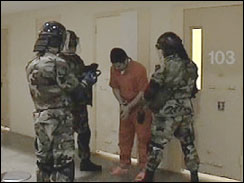
![[Photo]](http://www.washingtonpost.com/wp-dyn/content/photo/2007/06/21/PH2007062101461.jpg)
![[Photo]](http://media3.washingtonpost.com/wp-dyn/content/photo/2007/06/21/PH2007062102552.jpg)
![[Photo]](http://www.washingtonpost.com/wp-dyn/content/photo/2007/06/21/PH2007062101434.jpg)
![[Photo]](http://www.washingtonpost.com/wp-dyn/content/photo/2007/06/21/PH2007062101446.jpg)
![[Photo]](http://www.washingtonpost.com/wp-dyn/content/photo/2007/06/21/PH2007062101444.jpg)